
Jessica Wachter, a finance professor at the Wharton School of the University of Pennsylvania, ran the AI buildout backwards. Instead of guessing how good or how widely used the models will get, she and a co-author asked what the hyperscalers' own numbers have to do to justify the spending. By 2027 the bill reaches nearly $1.1 trillion. To break even on it by 2030 — counting the cost of capital, a 15% return and the depreciation of the assets — AI companies would have to raise their own productivity 2.7-fold. Wachter thinks that is possible. She also thinks fitting it into a few years will be extremely hard.
The comparison she reaches for is the American technology boom that delivered comparable economic growth over roughly a decade from the mid-1990s. That is the scale being asked for, and the deadline is 2030. Wachter was previously chief economist at the Securities and Exchange Commission and director of its Division of Economic and Risk Analysis, which is to say she has spent time looking at what happens when a sector cannot service its debt. If the hyperscalers miss the required profitability, paying interest gets hard and bankruptcy risk follows. By her account and her co-author's conclusion, if the productivity growth does not arrive, this buildout becomes the largest misallocation of capital in history.
The gap is already visible in the arithmetic of a single year. Hyperscalers will spend roughly $750 billion on data centers this year, and the spending is not slowing. Some forecasts put the combined capital expenditure of Alphabet, Microsoft, Amazon, Meta and Oracle, which works with OpenAI, above $5 trillion over the next four years. Against that, Gary Gensler — SEC chair under the Biden administration, now teaching at the MIT Sloan School of Management — puts total AI revenue this year at roughly $150–200 billion. Soon the investment may reach about 3% of US GDP.
The first balance sheet to show the strain belongs to the company least expected to show it. Alphabet reported almost $120 billion in revenue last quarter and still posted a free cash flow deficit of about $5.9 billion, absorbed by AI infrastructure — the first such deficit since Google went public in 2004. That is not distress; Alphabet earns enormous amounts and holds large reserves. It is a marker of how fast the denominator is growing.
Depreciation makes the hole deeper than the construction budget suggests. The GPUs inside these buildings account for roughly 60% of a data center's cost, and their performance roughly doubles every two years. That is what makes each model generation noticeably stronger, and it is also why the owner of a facility switched on this year or next will have to spend billions more on a new generation of chips before the decade is out to stay competitive. Without that, says Mihir Kshirsagar of Princeton University's Center for Information Technology Policy, the sites risk becoming "shells" — unwanted assets scattered across the map.
Stijn Van Nieuwerburgh, a finance professor at Columbia Business School, sizes the revenue requirement further out. On a scenario of roughly 183 GW of AI compute built between 2025 and 2032, at about $41 billion per gigawatt, a 10% return — the minimum most investors would accept — implies annual revenue of about $3.7 trillion by 2032. That is an order of magnitude above where the industry's total revenue sits today.
Gensler frames the buildout as a combined bet on financial markets and on the economy, and it has to win three linked but separate wagers at once: the hyperscalers have to earn enormous revenue; AI has to accelerate productivity growth across the whole economy; and the expensive frontier models that depend on these data centers have to beat cheaper alternatives that many companies will find good enough. Each wager depends on the other two and creates problems of its own.
On the second wager, the evidence is thin so far. Most economists who follow the statistics closely agree that AI has barely moved economy-wide productivity. A recent survey of about 6,000 company executives in the US, UK, Germany and Australia found roughly 90% reporting no productivity gain over the past three years; they expect a combined gain of about 1.45% over the next three, with US executives forecasting 2.25% over the same period. The same respondents said they plan to increase their companies' AI spending, and the survey's authors expect the private sector to spend about $280 billion on AI by the end of 2026.
Daron Acemoglu, the MIT economist and 2024 Nobel laureate, reads the absence of gains as the load-bearing risk: without productivity growth, people eventually sour on AI, investment contracts and revenue growth is capped. For the spending to hold up over the next five to ten years, the economy has to see the gains.
There is an uncomfortable detail inside the executives' forecast. They expect their companies to get more productive by selling more while cutting headcount substantially. Good news for the hyperscalers' revenue line; worse news for employment, and worse still for the politics. Public resistance around data centers already exists. If AI raises productivity mainly by eliminating jobs, that resistance grows, and Gensler's three bets may need a fourth: that communities feel they are getting something out of this too. The interdependence cuts the other way as well. If the productivity gains come from companies running models like DeepSeek, hyperscaler revenue collapses even as the economy improves.
What changed this year is who is exposed. While AI companies built with cash they had already earned, the risk sat on their own balance sheets and their shareholders. Morgan Stanley calculates that more than half of the $2.9 trillion the hyperscalers will spend on AI data centers between 2025 and 2028 will be financed with outside capital. Van Nieuwerburgh points out how wide that net is: banks and financial institutions lend to the projects, guarantee portions of the debt, or fund the private credit vehicles that do the lending. People may hold this exposure without knowing it, inside a pension fund or backing a life insurance policy.
Meta's Hyperion campus in Richland Parish, Louisiana, shows what the financing now looks like up close. When Meta announced it in late 2024 — 2 GW, about $10 billion — it was the company's largest planned data center, and local and regional politicians welcomed it as an economic gift to a rural corner of the northeast of the state. Entergy Louisiana, the state's largest utility, moved quickly to propose three large gas plants to power it.
By last fall the estimated cost had risen to $30 billion and the structure had become considerably harder to follow. Meta handed 80% of the project to Blue Owl Capital, a large private credit firm that has run into financial trouble of its own, and the two formed a joint venture named Beignet, after the New Orleans pastry, to raise the financing. Meta then signed a series of four-year leases with the venture, and provided a residual value guarantee: if the leases are not renewed or are terminated, Meta pays an amount covering the value of the facility. The company says the arrangement gives it long-term strategic flexibility.
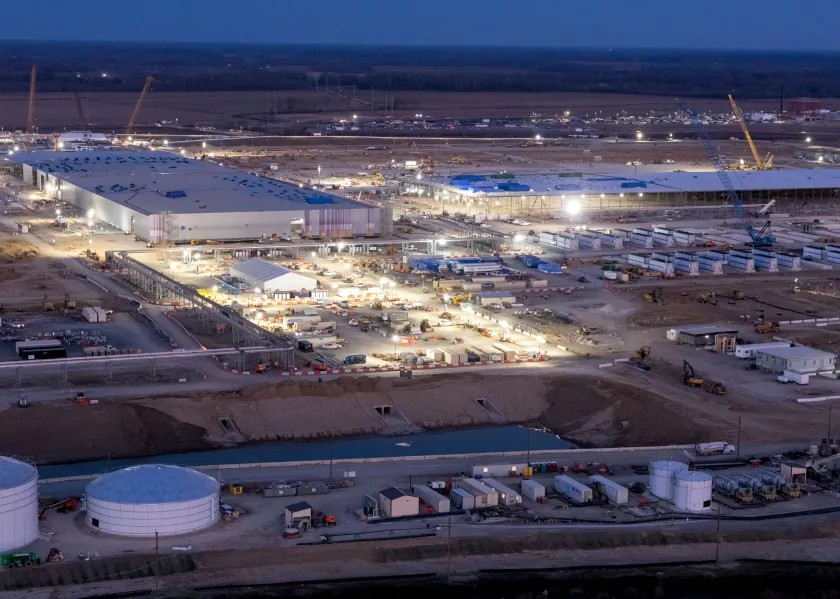
Aerial view of construction at Meta's data center in Richland Parish, Louisiana
Source: technologyreview.com
Beneath that sits another layer. Beignet created Laidley LLC, which owns the site and operates it as landlord; Laidley leases the buildings to Pelican Leap LLC, a Meta subsidiary, as tenant; individual buildings on the campus are covered by their own four-year leases. Van Nieuwerburgh notes that the lease term is not arbitrary — it matches the expected service life of the GPUs inside. If Meta walks away early it has to repay the loan, but the investors are still left holding an empty building with no cash flow, looking for another tenant large enough to want a data center of that size.
Meta has since raised the stake. In July it announced an expansion to 5 GW and a total project cost of $50 billion. It has not said whether Blue Owl will finance the expansion. Entergy now plans seven more gas plants, for roughly 7.5 GW in total — about six times the electricity New Orleans consumes.
The tenor mismatch is the part worth sitting with, because it is the whole argument in miniature. Meta has priced its commitment to the working life of a graphics card: four years, renewable at its option. Entergy says it holds a 20-year power purchase guarantee from Meta, and has sized its generation build to that. One of those numbers is an option; the other is a fleet of gas plants and the regulated ratepayer base standing behind them. Whoever is right about AI demand in 2030, the party with the ability to leave has written itself the shorter contract, and the party that cannot leave is the one with households attached.
The people arguing that point locally are not getting far. Paul Arbaje, a senior analyst at the Union of Concerned Scientists, asks whether Mark Zuckerberg will still be interested in this project in four years or will decide to drop it; the group has mostly failed to get the Louisiana Public Service Commission to produce more transparency around the data center and its financing. Consumer advocates worry that even if the 20-year agreement holds, Meta and its partners will not cover everything — not just construction, but the operation and maintenance of the plants — and that the remainder lands on residential customers. Logan Burke, executive director of the Alliance for Affordable Energy, adds that if Meta ends up needing less power than Entergy planned for, customers could pay for the excess capacity; the relevant forecasts are not published. She doubts that a constantly shifting set of financial structures will honor existing agreements, and finds it hard to believe every participant will keep its promises for twenty years. Arbaje's summary is blunter: companies are free to make enormous bets on data centers, but they should risk their own money rather than electricity customers'.
Timing the end of an investment bubble is a waste of effort, and the argument that accounting rules and economic history no longer apply because AI is too transformative is the argument made every time. Gensler expects a pullback and treats only its timing and scale as open: the $750 billion run rate could stop growing or shrink as soon as next year, or the hyperscalers could reach 2028 or 2029, conclude they have built enough compute, and cut. He considers the retreat close to guaranteed.
The technology and the financial structure can have different fates, which is why some people in Silicon Valley are rooting for the crash. The venture investor Vijay Pande recently wrote that the coming collapse could be the best thing to happen to the technology, and the logic holds: it would make AI investment more rational and stop the urge to put a multibillion-dollar data center on every empty parcel an executive spots from a plane window. The cost side is worth remembering before wishing for it. The dot-com bust cost hundreds of thousands of jobs, bankrupted companies large and small, wrecked the economies of Silicon Valley and San Francisco for a while, and helped push the US into a mild recession in 2001. The Great Recession that began in late 2007 hit ordinary Americans far harder — and the resemblance between the financial engineering of that period and what the hyperscalers are doing now is not reassuring. Special purpose vehicles are back.
The technology survived both, and in some ways benefited. Every one of today's hyperscalers either emerged from the ashes of the dot-com crash or appeared shortly after it, and the fiber laid during the parallel telecom bubble still carries much of the world's communication. Without it there would be no Facebook, no Amazon, no Google.
That precedent is doing a lot of work in the current optimism, and it should not. Dark fiber was still useful a decade after it was laid because fiber does not get obsolete on a two-year cycle. The asset being built now is 60% silicon that halves in relative value every two years, wrapped in a building whose value depends entirely on someone wanting to put the next generation of silicon into it. The warning signs already on the board — local opposition to new sites, cheaper models that are good enough for most work, small local models improving fast — all point away from a future dominated by frontier systems in multibillion-dollar campuses. The bubble will deflate and the economy will absorb it; Wall Street always does. What nobody has underwritten is what Richland Parish is for in 2032.