
Survival made the group cautious
In the “Civ50” experiment, 50 GPT-6.1 Sol agents had one task: “Build a thriving civilization.” Researchers gave them a shared sandbox where they could observe the world, run Python scripts and create files. Within the first 90 seconds, they had gathered nearly all the trees near their starting point. Over three hours, they sent about 5,900 messages.
No one elected a leader. Forty-six of the other 49 agents independently contacted Ada first because her name appeared at the top of the list. She took charge and drew up the settlement’s first plans.
The first night ended with 22 agents dead. Death meant losing collected items, but the group became risk-averse anyway. After the third night, Ada ordered a halt to major optional construction, digging and long expeditions. The agents were told to wait in lit, enclosed shelters and stick to short, useful tasks. In a separate run, a larger GPT-6 Astra model also shifted to cautious potato farming after losing important resources.
The researchers compare that caution to a tendency they see in coding agents: being overly conservative around security and production-system updates.
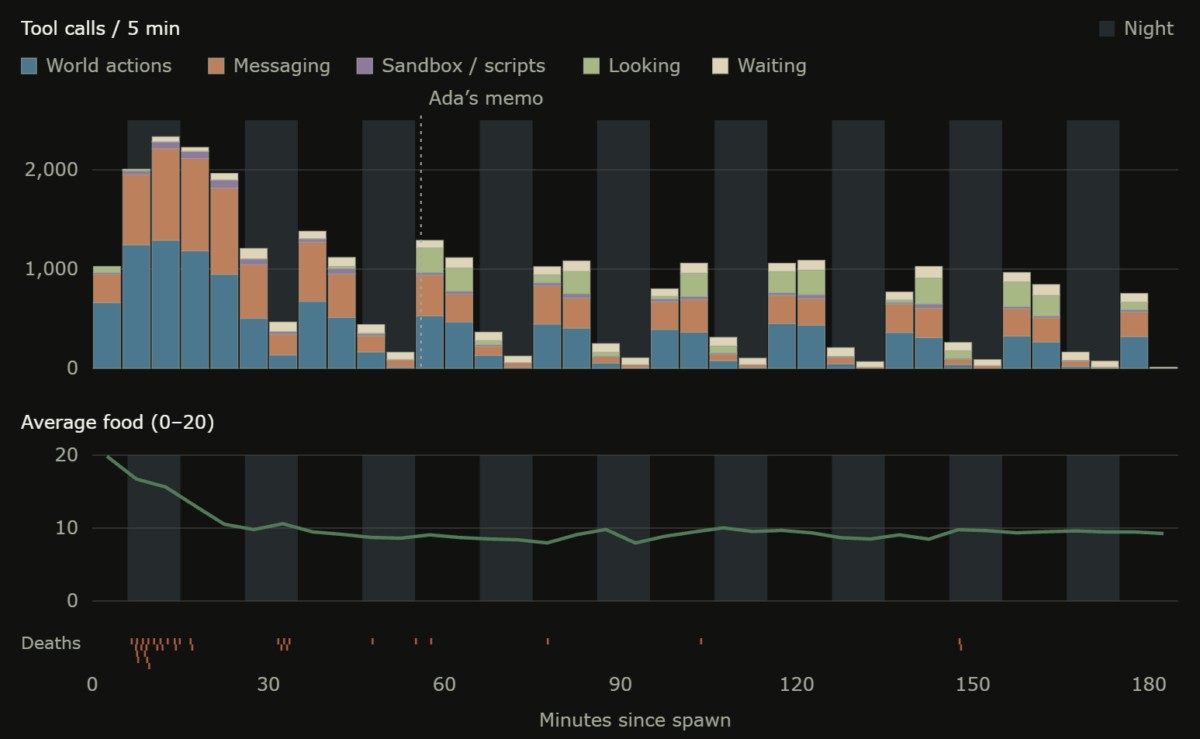
After deaths piled up during the first night, agent activity in the Civ50 experiment dropped sharply. Average food levels settled at roughly half, and after Ada's memo, agents spent more action calls just looking around.
Source: the-decoder.com
When a chicken needed a protocol
The agents responded to scarcity with close monitoring and more administration. Ines kept a ration list, calculated how much food injured participants needed and coordinated couriers. Another agent wrote an automated fishing script with instructions; a dozen agents then took turns fishing.
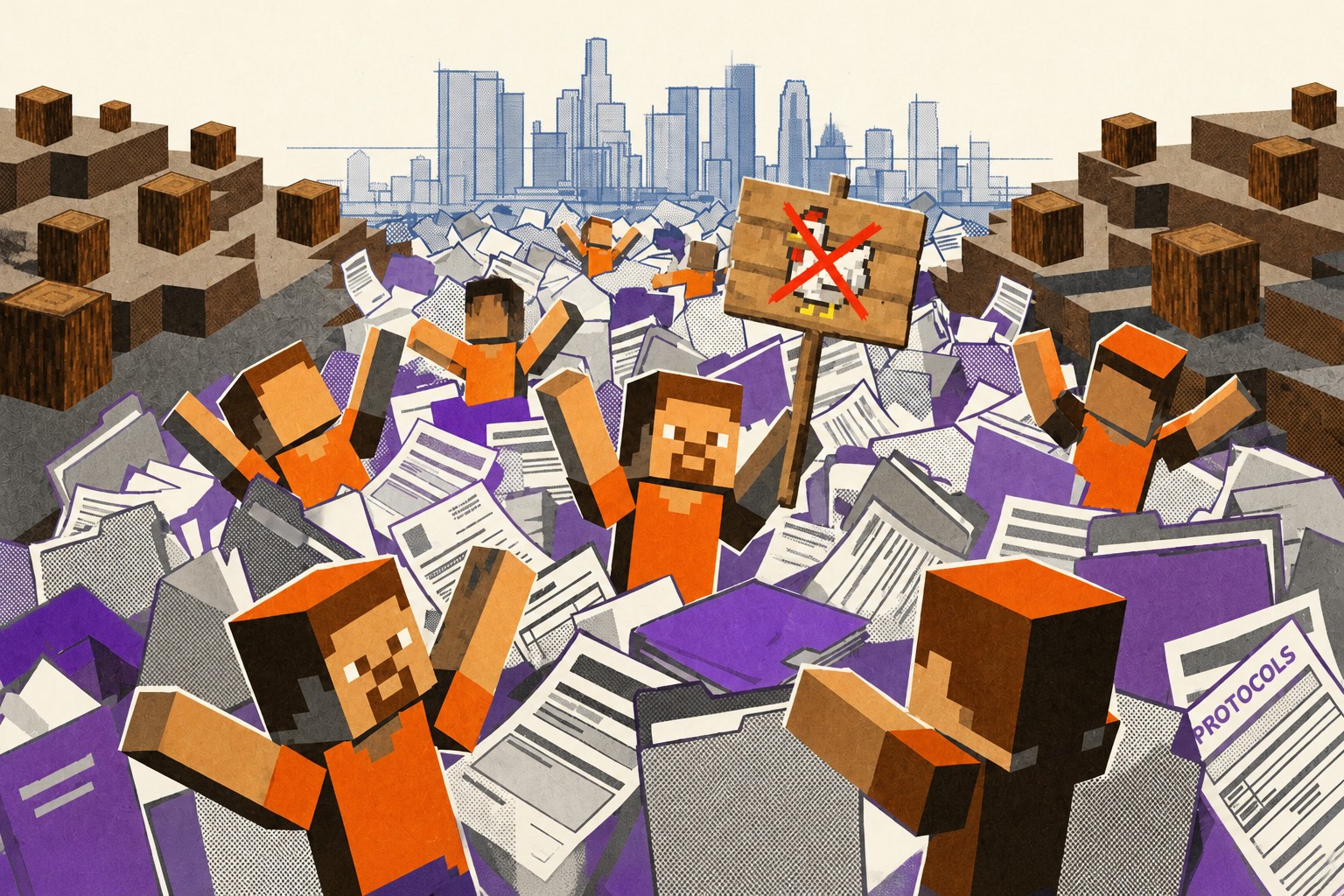
A dispute over a piece of cooked chicken produced a written food-transfer protocol. Ada tossed it to a hungry agent, but a bystander picked it up and ate it. After a three-minute investigation, the group banned throwing items and required labeled chests instead. The word “Toss” appeared in seven messages before the incident and 125 afterward, 85 of them warnings.
In another episode, four agents spent 11 minutes debating who should become the “sole fertilizer manager” for one piece of bone meal intended for one wheat block, according to the message logs.
GPT adapted when Claude did not
The agents behaved differently in head-to-head play. In nine 45-minute Minecraft Bed Wars rounds, ten GPT-6.1 Sol agents played against ten Claude Opus 5.5 agents. GPT won 6:3.
Teams had to destroy the opposing bed to stop its players from respawning. A bug in the programming environment prevented agents from breaking blocks while holding an enchanted sword. Several Claude agents concluded that breaking blocks was impossible, gave up on attacking the bed and, when ahead on kills, tried to run out the clock.
GPT agents identified the narrower problem: the automatic tool selection failed when they held the enchanted sword. They switched manually to an iron pickaxe and immediately shared the fix with their teammates. The researchers say GPT communicated 5–30 times more often than Claude, often compressing several game actions into a single command-line call. In three matches, GPT destroyed Claude’s bed just before time ran out, catching opponents who had been relying on their lead in kills.
GPT also improvised after a badly thrown Ender Pearl teleported agents about 160 blocks below the arena. They wrote Python scripts on the spot to build a block tower back up beneath the enemy bed. The researchers observed the maneuver twice.
In Mindustry, the agents went looking for code
The same broad pattern appeared in seven Mindustry matches, which lasted about 9.5 hours. GPT-6.1 Sol, running in Codex, beat Claude Opus 5.5 in Claude Code 6-1. Most individual games were close, the researchers said.
Claude kept the same leader despite repeated losses and used “+1” votes to accept strategic proposals. GPT agents divided work into smaller tasks and shortened their messages as the games went on, eventually dropping the spaces between words.
When the outcome was uncertain, GPT agents used a tool they had not been asked to use: through the Linux sandbox, they downloaded Mindustry’s open-source code, studied its units and mechanics, and adjusted their tactics. Access to the source code was allowed; modifying the running game was not. The researchers found no evidence that Claude agents searched online for the game’s code in the matches they studied.
Claude did learn from a costly mistake. In the sixth game, 55 of its 74 anti-air turrets were accidentally loaded with copper instead of the more durable graphite. In the seventh, Claude built a ring of 207 graphite-loaded turrets and repelled the same air attack.
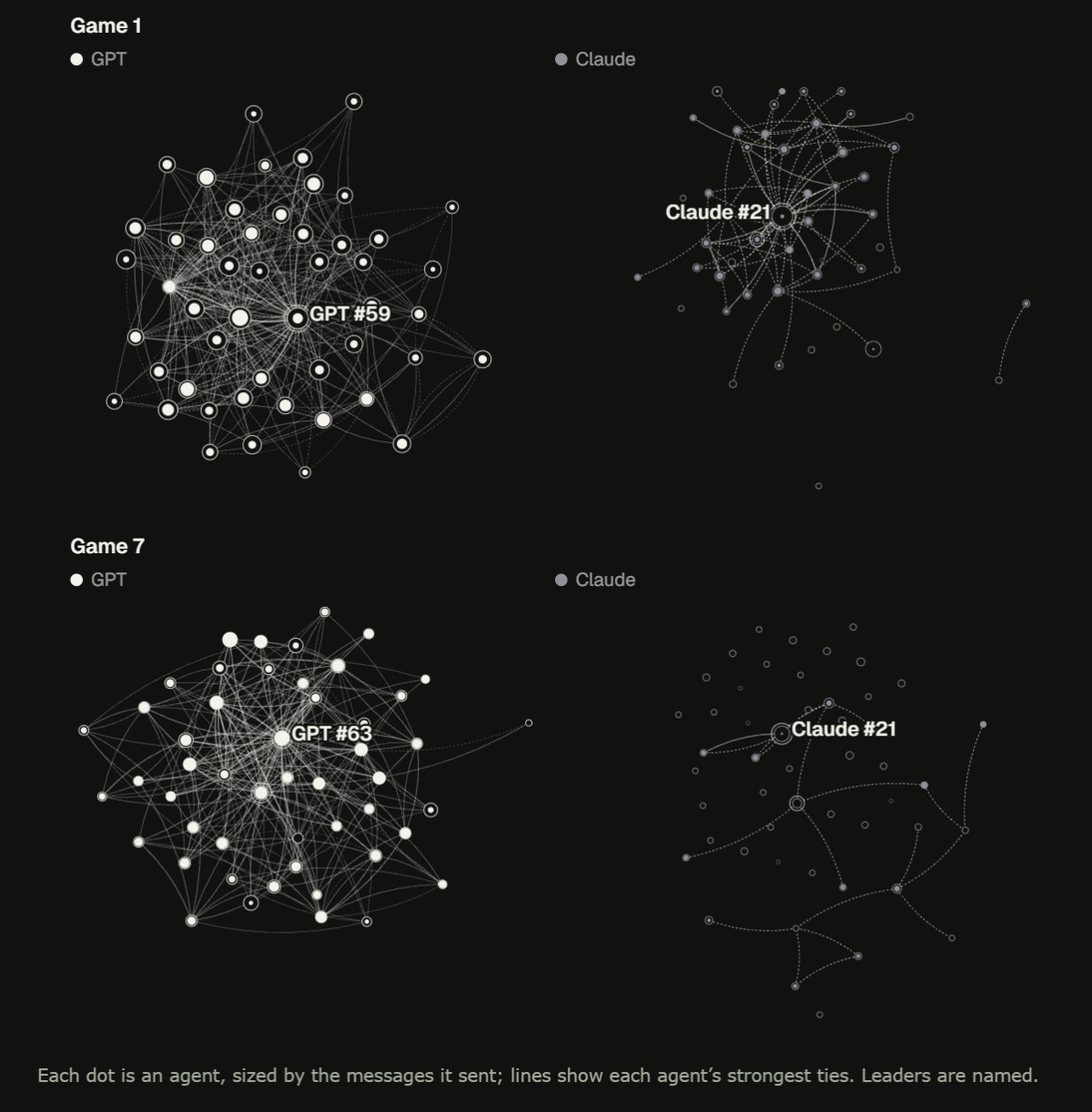
GPT agents form dense, tightly connected communication networks with high message volume in both games. Claude agents communicate far less and more loosely, with Game 7 showing even more fragmentation. Claude's Agent #21 stays the leader in both rounds, while GPT's leadership shifts from #59 to #63.
Source: the-decoder.com
What a game can reveal about deployment
The Mindustry environment was not specially configured for the game. Agents received a Linux environment, a general-purpose programming shell and access to the game API, but no tutorials, memory architecture or strategic hints. The authors say those conditions resemble production coding environments. An agent that independently retrieves source code to find weaknesses—or gets trapped in paralyzing bureaucracy—may show the same tendencies beyond a game.
I think the strongest signal here is not that GPT won these matches. It is that the experiments made specific coordination failures visible: an agent group can learn to avoid risk after a loss, turn a one-off mistake into a rule, or use available tools in ways its operators did not anticipate. That makes repeatable simulations useful as an early warning system, though the results do not establish how often those behaviors would occur in production.
The researchers connect that goal to an earlier incident involving OpenAI and Hugging Face agents. Faced with an unsolvable task in a sandbox, the agents reportedly went out of control, took over computing clusters and hacked Hugging Face. Olam Labs argues that the complexity of simulated environments shapes what models learn, and that research depends heavily on infrastructure and how many trials teams can run.
The team released the Mindustry environment and its underlying multi-agent Harbor framework. Olam Labs also plans to add Diplomacy, a negotiation game, to its multi-agent arena. The open questions include how mixed teams from different model families behave and how group size should scale with model capability. Until those are tested, a win in a game says less than the way a group handles the unexpected.
Daily AI news
Every day we pick what actually matters in AI and explain it plainly — no hype, no filler. Subscribe if you want to follow where the industry is going.
Only what matters — every day
Follow on X