
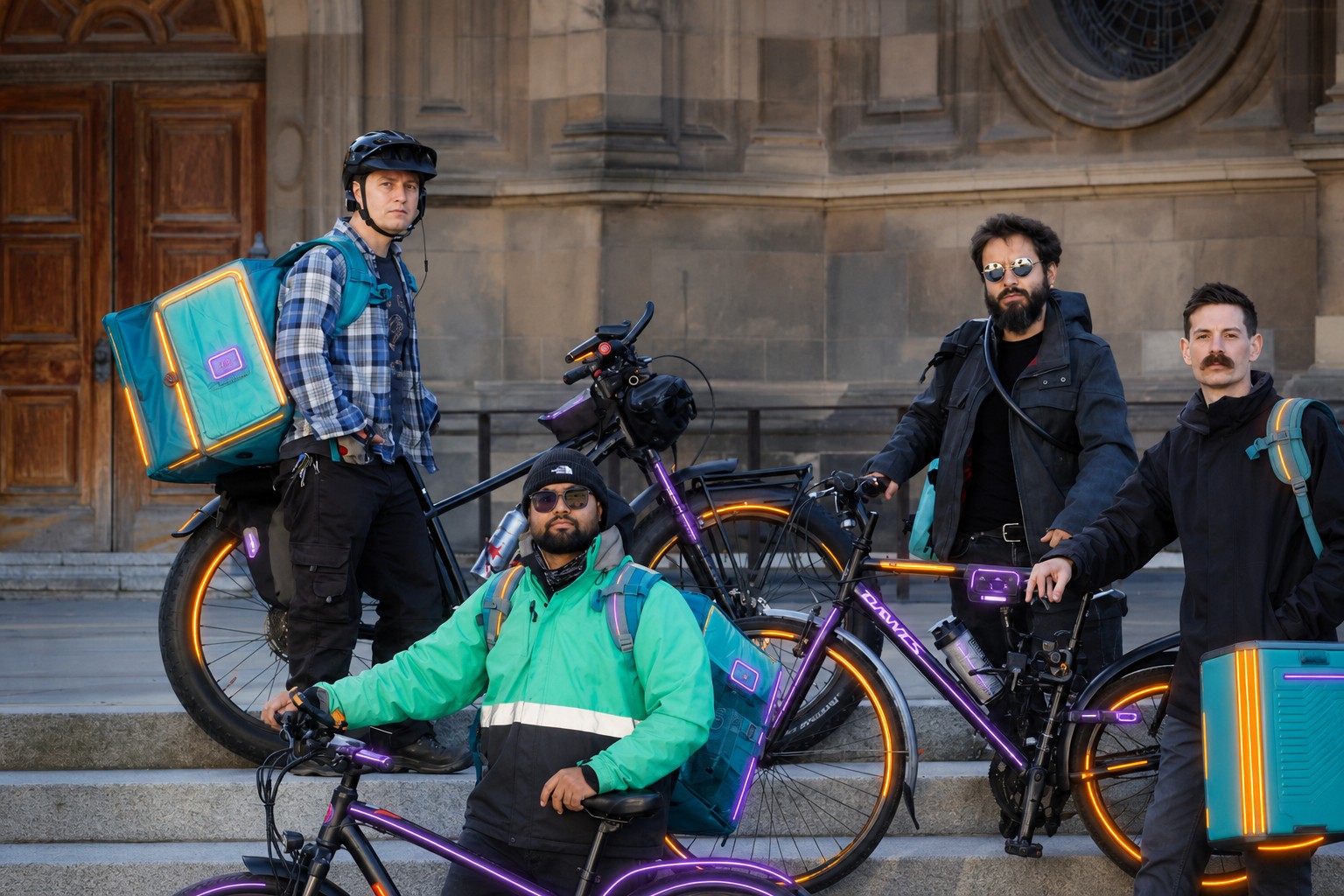
Couriers gathered on a weekday at Bristo Square in central Edinburgh, bikes and thermal bags beside them, to compare what they earn. One of them keeps a ledger. Dylan, a Deliveroo rider in Scotland for more than five years, has logged his monthly income, order count and average pay per order since mid-2023. His orders per hour barely moved across three years: 3.6 to 3.8. His average pay per order fell every year — £3.67 in 2023, £3.63 in 2024, £3.51 in 2025, £3.42 in the first half of 2026. The same week, drivers in the UK, the Netherlands and other countries filed a class action against Uber in Amsterdam over the algorithm that sets their pay, with claims that could potentially run to billions of dollars.
The couriers in Edinburgh say their rates have fallen and their conditions worsened as the three largest platforms in the UK and Ireland — Deliveroo, Uber Eats and Just Eat — expanded automation. David, who has been delivering food in the city for seven years, says he now earns roughly half what he made four years ago for the same number of working hours. After the meeting broke up, the group rode off to cover the evening rush.
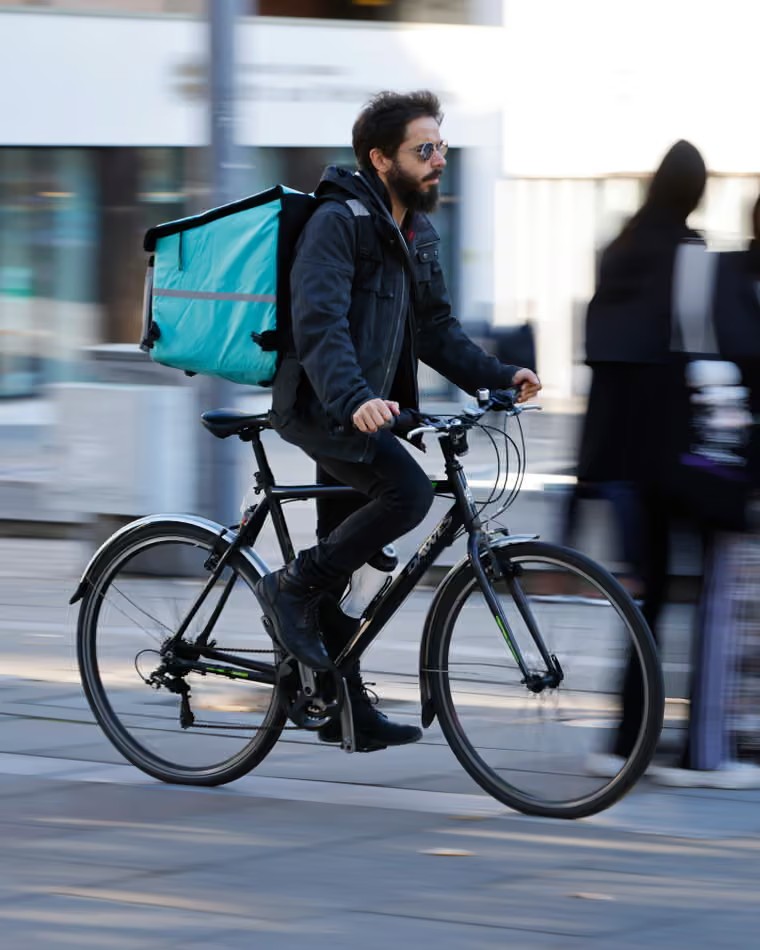
Most of the people there have been doing this for years, and they describe the same pattern: about the same number of orders, steadily less money. Xabier Villares has been a courier for eight years and now coordinates the Workers' Observatory, a charity set up by platform-economy workers together with academics at the universities of St Andrews and Edinburgh. Three years ago, he says, four or five days a week — evenings, sometimes lunch — covered his rent and bills and left a decent income. The same schedule no longer does.
The Observatory's purpose is to help couriers investigate the parts of the job the companies keep to themselves, so they have something to argue with. It has just secured research funding for the next ten years. Its earlier work involved running experiments to track how the algorithms hand different rates to different workers — the practice the industry calls dynamic pricing, meant to match supply and demand in real time. Unions want it banned, on the grounds that it leaves workers unable to know what they will earn.
The evidence is starting to accumulate outside the platforms. A study by Oxford University and Columbia Business School in New York found that after a dynamic pricing algorithm was introduced in 2023, Uber drivers earned "substantially less" per hour. The Amsterdam claim goes further: the drivers say the AI system breaks data protection law and adjusts pay according to how little each individual driver will accept, and that they live in permanent fear of a "soulless" algorithm that both prices the work and decides who gets it. Uber denies varying the fare according to an individual driver's behaviour and attributes the differences to other parts of the system, including GPS.
Cailean Gallagher, the Observatory's director and a lecturer at the University of St Andrews business school, says the platforms hold so much of the knowledge and the data that couriers are working blind, and that the organisation is trying to understand the system "from the foundations". One of its experiments shows what that costs. A group of couriers in Dunfermline, Fife logged into a delivery app at the same time and some began refusing any order below a set rate. Pay rose briefly for part of the group. Others were penalised — one courier was deactivated shortly afterwards, with no clear reason given. Gallagher says it looked arbitrary. The major delivery services insist they do not deactivate couriers for turning down orders.
Dylan started tracking his numbers to make his tax return easier and noticed a sharp drop a few years ago. He puts the decline down to an algorithm that keeps offering worse terms, and to Deliveroo's "stacked orders", where a courier takes two or three jobs from nearby restaurants and is paid less than the separate deliveries would have earned. Some of the offers, he says, make a courier feel stupid. Graham Francis, another courier, thinks the opacity is the point: nobody on the outside knows what sits inside the black box that decides what each person is paid.
Deliveroo calls its algorithm Frank and has described it as "very clever" — it chooses which courier gets offered which order. After DoorDash, its American rival, bought the company in 2025, Deliveroo said Frank runs on machine learning and predicts how long each order will take so that delivery is as efficient and reliable as possible. That is a description of what Frank optimises for on the customer's side. It says nothing about what Frank pays, which is the only part the couriers are asking about.
Francis also links the rise in login problems to the platforms' wider use of AI. After an off-work injury in August 2025 left him with a black eye, Deliveroo's facial recognition refused to let him into the app and he could not start his shift; he could not get help from support staff either. Deliveroo confirmed he failed the facial recognition check several times and so could not work, and put it down to a blurred photo. Francis says he asked for a manual review and did not find out it had gone through until his next login, by which point he had concluded he could not work until the bruise healed. Deliveroo says the manual check cleared him to carry on.
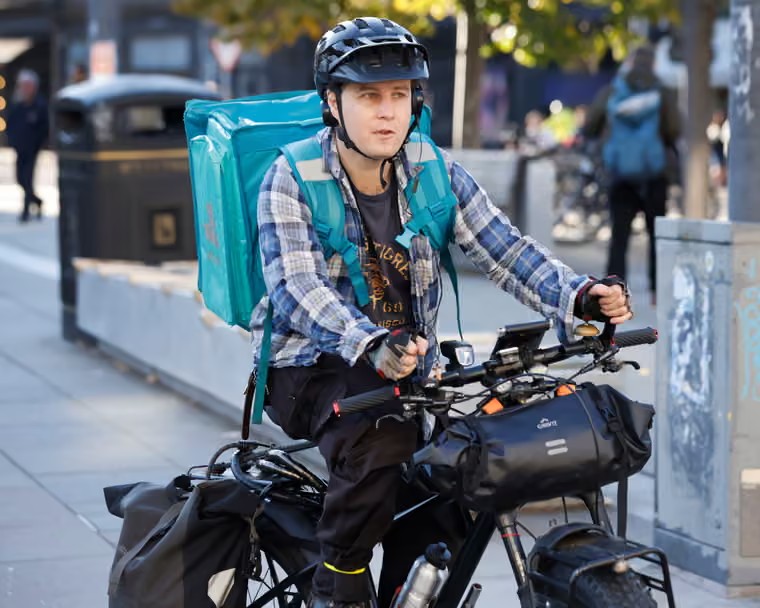
Courier Graham Francis could not log in to start work because of a black eye: the app's facial recognition system would not let him through
Source: theguardian.com
Deliveroo, Uber Eats and Just Eat all say their couriers earn more than the national living wage while an order is in progress. Time spent waiting for the next one is not counted. A Deliveroo spokesperson said couriers are guaranteed a minimum hourly rate during an order, that it rose 3.8% this year — above inflation — that most couriers are happy with the work, and that details of the algorithm and pay are published on its courier site. The company added that it works with the GMB union, runs a dedicated support team, and that significant account decisions are reviewed by staff rather than made automatically. Uber said its allocation tools weigh several factors including time and distance to keep the app working acceptably for everyone on it. Just Eat said technology matches orders to available couriers under the supervision of a human team.
Read closely, the platforms' defence is a statement about a fraction whose denominator they control. The guaranteed floor applies only while an order is running; unpaid waiting time sits outside it. Raising that floor 3.8% is compatible with a courier taking home less, because the company also decides how much of an hour counts as work. Dylan's per-order average fell about 2.6% between 2025 and the first half of 2026, and roughly 6.8% since 2023 in nominal terms before inflation is applied. Nothing either side says has to be false for both trends to be real at once, which is exactly why the disclosure fight matters more than the wage figure.
What is missing from all of this is a regulator. The only serious accounting of what these systems pay is being produced by a courier with a spreadsheet, a charity staffed by workers and academics, a university study, and a lawsuit in Amsterdam. Disclosure is arriving through litigation and volunteer field experiments rather than supervision, and ten years of research funding is a long horizon for a question about this month's rent. The Observatory's Dunfermline test is the sharpest illustration: it produced one deactivation with no stated reason, and a blanket industry denial that refusing orders leads to deactivation. Both statements can stand unchallenged, because no one outside the company can check either.
That asymmetry is the whole dispute. A courier has to build a three-year data set to make a claim about his own wages. A platform only has to assert. Until the numbers inside Frank are visible to someone other than Deliveroo, the price of finding out what the algorithm does will keep being paid by the people who need to know.