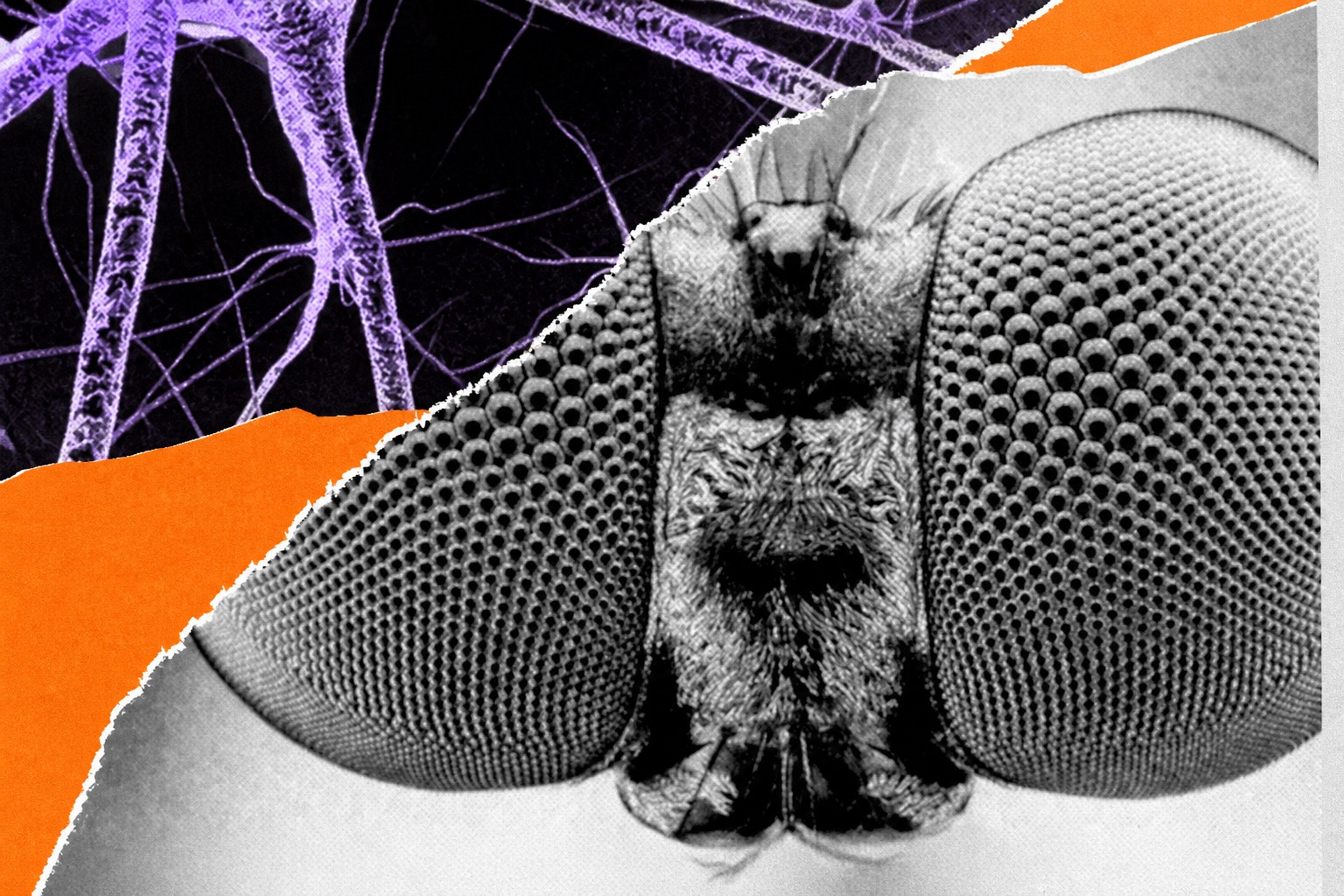
A WIRED writer has hooked a fruit fly's brain up to a headline generator. PitchFly runs the open-source connectome of a male Drosophila — 166,000 neurons and the 125 million synapses linking them, mapped by researchers at Google and several academic institutions — and feeds it a year of WIRED's best-performing headlines so that a simulated insect can propose story ideas. It is a joke with a working pipeline underneath, and the pipeline is the part worth looking at.
The connectome is a map of how those neurons respond to stimuli, which makes it possible to simulate the fly's reaction to a wide range of inputs. It is a very simple form of AI, derived from a description of a real biological intelligence rather than from text. Because the researchers released it as open source, anyone can pull it into a project of their own with a few prompts.
For PitchFly, the writer collected hundreds of WIRED's most popular headlines from the past year and loaded them into the connectome. Codex did the technical work: turning headlines into words and phrases, then into a representation the network could accept. The most successful pieces went in, and the fly brain was asked to generate ideas of its own on that basis. The virtual fly acquired a small hat somewhere along the way; the writer does not know why, and thinks it looks stylish.
This is not a fly-based language model, though someone has apparently already built one of those. The brain does not know what the words mean and does not check whether the phrases it assembles make any sense. It recombines patterns it has already seen.
A cynic, the writer allows, might say that some journalists come up with topics much the same way. On the evidence of the output, he is not planning to be replaced:
"A small shift in agentic AI is rewriting the rules of food and drink"
"What the security news is quietly doing to Donald Trump"
"The race to reinvent privacy before artificial intelligence destroys it"
"Is China about to make digital distribution obsolete?"
The program can be trained further on new WIRED headlines. For now it is a working proof of concept and, in his phrasing, proof at last that the average WIRED writer is intellectually superior to a fruit fly.
PitchFly is one of dozens of odd projects that appeared after the connectome was published in early September. An X user, Lyra Bubbles, posted a demo of a virtual fly brain trained to play the VR game Beat Saber. Alex Wormuth, a software engineer at Coinbase, built StonkFly, which uses the tiny brain to make stock trading decisions; it loses money, but does surprisingly well for a fly. Others have put the connectome on Doom, Minecraft and Pong. Some fly brains have apparently learned to solve a Rubik's cube. One project handed the fly a set of virtual cars and established that flies are poor at parallel parking — the writer, no better at it himself, declined to judge them.
Not all of it survives inspection. The writer did not verify that every project actually runs the connectome; some may be nothing more than amusing animations, and others are plainly parody, including one that trains a fly to take a well-earned rest. Alongside them sit serious efforts: visualizations for studying the connectome, and tools for modifying neural circuits.
Wormuth told the writer in a direct message that the fly provides light comic relief at a moment when everyone is preoccupied with the existential risks of AI. Working with the connectome also struck him as philosophically interesting: it raises the ethics of running these experiments at all, and the question of whether a copy of a fly's brain has consciousness.
The fly is doing less of the work here than the billing suggests. Codex built the encoding and the harness; the connectome supplies a fixed recombination engine with no idea it is being pointed at English. Take the insect out and PitchFly is a small stochastic remixer with an unusually distinguished pedigree. What the whole wave of projects demonstrates is a change in cost, not in capability: a research artifact of this complexity used to require a lab to operate, and now it takes an afternoon and a coding agent. That is the actual result, and it is being filed as a novelty.
The scientific case for connectomes is separate and much older. Brain maps across species are how neuroscientists expect to get at the biological basis of intelligence; the 86 billion neurons of the human brain are out of reach for now, so simpler organisms carry the load. The fly connectome also lets researchers test theories about how damage reshapes neural wiring, and how that damage might one day be repaired.
The AI lesson people are drawing from all this — that the best use of the enormous language models run by the large AI companies may be to produce small specialized ones for narrow jobs — sits awkwardly next to what actually happened. The specialized model here came free, from a neuroscience collaboration, and it did none of the engineering. The general model was required to make it do anything at all.