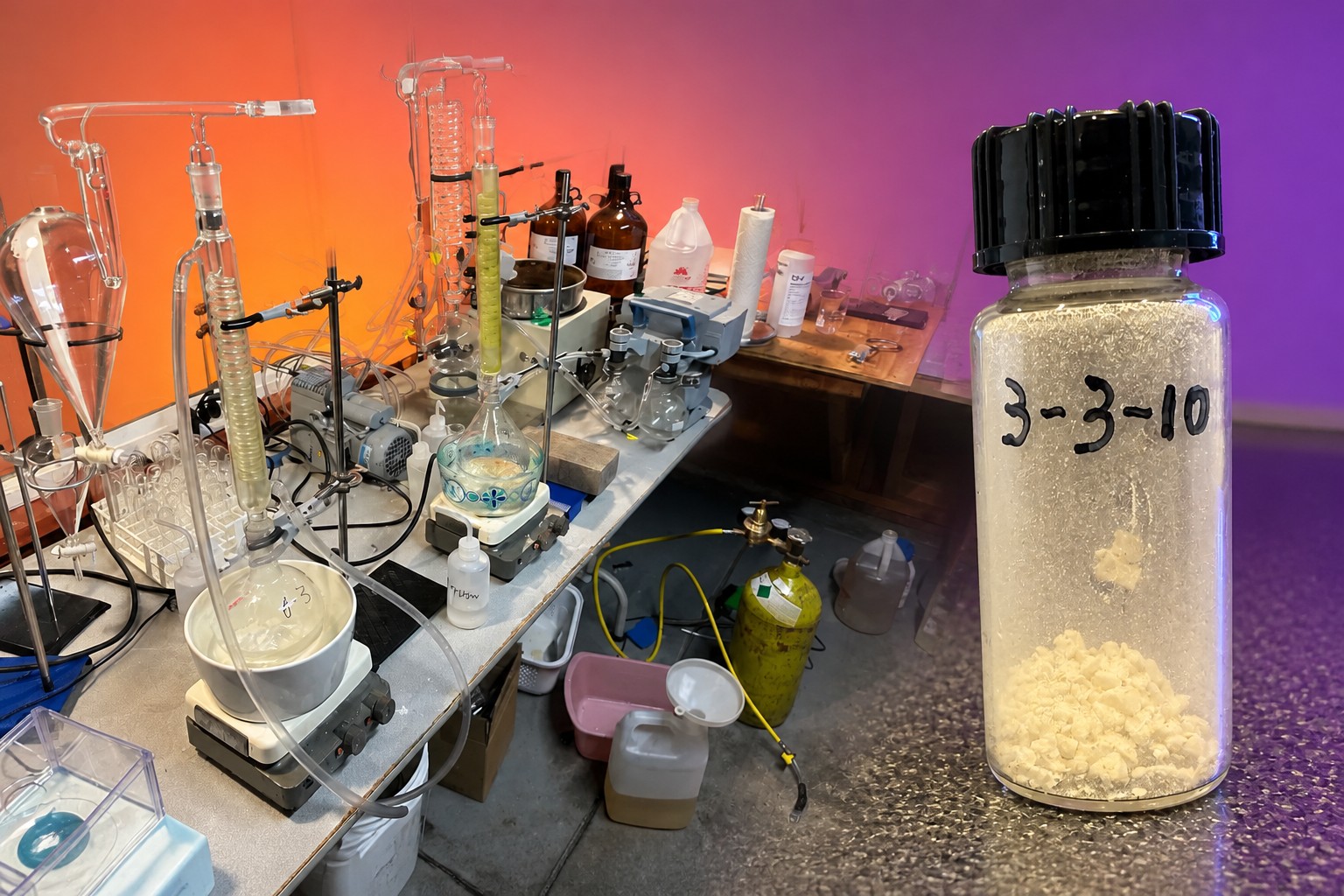
A man posting as Yao has gone viral on X with a photograph of a small vial of yellow powder and the claim that it is the first sample of a new schizophrenia drug, PAC-3310, whose molecule was designed by ChatGPT. He describes himself as a young biochemist with no pharmaceutical employer. His laboratory is several folding tables in a garage. He says the compound is a selective M4 muscarinic receptor agonist, and he compares it to Cobenfy, the recently approved antipsychotic, calling his own version an improvement on it.
The vial is the small part of the claim. On his GitHub page, Yao writes that over the past year he has used AI to design several thousand new small molecules, among them an Alzheimer's candidate he says he is working on alongside PAC-3310. He taught himself synthetic chemistry, built the garage lab, and has synthesized roughly a hundred of his own designs. Those are now being tested, he says, on cell lines and in mice.
The number he leads with is cost. Drug developers, Yao noted, typically spend tens of millions of dollars to generate preclinical efficacy data on a new compound. He puts his own approach at one thousandth of that — tens of thousands of dollars. The description of the setup gives some sense of where the savings come from: in place of a fume hood, a household fan.
Set that against what the rest of the path costs. Getting near a new drug application at the FDA means several stages of preclinical work followed by three phases of clinical trials. The application itself runs about 12 months and includes an inspection of the site where the drug would be manufactured. Across the whole process, tens of millions is a low estimate; several billion is closer. And only 13.8% of drugs that reach clinical trials win full FDA approval.
The historical setting matters too. In the 1970s, a self-directed chemist working outside institutions would have had company. Today a private one-person lab cannot simply turn out hundreds of new drug candidates a year: regulatory requirements are far stricter, and the most obvious places to look for medicines have been worked through over decades of searching.
The Alzheimer's claim is the harder one. A 2019 study found that no new drug for the disease had been approved since 2003 — not for want of trying. More than 200 proposed compounds either failed in clinical trials or were abandoned by their developers. The failure rate is high enough to sustain a genre: the organic chemist Derek Lowe runs a long-standing drug-discovery blog that regularly takes apart the latest collapsed neurodegenerative candidate. Expecting ChatGPT on its own to clear scientific and institutional obstacles of that size is a departure from reality.
The reaction on X went straight to the irony. Commenters noted that ChatGPT, known for cases in which it pushed vulnerable people toward dangerous breaks with reality, is here being used to design treatments for cognitive illness, Alzheimer's and schizophrenia among them. One joked about handing a person with schizophrenia a drug made by ChatGPT. Another wrote that believing you can single-handedly cure schizophrenia with a compound made on a folding table in your garage is itself a textbook symptom of schizophrenia.
The jokes are the easy part, and they let everyone skip the load-bearing claim. Yao's thousand-fold saving compares two different things. AI has genuinely collapsed the cost of proposing molecules — thousands of plausible small-molecule designs in a year by one person is a real change from a decade ago. It has done nothing to the cost of finding out whether any of them is a medicine. Announcing a thousand-fold improvement on the step that was never the bottleneck is not a breakthrough in drug development; it is a measurement of which step got cheap.
What the account is quiet about is also the part that would settle it. Nothing in it describes results from the cell-line or mouse work — only that the work is under way. There is no independent replication, no named collaborator, no data anyone else can check. A vial and a repository are evidence of synthesis, not of activity, and "improved version of Cobenfy" is a claim that assays answer, not a claim that a GitHub README can make.
The uncomfortable part is what this looks like at scale. Designing plausible compounds used to be expensive enough that it did the gatekeeping on its own: almost nobody had a hundred novel molecules sitting in a garage, so almost nobody had to ask what happens next. That filter is gone, and the validation system behind it — preclinical stages, three trial phases, a 13.8% success rate — was never built to absorb the volume. Yao's chemistry may be fine or it may be nothing. Either way he is early, not unusual.