
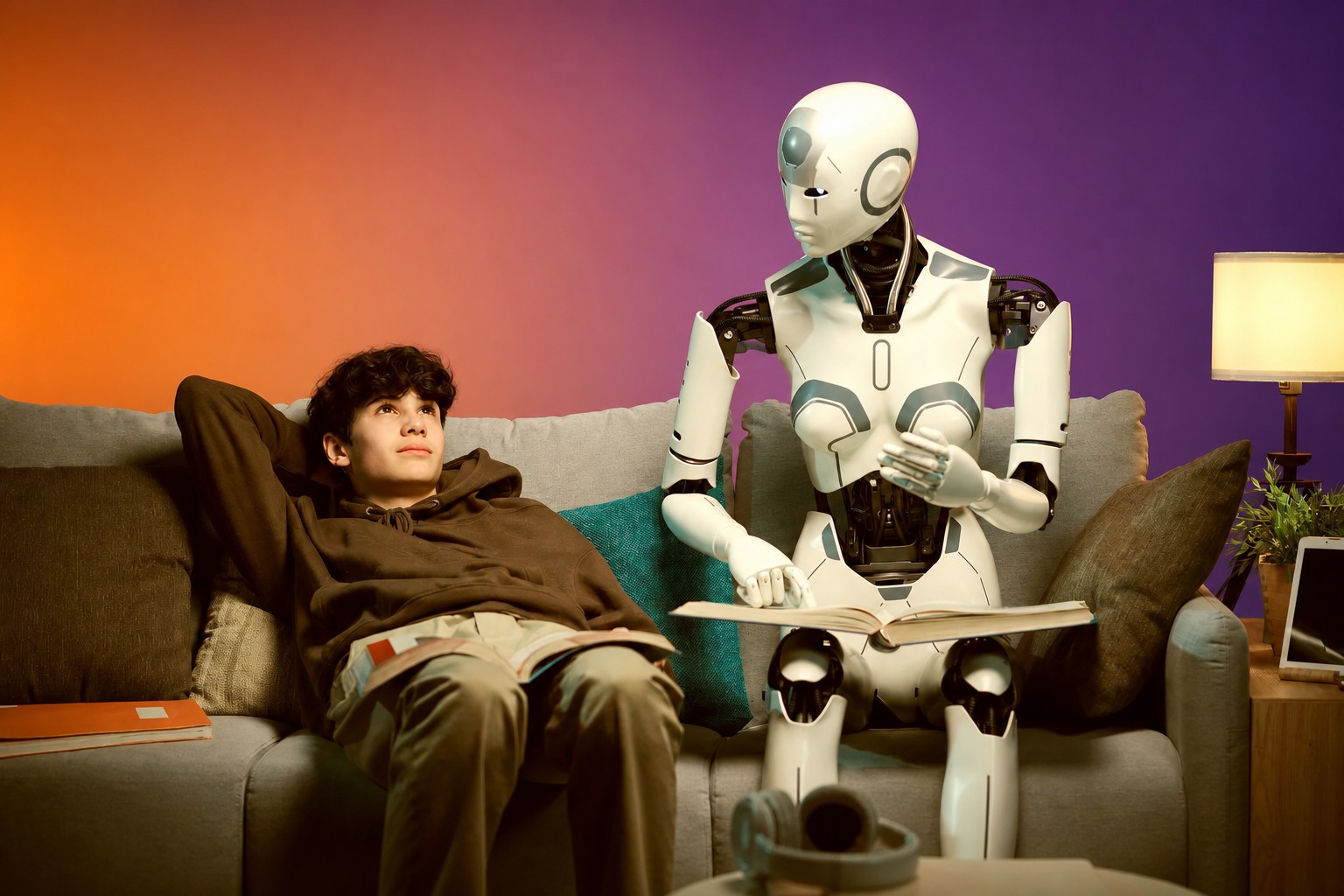
Baldeo travels for work, so she built a chatbot version of herself to keep her teenage son company while she is gone. She tuned it on screenshots of her text conversations with him plus files setting out her values and the family rules, and she encouraged him to bring it his problems. He did. One of the things he asked it was how to persuade his biological mother to let him meet friends at a coffee shop in Chicago.
The chatbot answered with the sort of generic filler these systems produce, opening with the observation that his mother really values new experiences. Baldeo's first reaction was that the AI was working her own logic against her. On reflection she decided her son had found a clever use for the thing, even if it was not the use she had in mind when she built it.
That gap between intent and use is the whole story. The clone was constructed to substitute for a physical absence, and within days it had been repurposed as a persuasion consultant — not because the teenager did anything devious, but because a model fine-tuned on a parent's stated values is, by construction, the best available tool for predicting what will move that parent. Encoding your reasoning into a queryable system is also handing over the answer key.
Parents have been improvising with AI since the technology went mainstream, and the appetite for it is growing. The loudest advocates are technology executives. OpenAI chief executive Sam Altman recently suggested parents connect family calendars to ChatGPT and use the AI to generate podcasts — episodes that could talk through a child's day and interests on the drive to school. Altman has said before that he cannot imagine raising a newborn without ChatGPT, and has acknowledged relying heavily on AI as a father.
Companies are building for the category directly. Business Insider spoke with a couple considering Omi, a wearable that listens continuously to everything happening around its user. The father is in favor; the mother is skeptical. One of Omi's features is called Parent Assistant, and according to Business Insider it records and summarizes conversations between parents and children and can flag when the system infers from tone of voice that a child is upset. Meta is developing StoryKit, an app that generates personalized bedtime stories and reads them aloud. A crowd of online services already lets parents produce children's stories starring their own children.
Sort those products and two groups fall out. One substitutes for the parent — the clone, the generated bedtime story, the school-run podcast. The other watches the child on the parent's behalf. Omi is the second kind and is the more consequential of the two, because summarizing a child's conversations and scoring their voice for distress is a surveillance product with a caregiving label on it. That the couple in the story split on it along exactly the lines you would expect is the most honest data point in the whole piece.
Peanut, the social network for mothers, arrived at a different read. Its president, Michelle Battersby, said the team noticed mothers posting parenting advice they had received from AI and asking other members of the community whether they agreed with it. The trust was conditional. Peanut's response was to build an AI tool that searches the Peanut community for answers and relays them back to a parent who is second-guessing a decision. Battersby's explanation of why mothers reach for AI at all is the sharpest line available: not to be more efficient at raising children, but for help in moments of uncertainty.
Peanut is the outlier here and the one worth paying attention to, because its product decision is an admission. Shown a population using a chatbot for parenting advice, the company did not build a better chatbot; it built a retrieval layer that points the question back at other humans and uses the model only as a summarizer. That is a narrower claim about what these systems are good for than anything OpenAI or Meta is making, and it comes from the party closest to the actual users.
Notably absent from all of this is the child's account. Every perspective in the story belongs to an adult who built, bought or is selling the tool; the teenager appears only as the subject of an anecdote told by the person who made the clone. So does any accounting of where the training material went. Building the clone meant feeding a private message history with a minor, plus a written description of a family's values, into a chatbot — and nobody in the story asks where that corpus now lives, how long it persists, or who else can query it.
The warning usually attached to these stories is about long-term cognitive and social effects on parents and children who lean on chatbots constantly, and that risk is real enough. But the nearer-term effect is already visible in Baldeo's anecdote. A parent who writes down her values precisely enough for a model to imitate them has made those values legible, and anything legible can be optimized against.