
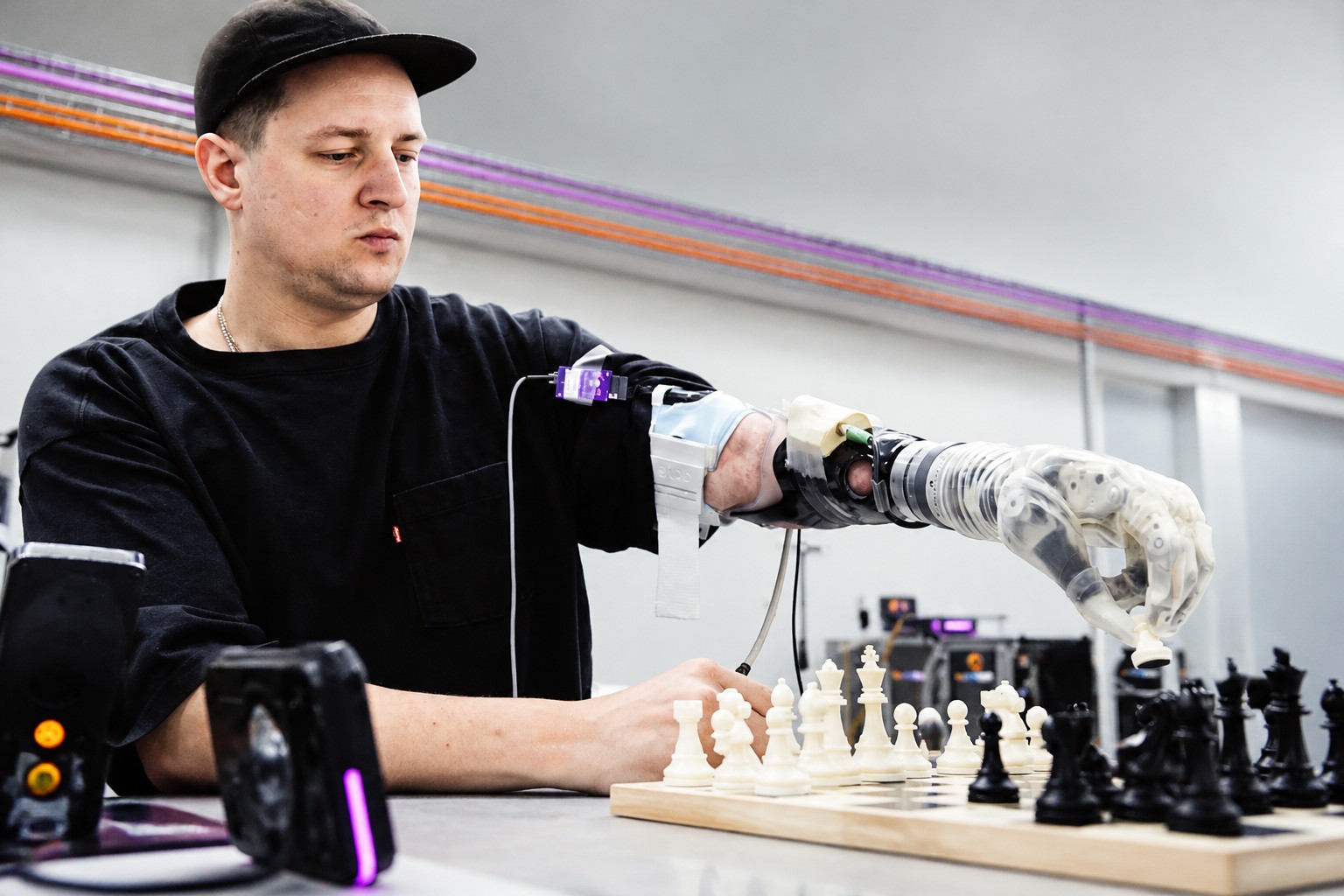
University of Utah clinical trial participant Evie Davidson uses a bionic arm connected to the nerves in his forearm. The device lets him control movements and feel pressure. He is the first patient allowed to take the experimental system home and use it on his own. Since July 10, Davidson has been using it in daily life: learning to cook, handling fragile objects and now writing his name in a few seconds. Researchers are studying how useful this connection to the nervous system is in everyday life, where it may fail, and how it affects well-being and brain function.
A bionic arm with feedback helps a patient feel pressure
How Davidson lost his arm
In 2009, when Davidson was 16, he climbed about 35 feet — roughly 11 meters — up a telephone pole to photograph the sunset. As he climbed down, he lost his footing, grabbed a wire, was electrocuted and then fell.
Second- and third-degree burns covered 37% of his body. Davidson also broke his back in about 50 places, eight ribs and probably his left wrist; his spinal cord was damaged. About ten days later, gangrene set in in his left hand, the one he had used to grab the wire. The arm was amputated. Davidson spent about a month in a coma. When he woke up, doctors told him he was paralyzed, would not be able to walk and had lost his dominant left arm.
Davidson is now 33 and works as a psychotherapist with people who have experienced trauma. After his injury, he went through physical therapy and adapted to life with a changed body. His first prosthesis, which he received a year and a half later, was a simple hook he could use to lift objects. Davidson says it helped him feel psychologically whole.
Later, he tried more sophisticated prostheses. Some let him control individual fingers with muscle movements. His health insurance covered part of the cost of devices and replacements about once every five years; Davidson paid for the rest himself. He bought a third arm on eBay and joked that he had bought a “secondhand second arm.”
How the connection to the nerves works
The bionic arm is part of the LUKE system, named after Luke Skywalker from “Star Wars.” The prosthesis was developed in the 2000s, its first trials began in 2014, and the same year the US Food and Drug Administration (FDA) approved the device. The trial Davidson is taking part in focuses primarily on a new way to connect the prosthesis to the nervous system. The connection is intended to let a person control the arm and receive feedback about pressure.
Davidson met the University of Utah team by chance: he ran into a researcher at a supermarket. Since 2013, researchers had been studying a system that connects to the nerves in a residual limb and allows a person to control a bionic limb. Jake George, director of the university’s neuro-robotics lab, says Davidson was a good fit for the trial.
Before surgery, Davidson underwent physical and psychological evaluations. The team checked whether he was healthy enough for surgery, whether his brain still had a representation of his left arm, and whether the nerves in his forearm were functioning. A specialist also assessed his reasons for wanting to take part. Participants are not paid and do not keep the device: they must undergo two surgeries, one to implant the devices and another to remove them later. George said Davidson agreed because he wanted to help others.
At the end of January this year, Davidson flew from Florida to Utah for the first surgery. Engineers and the surgical team took part. The surgeon exposed three nerves and placed an array of 100 electrode needles in each one. Nerve tissue is soft, so the electrodes were not simply inserted into it: George said the team used a device like a pneumatic gun to drive the needle array into the nerve at high speed.
The researchers also placed 24 electrodes in the muscles around the nerves. Wires from the arrays and pairs of muscle electrodes were brought out through the skin. Just two days after surgery, Davidson asked to be connected to the equipment.
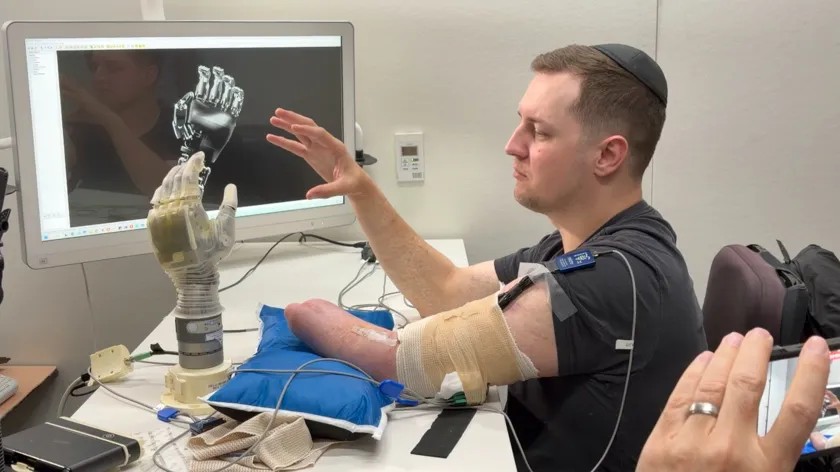
The team then trained a computer system to translate electrical activity in the nerves into commands for hand and wrist movements. To do this, the researchers recorded signals from hundreds of connection points while Davidson imagined different movements. George said the calibration took about five minutes.
Calibrating the feedback took much longer. Team members stimulated the electrode connection points one by one and asked Davidson whether he could feel anything, gradually changing the signal strength. George said the whole process takes about three days.
Learning to use the prosthesis at home
Davidson’s wires were later consolidated, making the connection simpler. To use the prosthesis, he puts the arm on, connects it to the wires and starts it with a small computer.
Davidson learned to control the arm during sessions with a physical therapist. Lynn Seckinger, an occupational therapist with the University of Utah Health system, says learning to use the technology is like learning a new language. At first, they practiced holding and stabilizing objects, guided by Davidson’s goal of cooking at home. He learned to hold and use kitchen utensils, chop food, and carry plates and bowls. Davidson managed to crack an egg and make an omelet.
Since July 10, he has been using the arm at home and noticing improvements. Writing his name used to take several minutes; now it takes a few seconds. Davidson currently wears the prosthesis about six days a week, changes its batteries once or twice a day, and takes the arm off at night. It weighs about five pounds — roughly 2.3 kilograms.
Davidson sometimes feels pain in the prosthesis. It may be phantom pain, a symptom that can affect people after an amputation. He also feels tension in his wrist, similar to what he experiences in his right hand after typing for a long time. Davidson noticed that the tension eases if he bends the prosthetic fingers back and stretches his wrist.
Chris Duncan, a rehabilitation physician and chief medical officer at neurotechnology company BIOS, which supports the trial, says the sensation has no physiological explanation. During a normal hand stretch, the tendons running through the forearm are pulled, but the bionic arm has no tendons: actuators create its movements. Duncan thinks the effect may be related to how Davidson’s brain represents the arm, but he has no precise explanation.
Source: technologyreview.com
What comes next
The research team plans a larger trial and hopes to get FDA approval for a device that transmits sensations in both directions. That could make it possible to pay for the device through health insurance. Duncan says doctors and insurers need to understand the value of this technological approach for patients. The team also hopes the technology could be used to control other devices, such as remote controls and wheelchairs.
Davidson will keep the implants and prosthesis for at least a few more months. The trial is designed to last at least a year, ending by late January 2027. George would like to extend Davidson’s participation if funding allows and says the team does not want to leave him without support. Davidson understood from the outset that he would not be able to keep the device. He is taking part in the study to help advance the technology, even if he does not benefit from it permanently himself.
Dataist's take: The trial is testing not only how accurately the prosthesis can be controlled, but also how its feedback feels and whether it helps in everyday life. For now, the device requires a wired connection, a separate computer and extensive calibration, while Davidson’s participation is limited by funding and the terms of the study. Before the system can be widely used, it still needs FDA approval and must show that it offers patients enough benefit.
Daily AI news
Every day we pick what actually matters in AI and explain it plainly — no hype, no filler. Subscribe if you want to follow where the industry is going.
Only what matters — every day
Follow on X