
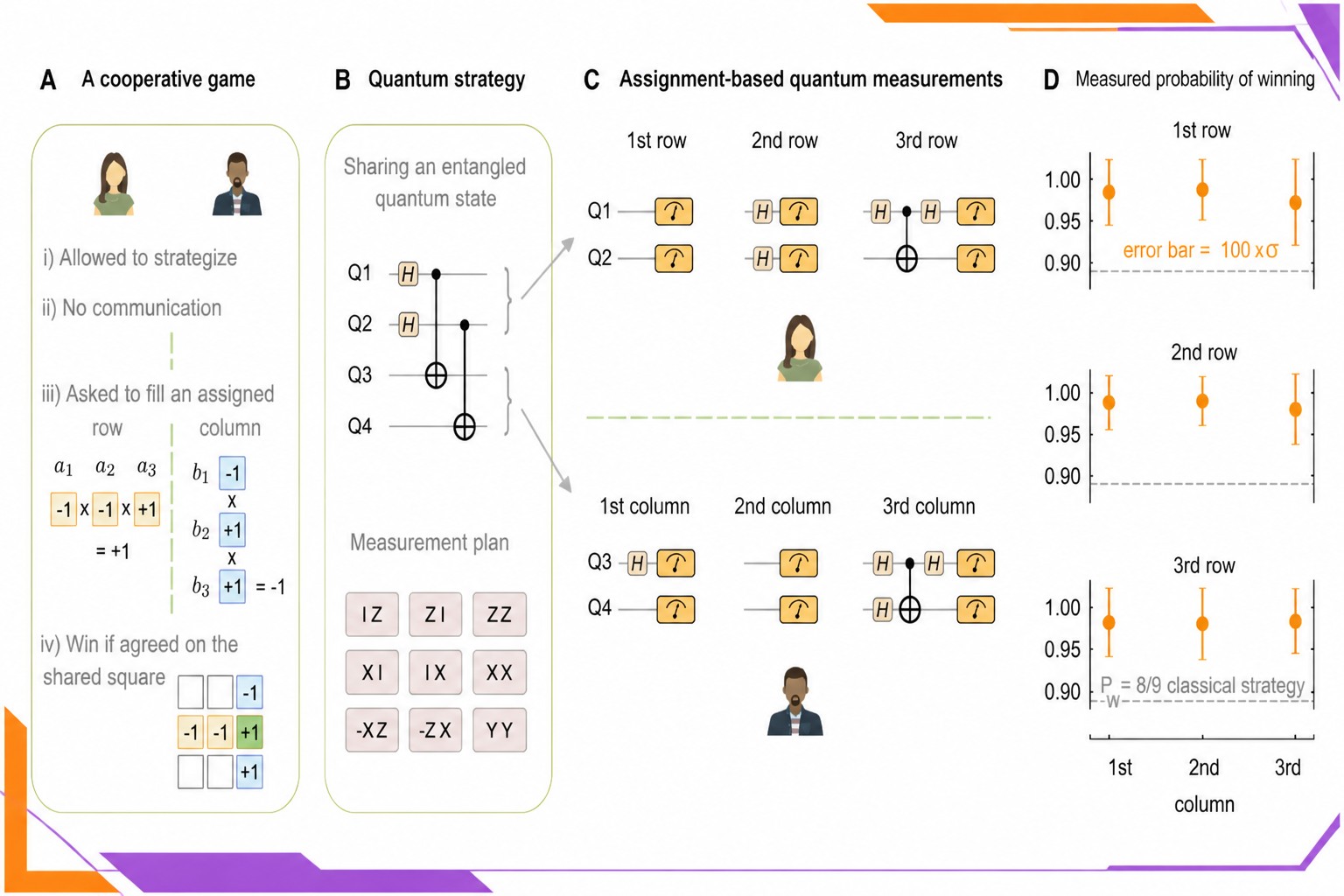
Google Quantum AI ran experiments on contextuality using a superconducting quantum processor. Contextuality is a property of quantum mechanics in which the result of a measurement depends on which compatible measurements are performed alongside it. The Willow processor won the magic-square game in 98.30% of cases, against a classical limit of 88.89%, and outperformed classical strategies on other tasks involving systems of up to 105 qubits. The experiments also exposed hardware errors that can go unnoticed in standard tests using random circuits.
Google demonstrates quantum advantage on a 105-qubit processor
The authors of the study are Google Quantum AI and Google Research scientists Shashwat Kumar and Rodrigo Cortiñas. Their research was published in Science. The team tested contextuality on superconducting quantum processors and used related tasks as a new way to evaluate hardware.
Why the square cannot be filled according to the rules
Imagine a 3 × 3 grid. Each cell must contain +1 or −1, so that the product of the numbers in every row is +1 and the product in every column is −1. It is impossible to fill in the grid this way: the row condition requires an even total number of −1s, while the column condition requires an odd number.
This contradiction gives rise to a game. Alice is given a row, Bob a column. Without communicating, they fill in their parts of the grid according to the respective rules. They win if the numbers in the shared cell match. Any plan drawn up in advance is equivalent to a completed grid, so such a strategy can win no more than eight out of nine rounds.
A quantum computer does not produce an impossible grid. Instead, it lets Alice and Bob generate matching answers during measurement. Their values are not written down in advance: the result depends on the other measurements in the same row or column, while quantum entanglement helps them coordinate their answers at the intersection.
This property is called quantum contextuality. It means that fixed values cannot be assigned to all possible measurements independently of which ones are performed together. When considering whether the Moon exists when no one is looking at it, Albert Einstein argued for the idea that physical properties exist in advance. For quantum systems, contextuality offers an experimentally testable answer: that approach does not always work.
Entanglement is usually described as the main resource of quantum computing. But theoretical work suggests that contextuality may be a more fundamental resource, underlying the advantage of some quantum algorithms over classical ones. Until recently, it had been demonstrated almost exclusively in small systems of a few particles. The remaining question was whether it persists in the large systems used in real quantum computers.
The game on the Willow processor
In the magic-square game, Alice and Bob each used two qubits and shared two entangled Bell pairs. For their assigned row or column, they performed predefined measurements and obtained values of +1 or −1.
A classical strategy wins no more than 88.89% of the time: it must lose at least one round out of nine. The team played all nine versions of the game 100,000 times each. Willow’s qubits won 98.30% of the rounds — 0.9830 ± 0.0001 — losing about once in sixty.
The difference from the classical limit is statistically significant. Under ideal conditions, shared entanglement and a coordinated measurement plan would make it possible to win every round. On real hardware, noise accounts for roughly one loss in sixty.
How contextuality was measured
To express contextuality as a number, the researchers used the Bell–Kochen–Specker inequality, which is related to the Bell test. It reduces a set of correlations to a quantity χ:
χ = R1 + R2 + R3 − C1 − C2 − C3,
where R denotes the products of the numbers in the rows, and C the products in the columns.
If measurement results are predetermined, χ cannot exceed 4 and can take only the values −4, 0, or 4. Quantum mechanics allows values up to 6; this limit is reached when all R values are +1 and all C values are −1. The test does not depend on the state in which the qubits were prepared, so it measures a property of the device itself rather than of a specially chosen input.
Measuring χ is not straightforward: the rows and columns must be tested on the same two qubits, one after another, without disturbing their state. The team used an auxiliary qubit — an ancilla — for this. It recorded the result of each measurement while leaving the two main qubits untouched. The researchers performed 540 measurements in a row and repeated the procedure 1,000 times. The resulting value was above the classical limit of 4 and just 7% below the quantum limit.
Testing larger systems
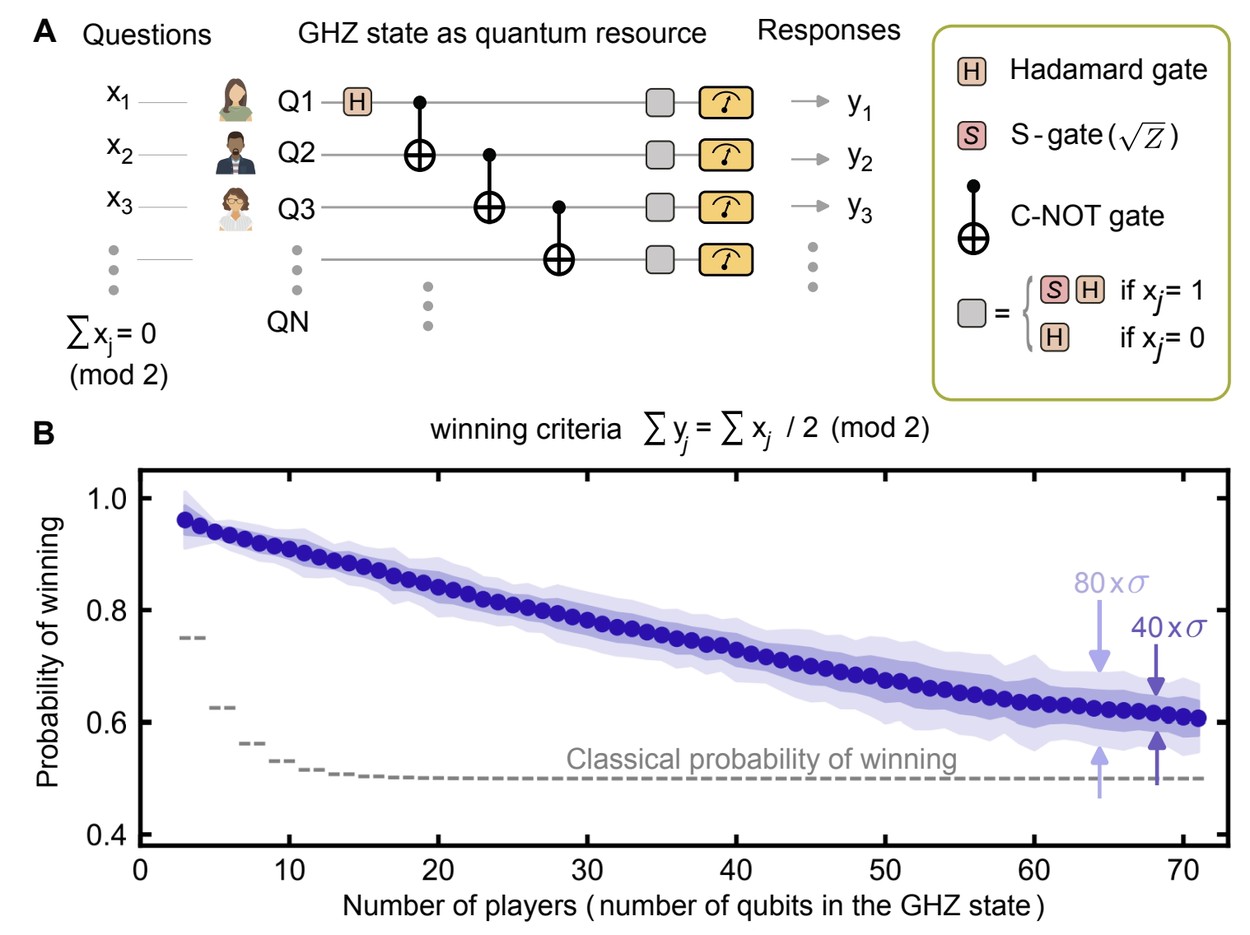
The GHZ parity game involves N players sharing a GHZ state — a superposition of states in which all qubits are 0 or all are 1. Each player receives a one-bit question and, without communicating with the others, gives a one-bit answer. Victory depends on whether the parity of the answers matches the rule set by the questions.
Random answers win half the time. A classical strategy does somewhat better: 75% for three players, with the rate approaching 50% as the number of participants grows. The shared GHZ state makes it possible to win every time.
The team tested the game with up to 71 participants, one per qubit. Noise kept the win rate below 100%, and it fell as qubits were added, but it exceeded the classical limit in every case. The researchers also confirmed genuine entanglement across 45 qubits — more than the full size of many previous experiments with GHZ states.
Source: research.google
Each player measured their qubit in a basis determined by the bit they received. Despite hardware noise, the win rate exceeded that of the best classical strategy by many standard deviations, even with 71 participants.
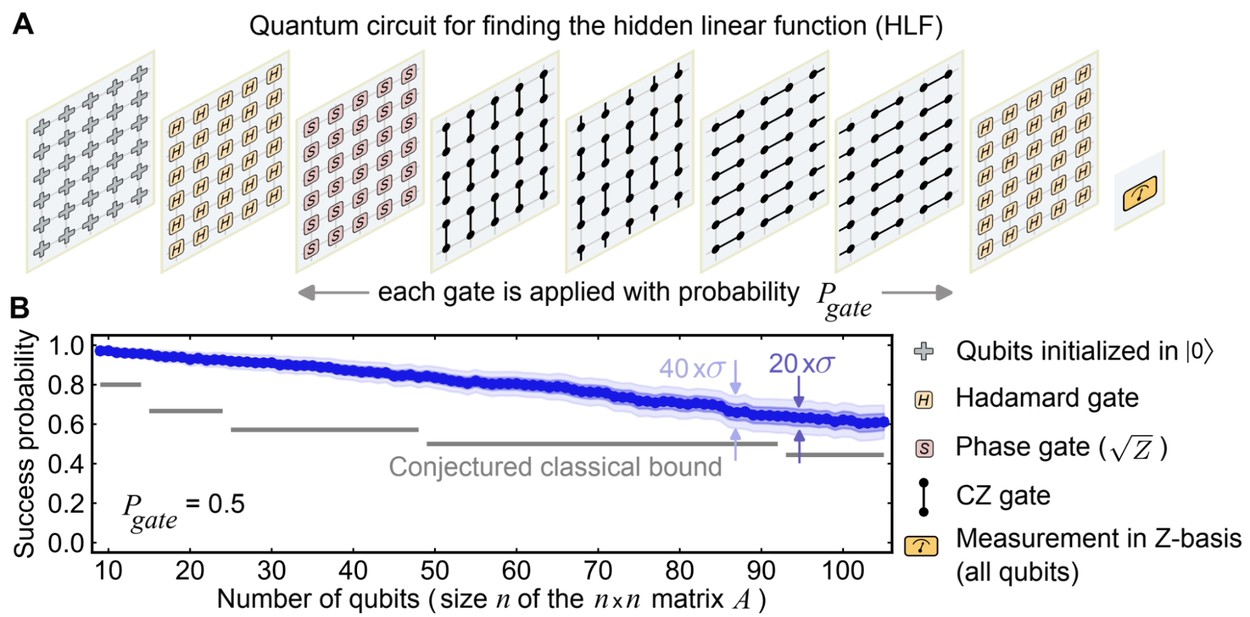
Another way to test quantum advantage is to compare constant-depth circuits. In 2018, a theorem showed that a constant-depth quantum circuit can solve the hidden linear function problem, while no constant-depth classical circuit can. The source of this advantage is thought to be related to contextuality.
Constant depth means that a circuit does not get deeper as the problem grows. Each output bit is calculated in a fixed number of steps, so information can travel only a short distance. A classical output can take into account only a limited region of the input data. In a quantum circuit, entanglement is created in advance, so this constraint does not apply.
Before this work, the algorithm had not been run on real hardware at large scale. The researchers solved hidden linear function problems on lattices of up to 105 qubits. The probability of success remained above one-half; the team used the shallow circuit specified by the theory.
Source: research.google
Encoding the problem on the processor required several layers of quantum operations. As the system grew, noise reduced the probability of success from about 1 to 0.6 on the processor’s largest size, but the result still exceeded the expected classical limit.
A new way to evaluate quantum processors
These tasks require many qubits to coordinate their results accurately and at the same time. During the experiments, they exposed subtle correlated errors — for example, small deviations that rotate a quantum state away from its intended direction. Standard tests using random circuits can average out such errors, making them hard to detect.
Contextuality can therefore also serve as a measure of hardware quality. Instead of comparing results only with the classical limit, the researchers propose measuring the distance to the maximum allowed by physics: χ = 6, a win probability of 1, or an ideal level of contextuality. This limit stays fixed, so the measurement can distinguish processors more precisely as they improve. That matters for applications requiring processors to run structured algorithms, including molecular simulations in chemistry and materials science: in such tasks, hidden errors can affect the result.
What comes next
The debate over whether physical properties exist before observation now has a measurable experimental test. The team’s results show that not every measurable quantity can be assigned a predetermined value.
Theory links contextuality to “magic states,” which error-corrected quantum computers need to run full-scale algorithms. Recently, the team prepared such states using magic-state cultivation. Measuring contextuality across a large number of qubits makes it possible to investigate an open question in physics and computer science on real hardware: what gives quantum computers their advantage.
The authors said the study was conducted by the Google Quantum AI team together with academic partners. They also thanked the specialists who built and maintained the hardware, control electronics, cryogenic systems, and software used in the experiments.
Dataist's take: The results show that contextuality can be tested on processors far larger than those used in early experiments and used to assess errors that standard tests miss. But even at 105 qubits, noise reduced the probability of success to 0.6, so an experimental advantage does not yet mean these systems are ready for practical computing.
Daily AI news
Every day we pick what actually matters in AI and explain it plainly — no hype, no filler. Subscribe if you want to follow where the industry is going.
Only what matters — every day
Follow on X