
Osmo is training a model to recognize smells and create them from text descriptions. To do this, the company has collected more than 10 million human smell ratings and 800 million “odor tokens”—data on molecules and their concentrations. Founder Alex Wiltschko says the model is already working with fragrance brands and, in one test, outperformed the in-house perfumers at a large company. But specialists disagree about how much these results support Osmo’s claims: smell depends on context, and medical applications will require better sensors and further improvements to the models.
Osmo is teaching AI to recognize smells and create new fragrances
How Osmo collects data
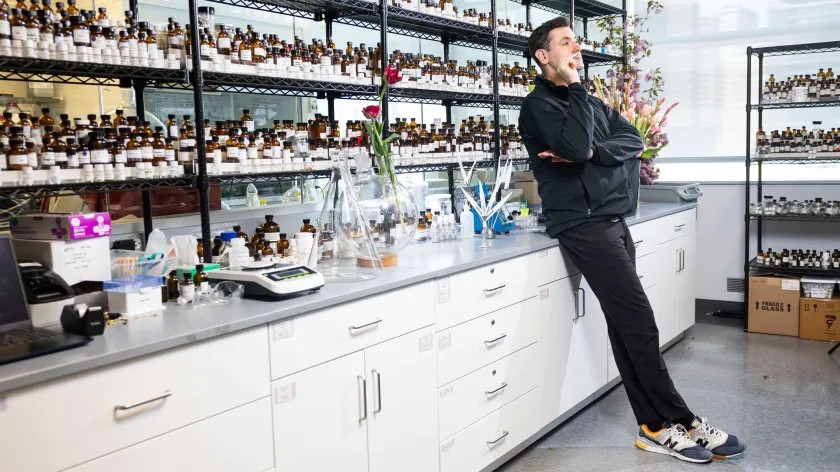
In a lab near Newark Airport in New Jersey, about 30 experienced odor specialists describe smells using words such as “nutty,” “peachy” and “marine.” Their ratings are compared with chemical analyses to create training data for a smell model. Osmo founder Alex Wiltschko says the company wants to give computers a sense of smell.
He sees smell as one of the main ways living beings interact with the world. Many species cannot communicate through sound or sight, he says, while smells can become strongly linked to memories: catching a familiar scent can be enough to bring a past event to mind.
Wiltschko founded Osmo in 2023, building on his work at Google Brain, Google’s former research lab. The company’s approach resembles that of AI startups in other fields: collect a large body of data and see what problems it can help solve. But before Osmo, existing databases contained fewer than 200,000 human descriptions of smells, by Wiltschko’s estimate. Chemical sensors are expensive, and the fragrance industry is reluctant to disclose the results of olfactory research.
Osmo now has its own dataset: more than 10 million human ratings and 800 million “odor tokens” describing specific molecules and their concentrations. Spectrometers and other chemical sensors run around the clock, analyzing the composition of fruit, flowers, pantry items and organs. About 70 trained annotators in the US and other countries smell samples and record their impressions using a shared vocabulary of scents.
Source: technologyreview.com
The company compares working with smells to working with language: just as changing the order of words changes a sentence’s meaning, changing the proportions of molecules can alter the scent people perceive. Wiltschko notes that the smell of a newborn and a freshly made plate of spaghetti share many “tokens.” He specifies that he means Barilla spaghetti.
From description to finished fragrance
Osmo does more than analyze smells; it creates them, too. The company uses a school-bus-sized robot that mixes ingredients according to precise formulas, producing samples for Osmo’s research and fragrances for clients.
The system can develop a fragrance from a text prompt in the style of ChatGPT. During a meeting at Web Summit in Lisbon, Wiltschko was asked to create a scent inspired by a Portuguese custard tart for men aged 18–23. A few minutes later, the model suggested three profiles—with creamy, coconut and fruity notes—and listed the molecules needed to make them. If the order had gone ahead, the custom fragrance L’Eau de Custard would have been ready in about a week.
Osmo says its model has reached “human-level olfactory intelligence.” The company defines this as a model that is roughly as good as the average person at recognizing and distinguishing smells, and performs at the level of a junior perfumer when creating fragrances. Osmo also claims that last month its model outperformed the in-house perfumers at one of the largest consumer goods companies.
The technology has already been used to create retail fragrances, including for Procter & Gamble. The Gates Foundation invested $5 million in Osmo at launch and later awarded it another $3.5 million in grant funding to assess molecules that repel disease-carrying insects. Osmo identified eight substances that repelled them better than DEET. The company also worked with online clothing marketplace StockX, using smells to detect counterfeit sneakers based on differences in the chemical composition of their materials.
Wiltschko is also considering threat detection at airports and disease diagnosis as possible future applications.
Disputes over accuracy and context
Avery Gilbert, a scientist who studies smell and the author of What the Nose Knows, is sharply critical of Osmo’s claims. In posts on Substack, he writes that some of the company’s promotional claims are unsupported by documentation, and that its patent applications still describe groups of people rating smells and perfumers, rather than AI alone. In March, Gilbert also questioned the company’s reliance on human ratings given its claims about AI’s capabilities. An Osmo representative did not respond before publication.
Michael Schmuker, a former professor of neural computation at the University of Hertfordshire who previously advised Osmo, considers the company’s technology a notable achievement. With colleagues, he created an open-source version of Osmo’s 2023 model by reverse-engineering it. But that version lacks the huge body of data Osmo collected later.
Even a large dataset may fail to capture the particularities of human smell. Schmuker stresses that a smell’s meaning depends on the situation: the same molecule can evoke different associations. For example, some molecules found in French Camembert cheese are also present in used diapers, but people do not confuse the smells because of context.
In a lab with controlled conditions, the lack of context may not matter. But it could be a problem if the technology becomes an “olfactory channel” for AI world models, as Wiltschko envisages. Potential applications include detecting spoiled food on a production line and identifying tumors by smell, as dogs trained to do so have in pilot studies.
For such applications, Schmuker says, sensors need to improve substantially and the models must continue to develop. The greatest potential prize is medical diagnosis. Wiltschko acknowledges that the path there is difficult and expensive: companies that tried to tackle the problem directly often failed, he says. Osmo plans to build a foundation first, one that can support research in different fields.
Dataist’s take: Osmo is already showing how large collections of chemical measurements and human ratings can be applied to perfumery and repellent development. But bringing the technology into diagnostics and other fields will depend on more than model quality: it will require better sensors and the ability to account for the context of a smell.
Daily AI news
Every day we pick what actually matters in AI and explain it plainly — no hype, no filler. Subscribe if you want to follow where the industry is going.
Only what matters — every day
Follow on X