
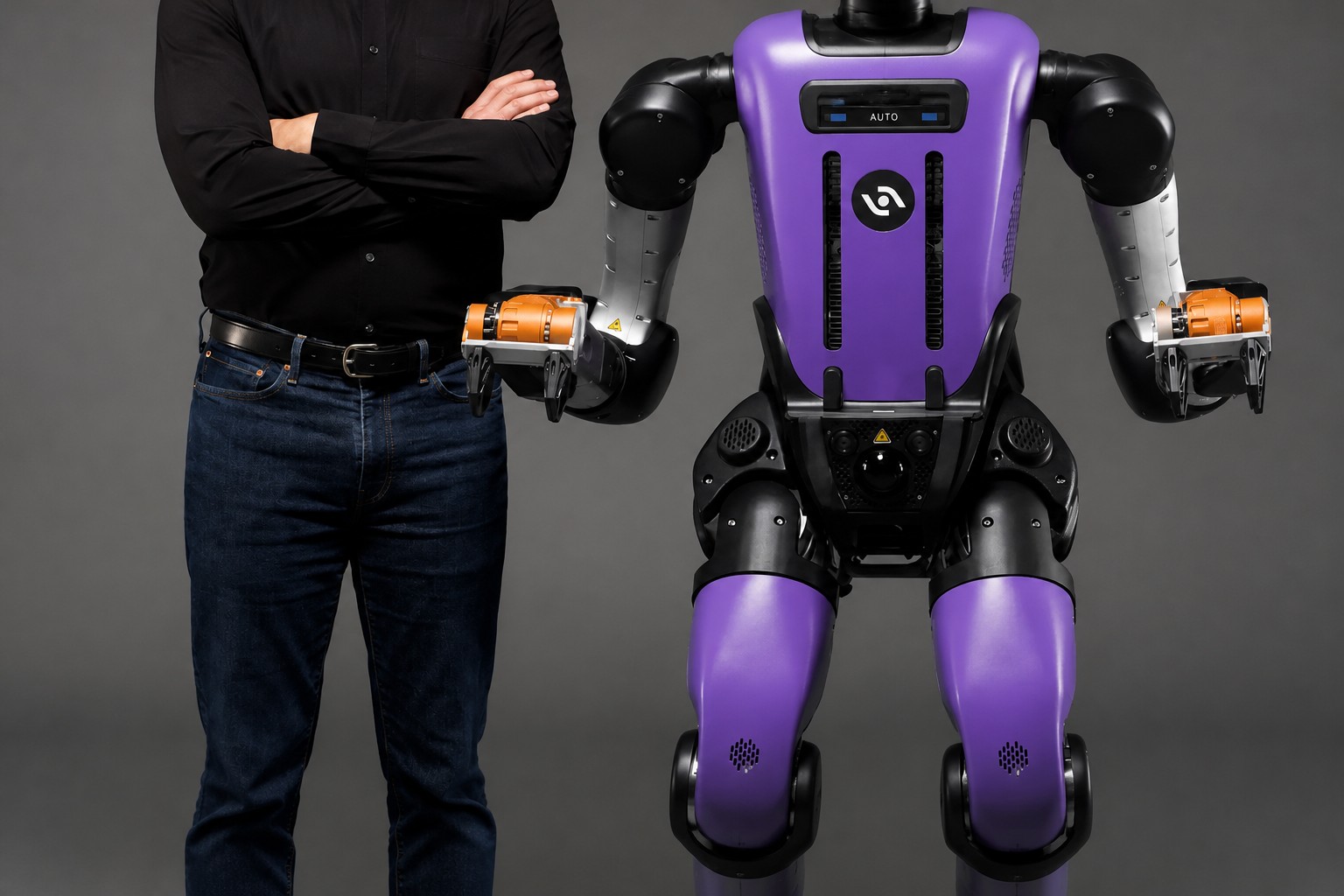
From a walking machine to a warehouse worker
Hurst began with a question from biomechanics: could a simple spring-and-mass model explain the way animals walk and run? In 2008, he founded Oregon State University’s Dynamic Robotics Laboratory to explore that idea. Its biped, ATRIAS, was built to demonstrate the physics of walking and running, not to look human. Yet its movement gave Hurst an early glimpse of the goal he would pursue with Agility Robotics.
The company’s first commercial product was Cassie, a research robot without a torso, arms or head. It used active, fluid movements to stay balanced rather than taking stiff, cautious steps. Universities and research organizations bought ten units, at $250,000 each. That market eventually filled up.
Cassie’s hardware let researchers focus on how software could control dynamic walking. Instead of relying only on detailed mathematical models, they began training robots through reinforcement learning in simulation. The approach now underpins much of the field’s work on dynamic movement.
To turn Cassie into a machine that could handle objects, Agility added an upright torso and arms. The resulting Digit became a mobile manipulator. Its first commercial task came from a practical constraint: customers needed to move containers through facilities that were difficult to automate with machines built for just one operation.
Agility tried Digit in a series of settings:
Those deployments gave Agility something research demonstrations could not: a clearer view of what customers needed, and what it took to keep robots working outside a lab.
The Robot I Didn’t Expect to Build
Source: spectrum.ieee.org
Safety became part of the product
Digit 4’s deployments exposed a limit. To meet insurers’ and regulators’ requirements, robots had to work behind physical barriers, apart from people. That constraint narrowed their usefulness. Agility spent two years designing Digit 5 to work safely alongside human colleagues instead.
The robot uses sensors to detect nearby people and respond to their position. If someone approaches, Digit stops working, sets down its load, sits on the floor and cuts power to its motors before the person can touch it. Agility says this cautious response is the only reasonable first step toward human-robot work that can be assessed for safety.
Making that possible shaped nearly every part of the machine: its body and legs, protective housings for safety sensors, and separate computers responsible for safety. Those systems add weight, size, complexity and power consumption.
Digit 5 weighs more than 120 kg. It is designed to repeatedly lift 23 kg containers to shelves 1.75 m high, in line with lifting limits recommended by the US National Institute for Occupational Safety and Health. Agility says the robot can do that work for up to 20 hours a day.
The battery and cooling system take up about 75 percent of its body. They are designed to let Digit work for 90 minutes, then fully recharge during a 9-minute break. Its docking station will supply 240 amps at 48 volts.
That machinery has consequences for movement. Digit 5 cannot run or jump as previous generations did, and it is bulkier than the graceful humanoid Hurst once imagined. Its legs have changed, too: the earlier, reversed design worked well for walking and running but made it harder to squat without the ankle hitting the ground. Digit 5 needs to lift heavy objects from near floor level, so Agility gave it human-shaped legs. Motors in its knees and hips work together to help it stand back up.
The Robot I Didn’t Expect to Build
Source: spectrum.ieee.org
The price of making a humanoid useful
I think the interesting shift is not that Digit 5 looks more human. It is that Agility has let the work determine what its humanoid should be. Safety certification, load limits and battery capacity are not distractions from the product; they are what make the product usable in a real facility. But they also push the robot away from Hurst’s original vision of lightness and fluidity.
The announcement is quiet about one practical measure: how much the robot costs, and whether its working time and recharge cycle make it economical for customers. The company has spent years learning through commercial deployments, but the facts here describe a robot designed for a demanding shift, not what that shift will cost.
Hurst says Digit 5 is a turning point for Agility. The roadmap includes picking individual items, tending machines, preparing parts for assembly and shipping, and eventually assembly itself. Modular construction and interchangeable tool attachments are meant to let the platform improve over time, while deployments provide data to train future behaviors.
For now, the robot is a compromise Hurst understands but does not love. He expects later Digits to become lighter, more graceful and more capable of interacting with people and objects. The commercial machine may be the foundation for that ambition, but it is not yet the machine he set out to build.
The Robot I Didn’t Expect to Build
Source: spectrum.ieee.org
The Robot I Didn’t Expect to Build
Source: spectrum.ieee.org
Daily AI news
Every day we pick what actually matters in AI and explain it plainly — no hype, no filler. Subscribe if you want to follow where the industry is going.
Only what matters — every day
Follow on X