
More answers, fewer correct ones
In the first two studies, participants could choose whether to ask AI for advice. Without AI, they abstained on 36% and 44% of questions. With access, those rates fell to 6% and 3%.
Study 2 also measured confidence. Without financial incentives, participants with AI access reported average confidence of 75.9 out of 100, compared with 29.6 without AI. Yet their accuracy fell from 27.6% to 10.0%.
Across studies without incentives, participants with AI answered correctly on 9.2% of questions, against 27.5% for the control group. They answered more often, but got roughly three times fewer questions right.
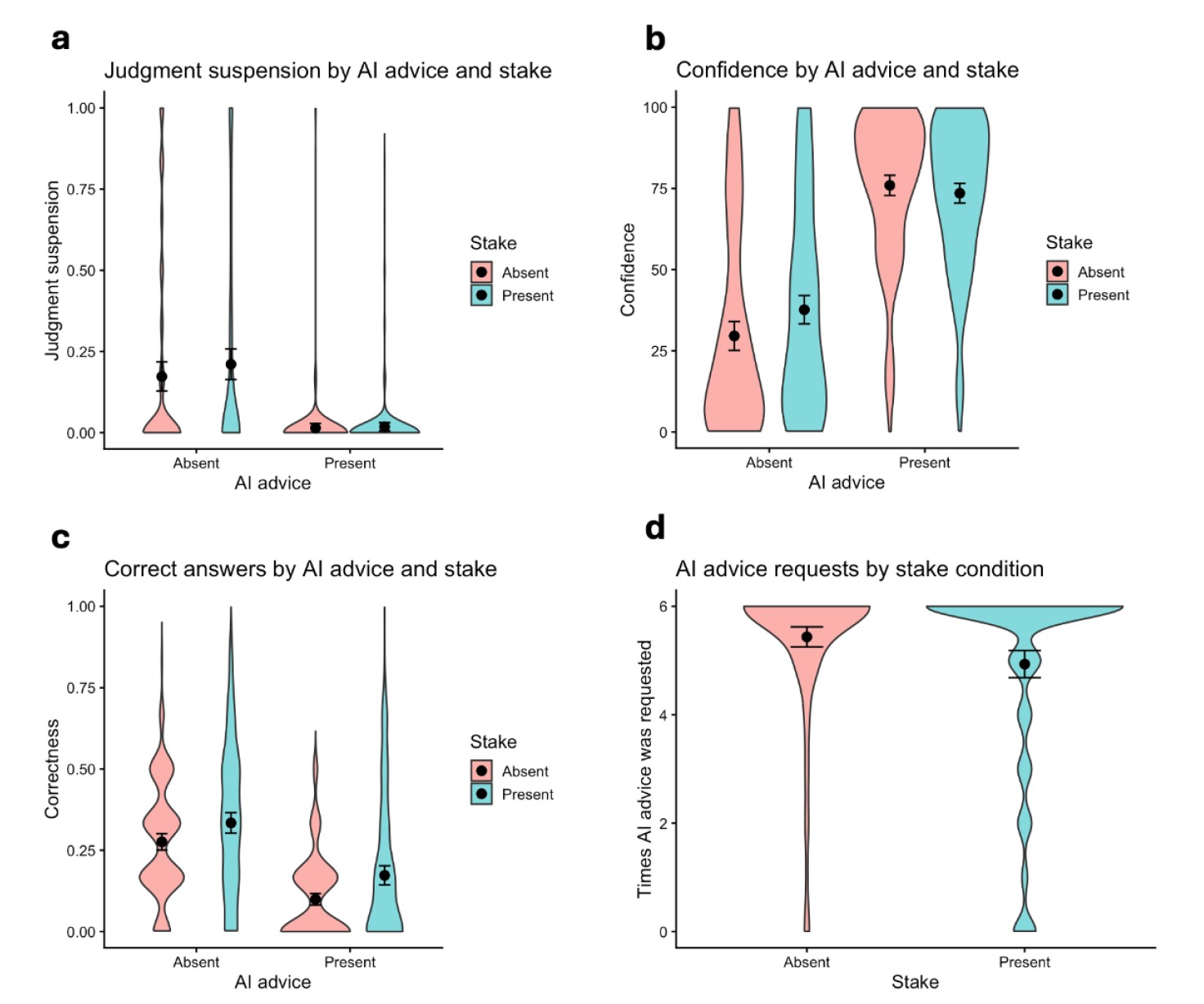
In Study 2, AI access drove judgment suspension to near zero (a) while confidence rose sharply (b). Correctness dropped at the same time (c). Financial incentives reduced how often participants sought AI advice (d). | Image: Marcoccia, Quattrociocchi, Capraro (2026)
Source: the-decoder.com
Incentives help, but leave a wide gap
In studies 2–4, participants earned 10 cents for a correct answer and lost 10 cents for a wrong one. “I don’t know” earned nothing. The researchers had preregistered a hypothesis that payment would encourage abstention, while AI access would weaken that effect. None of the three studies found a statistically significant interaction.
Instead, AI access and incentives mostly acted independently. Incentives reduced requests for AI advice: in study 3, participants made an average of 4.53 requests out of six, compared with 5.27 without incentives. When AI was available, incentivized participants also answered correctly more often. Abstention rose slightly, but remained well below the no-AI control group.
The authors say the incentive effect was small. Larger payments or rewards tied to reputation might narrow the gap more, but the study did not test that.
In study 4, participants were shown an AI answer automatically rather than having to request one. The researchers connect this setup to search engines that display AI-generated summaries and writing assistants that offer suggestions without being asked. The pattern barely changed: without incentives, abstention fell from 35% without AI to 1% when an AI answer appeared automatically. With incentives, it dropped from about 39% to 7%.
Confidence can travel with the answer
The researchers interpret the results through “epistemic”: a tendency to accept AI answers because they sound convincing, without checking them. Language models produce an answer rather than pausing when they do not know. The authors argue that users may take on this same unrestrained approach when they let AI judge for them.
That runs against findings on advice-taking, where people typically give outside recommendations too little weight and move only about a third of the way toward the adviser’s position. In this experiment, the authors say, participants moved in the opposite direction.
The team also concludes that AI access turned some answers that would otherwise have been correct into mistakes. Without financial incentives, participants with AI answered more questions than the control group, but got fewer right.
I think the most important detail is not that people used AI, but that they stopped treating uncertainty as a reason to withhold judgment. The study is limited to questions about movies, and it does not establish that the same effect will hold in other domains. Still, automatic answers matter because they remove even the small pause in which a person might decide whether to seek advice.
The authors suggest that as AI answers become more common, including answers users did not ask for, willingness to say “I don’t know” could be an early casualty of human-AI interaction. Preserving human judgment may depend less on making models more accurate than on whether people continue to recognize the limits of their own knowledge.
A wider concern about AI and judgment
Other work has also examined whether AI use affects human reasoning and cognitive skills:
Daily AI news
Every day we pick what actually matters in AI and explain it plainly — no hype, no filler. Subscribe if you want to follow where the industry is going.
Only what matters — every day
Follow on X