
What the recordings can and cannot show
Stephanie King of the University of Bristol has spent thousands of hours observing the Shark Bay dolphin population. Its members use buzzes, clicks, whistles and other sounds to communicate, navigate and find food. Underwater microphones recorded some of those sounds for the Threshold podcast.
King increasingly uses AI in her research workflow. Used responsibly, she says, it could change what scientists can do with the data they have collected. But she objects to framing the goal as “speaking dolphin.”
That framing is spreading. Research projects are presented as searches for an AI animal translator; headlines promise that scientists are close to “unlocking the secret language” of another species or “decoding animal speech.” The Coller Dolittle Challenge even offers prizes for an algorithm that can communicate with organisms outside the human species.
The problem is not that AI is being applied to animal behavior. It is that the technology is being asked to carry a story the evidence does not support.
Dolphins have been studied for decades, yet the meaning of many of their sounds remains unknown. Their hearing extends far beyond the human range, they process acoustic information faster than we do, and their sensory systems are organized differently.
Both humans and dolphins use echolocation. But dolphins process echolocation in a part of the brain associated with touch, while human processing is more closely connected with vision. A dolphin may not experience the underwater world as a person “seeing” through sound. It may be closer to hearing and feeling at the same time.
Feeding whistles and clicks into a large language model cannot recreate that experience. Before attempting a conversation, King argues, researchers need to understand what the signals and behaviors mean for dolphins themselves.
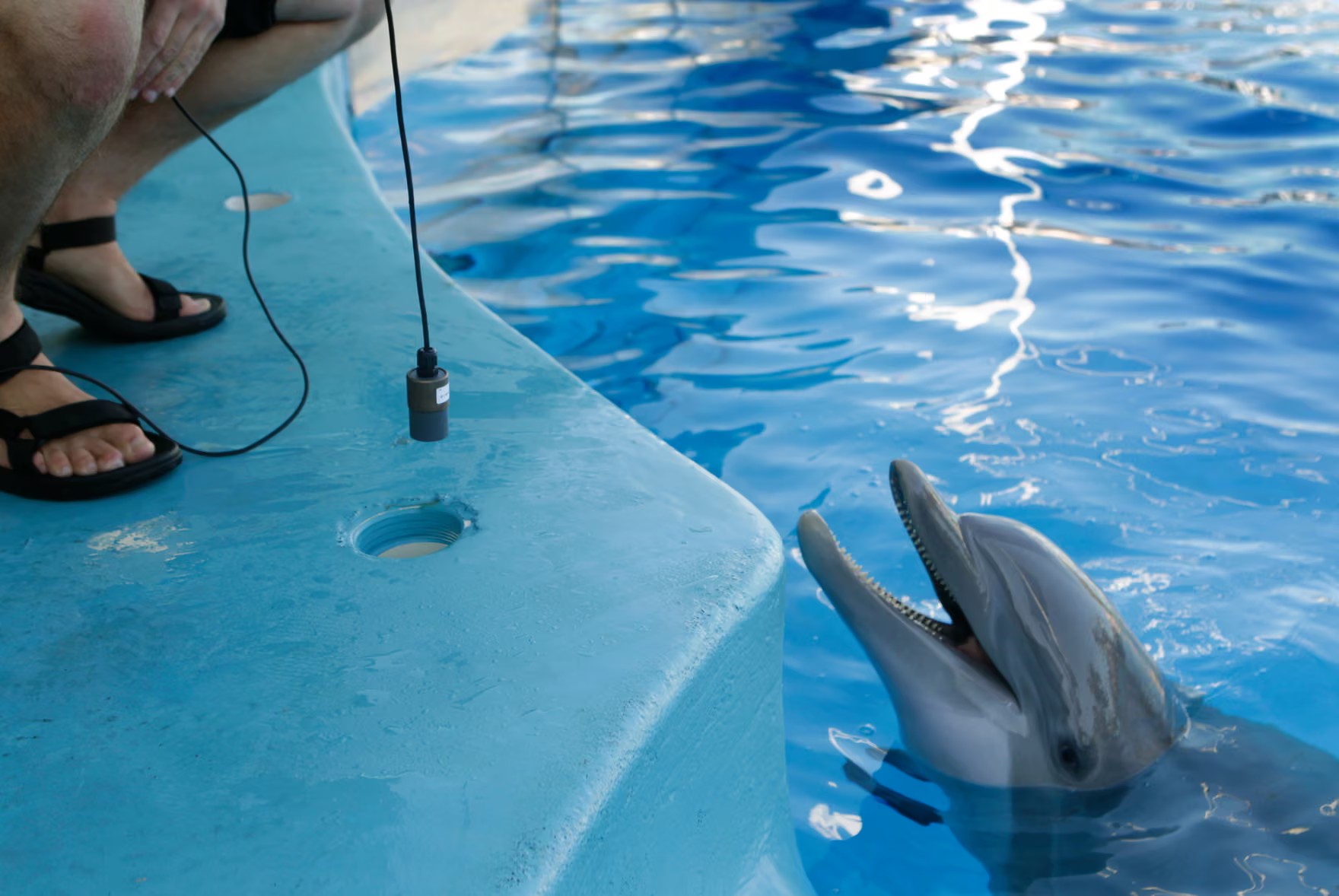
Bella, a pregnant dolphin at Six Flags Discovery Kingdom, watches trainer Adam Gilbert place a hydrophone into the pool to record her underwater sounds in Vallejo, California. Bella had been observed possibly communicating with her unborn baby and is the focus of new research project. Photograph: San Francisco Chronicle/Hearst Newspapers/Getty Images
Source: theguardian.com
High-pitched whistles are central to dolphin social communication. Mothers use them to maintain contact with calves, while some whistles function as individual identifiers similar to names.
Joyce Poole makes a parallel argument about elephants. A leading specialist in African savanna elephants, Poole has spent decades observing them in the wild and building a large archive of annotated field recordings covering sounds, movements and interactions.
She is frustrated by the goal of learning to talk with animals. The more immediate task, in her view, is to understand what elephants communicate and what they think, without inserting humans more deeply into their lives than necessary.
What understanding could change
Poole believes a clearer account of elephants’ inner lives could change how people treat them. Showing that elephants possess a complex communication system might encourage people to respect them more and preserve space for them, their ecosystems and other inhabitants of the planet.
That hope helps explain the appeal of animal-AI stories. As species disappear and biodiversity declines, people want good news. Humans have also been fascinated by other animals for as long as there has been human culture, especially by the idea that we might listen to them and learn.
César Rodríguez-Garavito, founder and director of the More Than Human Life program, or Moth, at New York University, sees AI as a possible way to understand animal life and include animals’ interests in decisions that shape their fate. Moth works on research and debate around the rights of nature.
Researchers and practitioners are already asking how the interests of whales might be considered when marine protected areas are regulated. Rodríguez-Garavito says including the voices of nonhuman animals in law and public policy is no longer science fiction.
Humans do not need AI to know that whales are harmed by noise, ship strikes, climate change and pollution. But a direct translation of a whale’s pain during underwater seismic testing, or its grief after a calf dies in a collision with a ship, might persuade people to act more forcefully.
The same capability could be used against animals rather than for them:
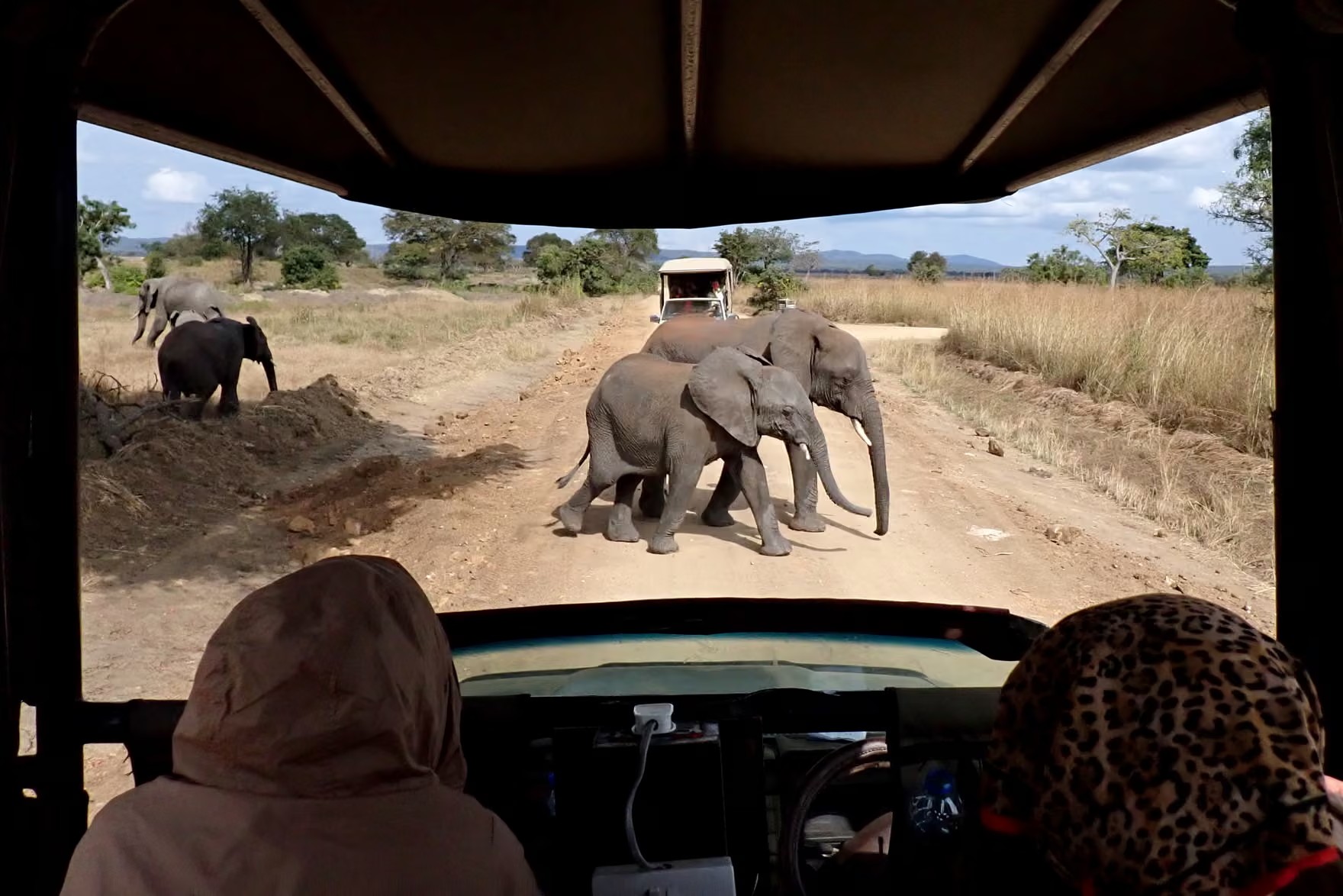
An adult African elephant and a younger calf crossing a dirt track during a game drive in Mikumi, Tanzania. Photograph: Vincenzo Izzo/LightRocket/Getty Images
Source: theguardian.com
The missing guardrails
Moth recently published Pepp, an ethical framework for technologies used to communicate with nonhuman animals. Its name comes from the English words for preparation, interaction, prevention and protection.
Whether and how those recommendations will be applied remains unclear. Rodríguez-Garavito connects the problem to the broader absence of legal and ethical limits on AI development. There is no international agreement on AI, so the field is advancing with few shared rules. In his view, universal principles defining what AI may and may not do would make the situation less alarming. For now, such principles have to be built from scratch, drawing on other areas of law.
Mickey Pardo, a senior research fellow at ElephantVoices who works with Poole, sees both benefits and risks in AI tools for studying animal communication. He also thinks both sides may be overstating the scale of what is to come.
Even playing recorded sounds without AI can stress animals, especially when researchers do not understand the signals’ context. A more complex AI system could increase that risk, Pardo says, but would probably intensify an existing problem rather than create an entirely new one.
He also questions whether AI is receiving too much attention while other forms of harm continue. Pardo considers the treatment of animals in biomedical science far more cruel than anything currently done by field researchers studying animal communication. That comparison does not remove the need to discuss AI’s ethical consequences, but it warns against concentrating on a hypothetical danger while overlooking harms that already occur.
The practical question is therefore not only whether AI can identify patterns. It is who controls the system, what intervention it permits and whether animals can be affected without anyone understanding the result.
The cost of getting the story wrong
Luke Rendell, a marine-mammal researcher at the University of St Andrews, worries that AI is acquiring an almost magical reputation. There is a belief that a machine will inevitably discover what humans could not. He calls that a kind of trick that creates unjustified confidence.
Earth Species Project writes that, because AI and large language models are advancing rapidly, decoding animal communication is no longer a question of whether it will happen but when. The organization also says it has already found evidence supporting the hypothesis that AI can decode shared language structures across species throughout the tree of life.
That language irritates Rendell. Like King, he sees the search for an animal “language” as anthropocentric. It could prevent researchers from recognizing the unique and highly diverse ways different species exchange information.
The reputational risk is not abstract. Rendell entered cetacean-communication research as the field was recovering from a 15-year “hangover” after John Lilly’s work. Lilly tried to teach dolphins English using controversial methods, including LSD. The experiments made him famous and ended with the tragic death of one participating dolphin.
For more than a decade afterward, dolphin-communication research was a source of jokes in scientific circles. During the last 15–20 years, knowledge of cetacean life and communication grew substantially, restoring the field’s scientific credibility. Rendell fears that irresponsible claims could damage that progress.
I think this is the strongest case against the translator narrative: it does not merely risk misleading the public about one technology. It can redirect money, distort research priorities and make a careful field look like another cycle of spectacular promises followed by disappointment.
King’s alternative is slower and more demanding. AI and machine learning should be used alongside close study of animals: when they signal, what is happening around them and how they behave at the same moment. Any AI conclusion should be checked against the field’s most important experts—the animals themselves.
That means years of patient observation, not Silicon Valley’s “move fast and break things.”
Dolphins receive sound waves through their lower jaws and produce sounds in the upper part of their heads. King explains the process while underwater microphones record a nearby dolphin’s buzzing.
What long observation provides
Days on the water with King involve quiet waiting and searching the horizon for the flash of a dolphin’s back. When one appears, she immediately calls out names: Juicy, Jungle and Piccolo. Interns photograph the animals and take notes.
King can recognize hundreds of individual dolphins from a brief look at a dorsal fin. She attributes that ability to countless hours spent in Shark Bay, where she returns every year and considers the work an important part of her life.
Back on shore, students compare fin photographs with images from previous years in their “dolphin album.” Some now suggest assigning that task to AI because it would be much faster. King insists on manual checking.
The reason is simple: if the goal is to understand animal behavior, the details matter. Details take time.
The same is true of the larger project. A wearable animal translator would be exciting, but it is not a prerequisite for paying attention to other species. The danger is not only that AI may fail to translate animals. It may succeed at making humans feel they understand them before the animals’ lives, contexts and boundaries have been understood at all.
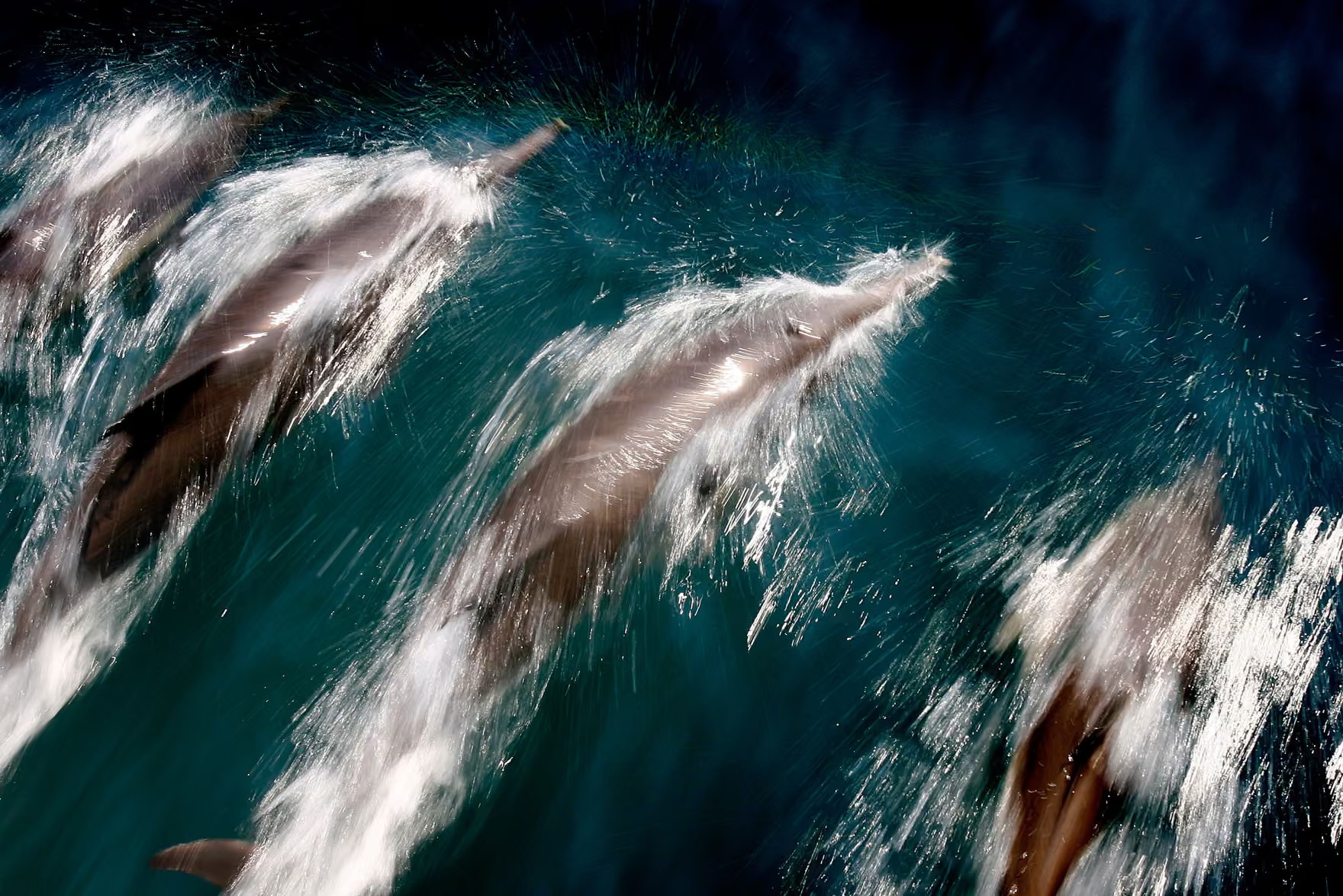
A pod of common dolphins surf the bow wake of a boat in the Catalina Channel near Long Beach, California. Photograph: David McNew/Getty Images
Source: theguardian.com
Daily AI news
Every day we pick what actually matters in AI and explain it plainly — no hype, no filler. Subscribe if you want to follow where the industry is going.
Only what matters — every day
Follow on X