What the experiment measured
Researchers randomly gave early access to an unreleased Google Labs patent-writing assistant to two-thirds of 133 lawyers at 11 intellectual-property firms. The firms worked regularly with Google, but not exclusively. The remaining lawyers received AI training but could not use the assistant during the three-month study. The tool is now part of Gemini Notebook.
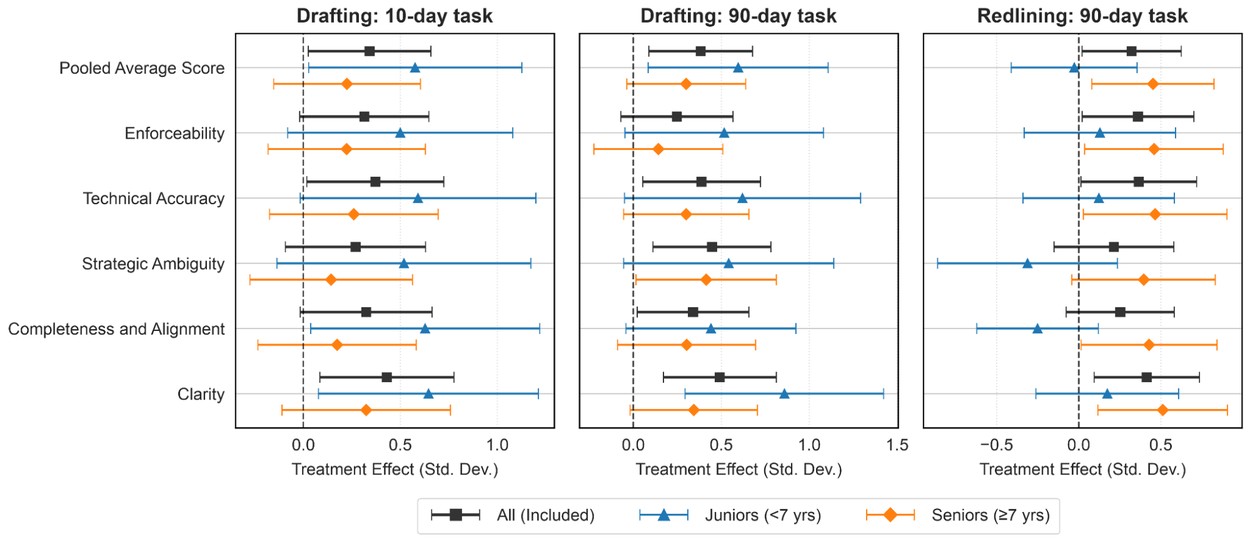
After 10 days, participants drafted a patent from materials about an invention. After 90 days, they did the same with a different fictional invention. Independent legal experts, unaware of who had prepared each draft, rated five aspects of quality: enforceability, accuracy, strategic ambiguity, completeness and clarity.
The effect was strongest for junior lawyers. They also worked faster: on the 10-day task, they finished 18 minutes ahead of the control group, whose average time was 124 minutes.
The test without AI
On day 90, lawyers also had to edit a fictional patent by hand, correcting substantive and stylistic errors. This task was meant to test professional judgment without the assistant. AI use was allowed for drafting, but not for editing.
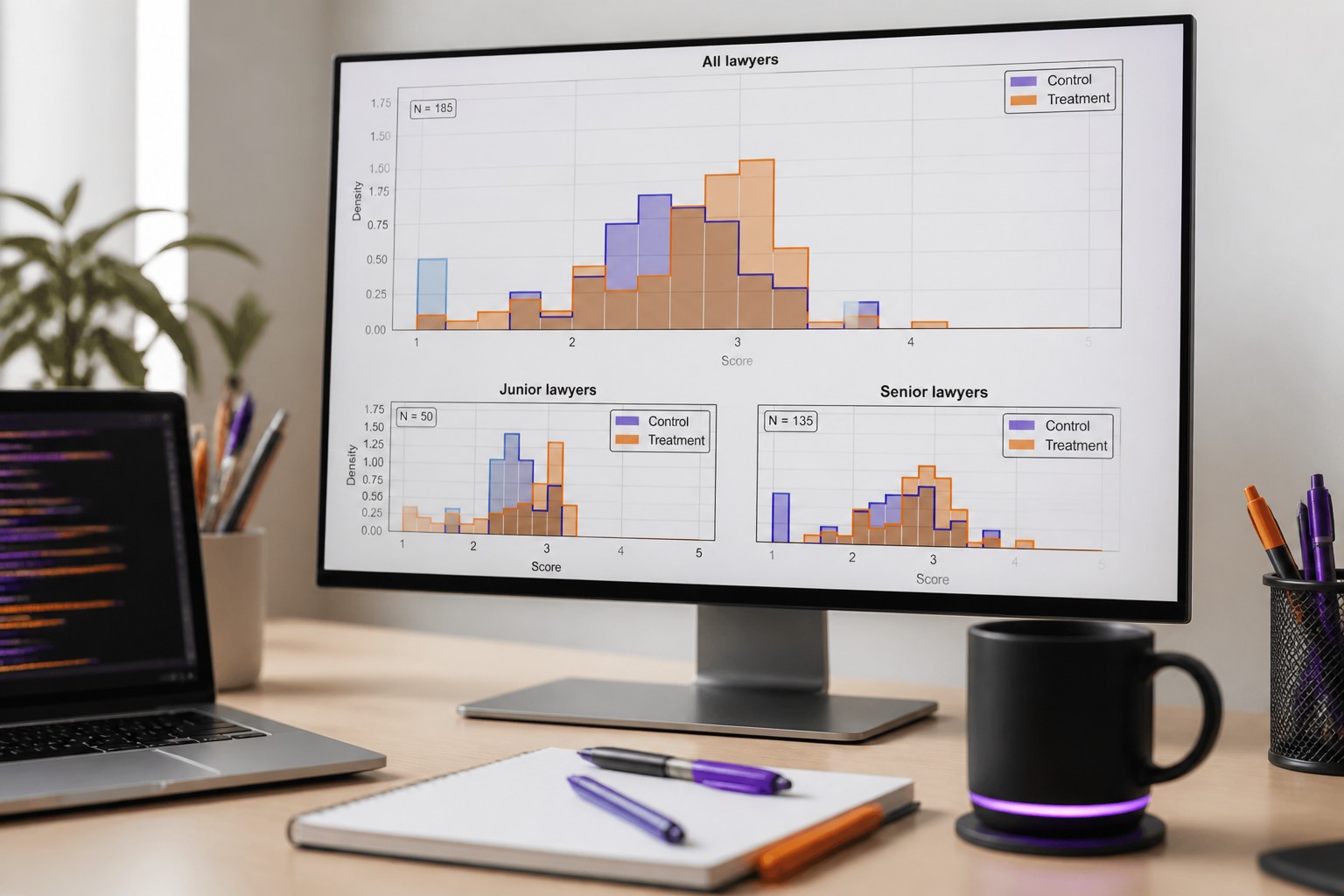
Overall, lawyers with access to AI scored 0.32 standard deviations above the control group, equivalent to 9 percentile points. But the gain came from senior lawyers: they outperformed the control group by 0.45 standard deviations, or 13 percentile points. Junior lawyers showed no significant improvement.
Their scores became more polarized: very low and good results grew more common, while middling scores declined. The share of excellent results stayed the same.
The editing patterns help explain the difference. Junior lawyers in both groups tended to work from the top of the document down, spending time on minor introductory sections before reaching the patent claims that mattered most. They were also more likely to swap in surface-level synonyms than to improve the patent’s commercial scope. Even when they spotted a serious defect, they often described the problem without fixing it in the document. Three months of AI-assisted rewriting did not erase that weakness.
Senior lawyers spent longer editing, skipped less important passages and restructured the patent claims. They removed language that could unintentionally narrow legal protections and supported many changes with specific legal doctrines. In follow-up interviews, they described the AI’s work as a “logic check,” not a finished document: a way to loosen their attachment to the original wording and focus on why the text needed to change.
Source: research.google
I think the result is less a verdict on whether AI teaches lawyers than a warning about what the study measured. The tool raised the floor on assisted drafting, but that did not mean junior lawyers had learned to make the harder decisions on their own. The same workflow can help an expert sharpen judgment and leave a less experienced lawyer with a better draft but the same habits.
What the study leaves open
The experiment involved a small group of patent lawyers and ran for only three months; the researchers note that both constraints reflect the high hourly cost of senior specialists and the years it takes to build durable expertise. Models and lawyers’ familiarity with AI have also changed quickly over the past year, making the results difficult to treat as a lasting measure.
What I’d want to know is whether the junior lawyers who benefited from AI-assisted drafting eventually improve at unaided editing, and what kind of practice gets them there. The study suggests that better output today and stronger judgment tomorrow are separate design goals. For legal AI, the measure of a useful tool may be whether it helps juniors learn to do without it.
Daily AI news
Every day we pick what actually matters in AI and explain it plainly — no hype, no filler. Subscribe if you want to follow where the industry is going.
Only what matters — every day
Follow on X