
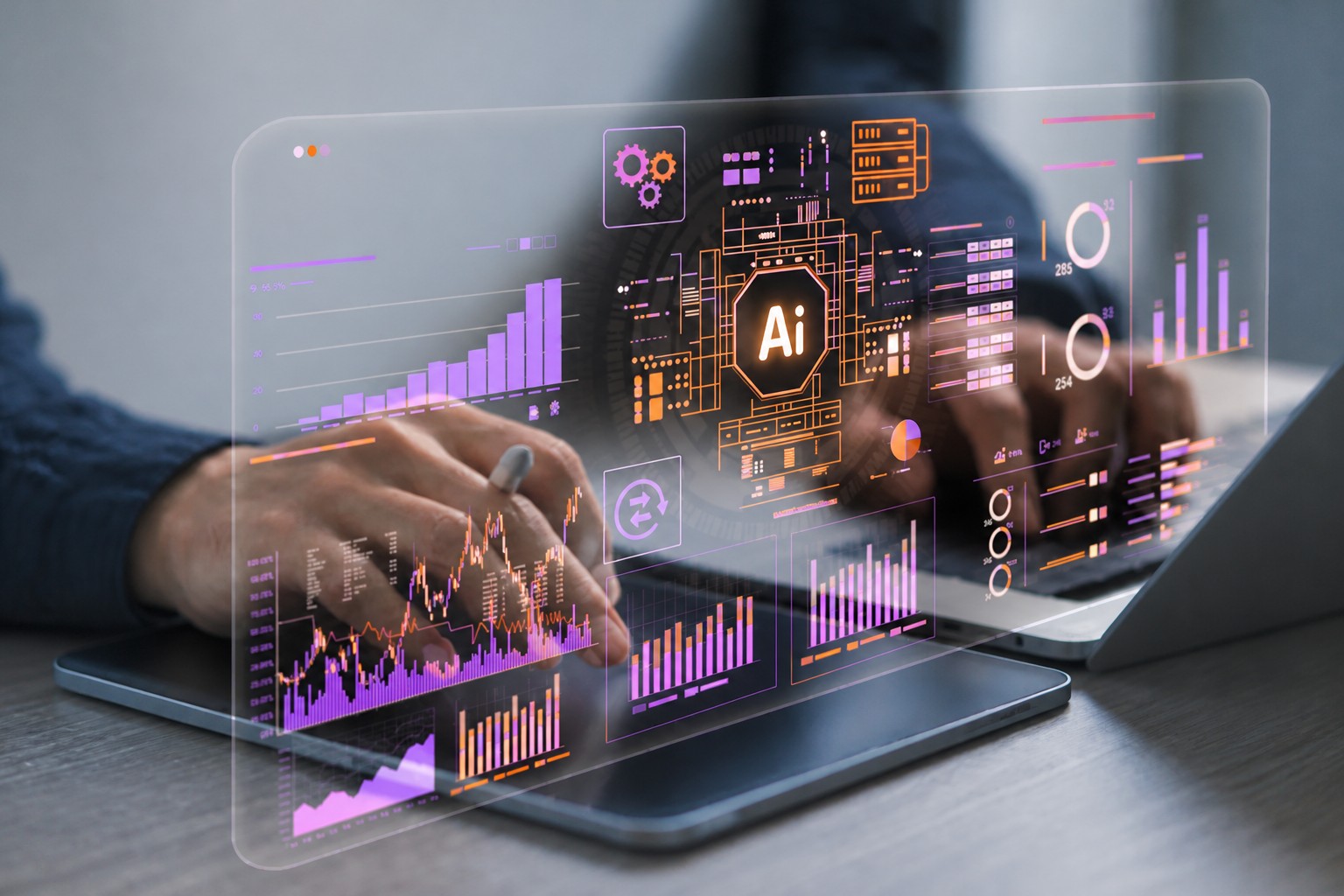
AI in the day-to-day work of financial firms
Finance has long relied on data, predictive analytics and pattern recognition. Investment professionals need high-quality research, fast access to information and accurate financial modeling. Generative AI, machine learning and advanced analytics expand these capabilities: systems process more data and identify trends and market signals faster than human analysts.
AI could also affect how organizations assess risk, build portfolios and allocate capital. Goldman Sachs has expanded its use of generative AI with GS AI Assistant. It helps employees conduct research, summarize documents, analyze data and develop software.
Morgan Stanley has introduced AI tools in wealth management. The company’s platform gives financial advisers access to internal research and expertise. Other tools prepare meeting summaries, help advisers stay in touch with clients and support investment research. According to Morgan Stanley, more than 98% of financial adviser teams actively use its AI assistant. The internal chatbot, AI @ Morgan Stanley Assistant, is integrated into workflows and helps employees access the firm’s knowledge base, research and internal documents.
These systems do not necessarily replace analysts, advisers and investment bankers. They can take on some information-gathering and processing, giving professionals more time to assess opportunities and work with clients. The advantage comes when AI’s analytical capabilities are combined with human expertise and knowledge of the financial organization.
How AI is changing the work of funds
Quantitative asset managers and hedge funds already use algorithmic trading, statistical analysis and mathematical models. AI makes it possible to work with larger, more diverse datasets, look for complex relationships and spot trends that traditional methods may miss.
Machine learning analyzes corporate earnings, economic data, interest rates, market sentiment and trading history. Natural language processing helps examine analyst reports, financial news, regulatory documents and companies’ earnings calls.
Funds also use alternative data to assess economic trends and company performance:
AI is used for risk modeling, trade execution, predictive analytics and portfolio design. In 2025, 95% of alternative investment managers surveyed by the Alternative Investment Management Association said they used generative AI at work.
But faster research does not automatically mean higher returns. A separate question is whether using AI leads to higher risk-adjusted returns, more disciplined investment strategies and better conclusions.
Analytics are becoming more accessible
Large investment banks and hedge funds have traditionally had advantages in quantitative modeling, with specialized analysts, proprietary research and computing resources. Individual investors, family offices and smaller firms often could not afford these capabilities.
Cloud computing, generative AI assistants and more accessible analytics platforms are beginning to narrow the gap. Smaller organizations can research data that previously required substantial resources to process. Family offices and independent asset managers use AI to study correlations, look for risks, assess investment opportunities and review asset allocations.
Advantages in scale, confidential information and experienced staff remain. But smaller firms can become more efficient by combining accessible AI technologies with investment expertise.
Investor experience and the limits of forecasting
James Paul Luthardt, founder and chief investment officer of Kirtland Hills Capital, bases his approach to finding opportunities and managing risk on a combination of macroeconomic analysis, fundamental research and quantitative methods. His example reflects a principle that matters in AI-assisted investing: technology can improve research, but decisions still require sound human judgment.
Investment professionals can use AI to analyze more data, look for possible relationships between securities, assess portfolio risks and test market scenarios. Machine learning can suggest new analytical approaches that are difficult to uncover with traditional methods. But markets are influenced by monetary policy, corporate leadership, human behavior, geopolitics and unforeseen economic events. Predictive models and historical data cannot explain every market scenario.
Businessman works on laptop Showing business analytics dashboard with charts, metrics, and KPI to analyze performance and create insight reports for operations management. Data analysis concept.Ai — getty.
Source: forbes.com
Models built on historical correlations can become less accurate during periods of stress. Agentic systems can continuously monitor risks related to interest rates, credit, liquidity and concentration, and run stress tests focused on future scenarios.
For families whose assets include operating businesses, private credit, real estate and concentrated equity positions, a real-time, unified view of the balance sheet was historically unavailable. Assessing total economic exposure may be more useful than analyzing each investment separately.
In the author’s assessment, one particularly notable effect of agentic AI could be greater operational efficiency in wealth management. As assets, client-service complexity and regulatory obligations grow, financial organizations have needed more staff for decades. Electronic trading and portfolio software have reduced that dependence, and agentic systems could change it further.
Luthardt believes analytical tools should be combined with an understanding of risk, value and companies’ fundamentals. AI can strengthen research, but professionals must determine what a potential opportunity means and whether the associated risk is acceptable.
AI risks and “model herding”
Insufficient, biased or inaccurate data can lead to faulty investment conclusions. Models also risk relying too heavily on past patterns that may not hold when economic conditions change. Another danger is greater market concentration.
If many companies use similar data, algorithms and trading signals, their decisions may become more aligned. During periods of market stress, this could increase volatility.
Luthardt is optimistic about AI’s potential but acknowledges the risks of adopting it. In his view, the technology could improve each individual portfolio while making the market more fragile.
The main systemic risk is “model herding”: the more capital relies on the same models, data and risk signals, the more investment decisions may converge, even if companies believe their strategies are unique. In calm periods, this can look like efficiency. Under stress, it may lead participants to exit similar positions at the same time.
A similar situation arose in August 2007: quantitative funds with similar positions suffered sharp losses when they began closing them simultaneously. AI could make this dynamic broader and faster.
Financial institutions also remain attractive targets for sophisticated hackers. AI-related threats include data poisoning, model manipulation, compromised AI agents and unauthorized access to private financial information. As the industry becomes more dependent on AI, governance, model validation, cybersecurity and human oversight become more important. Organizations need to monitor not only whether systems work, but also whether their outputs are reliable and understandable and whether they meet legal and fiduciary obligations.
Agentic systems and quantum computing
Agentic AI systems are designed to manage workflows and carry out multistep tasks with varying degrees of autonomy. In investment management, they can track economic data, analyze company earnings, spot market trends, assess portfolio risks and suggest recommendations to professionals.
Several specialized agents can work together to support portfolio monitoring, risk management, compliance and research. This could make investment firms more responsive and efficient. But highly autonomous financial systems require human accountability, auditability and clear limits on their authority.
In the future, combining AI with quantum computing could expand modeling and optimization capabilities. Potential applications include complex portfolio optimization, risk modeling, derivatives pricing and other computationally intensive financial tasks. Financial institutions are already exploring the potential of large-scale, fault-tolerant quantum computing, but the field is still at the research stage. In the near term, advances in data analytics, cloud computing, machine learning and conventional AI will play the main role; quantum computing could complement these tools.
Investing in the age of AI
Hedge funds use machine learning and alternative data, large financial organizations are adopting AI for research and customer service, and smaller firms are gaining access to more advanced analytics. Agentic AI and next-generation computing technologies could significantly change how financial markets operate.
Technical sophistication alone does not guarantee investment results. Markets depend on unforeseen events, corporate governance, economic conditions, human behavior and geopolitical shifts. AI does not eliminate uncertainty, but it can help make its causes easier to understand. Success will likely depend on combining data analysis with expertise, critical thinking and discipline in decision-making.
Dataist’s take: AI is broadening access to analytics and helping investment teams work faster, but its spread also brings systemic risk: similar models may push firms toward the same actions. The technology’s potential therefore depends not only on the quality of its analysis, but also on oversight, model validation and professionals’ ability to assess risks that algorithms may miss.
Daily AI news
Every day we pick what actually matters in AI and explain it plainly — no hype, no filler. Subscribe if you want to follow where the industry is going.
Only what matters — every day
Follow on X