

US companies increased their use of AI models to a record level, even as spending grew more slowly and token prices fell. According to the Ramp AI Index, which tracks payments from more than 85,000 US companies, token prices fell 21.2% over six weeks while token volume rose 1.5%. OpenRouter data show a similar pattern: since the start of 2026, weekly token volume has grown 1,215%, while spending has risen 455%. Stripe’s index also records growth in the AI business, but at a slower pace.
AI use is rising, but industry growth is slowing
Use is growing faster than spending
Tokens are units of computation that AI providers use to measure model usage and bill customers. According to Ramp chief economist Ara Kharazian, token prices fell 21.2% over six weeks, while token volume rose 1.5% to a record.
Companies’ actual spending on AI APIs fell 6.3% from the peak recorded two weeks earlier. Comparing the weeks ending November 15 and October 18, spending was still up 12%, but token volume over the same period increased 27.2%. The gap between model usage and the revenue it generates continues to widen.
The average price per million tokens for OpenAI and Anthropic combined fell to $0.45, 11.2% below the level a month earlier. A million OpenAI tokens cost $0.38, while a million Anthropic tokens cost $0.50.
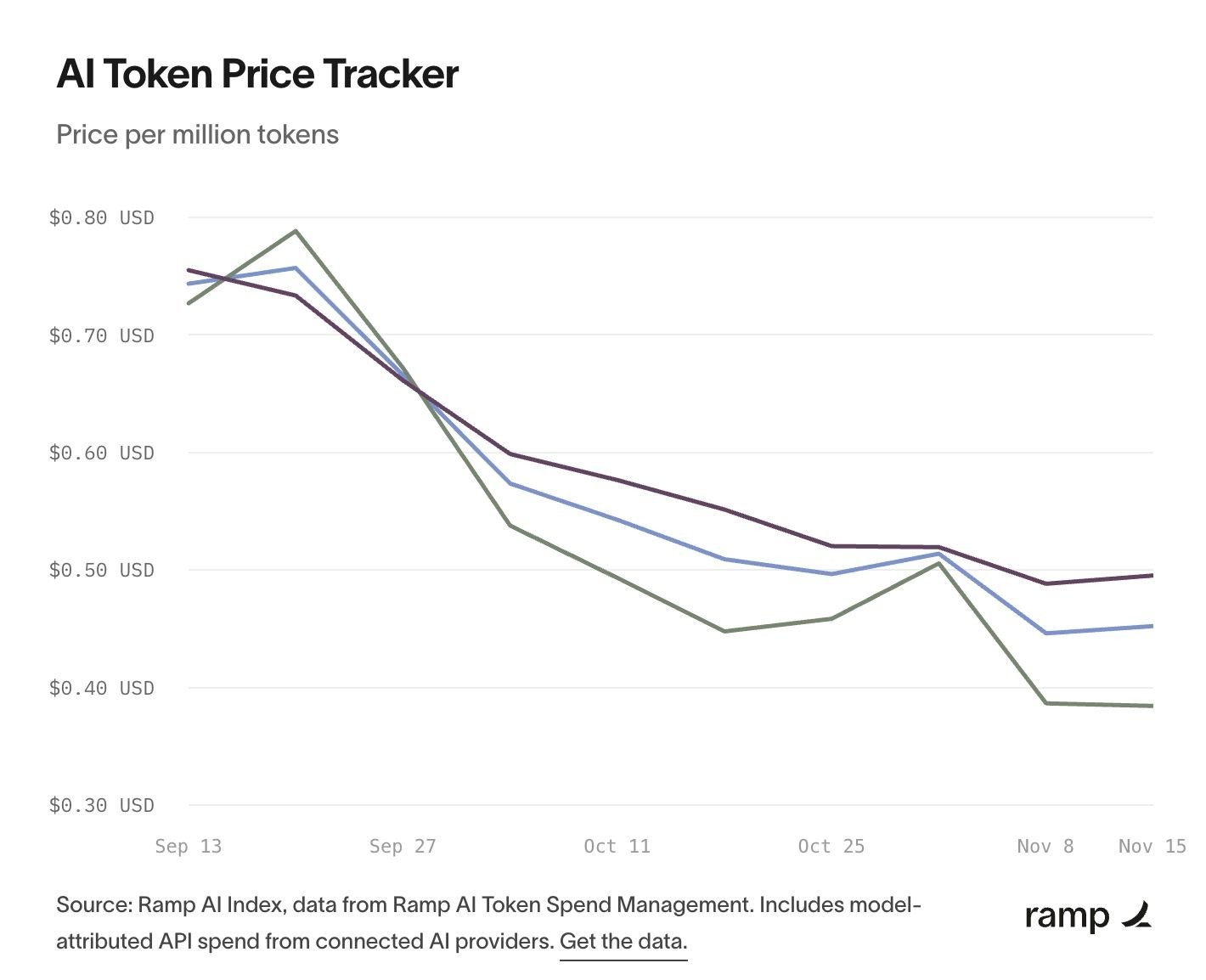
The price war between OpenAI, Anthropic and Chinese providers is having an effect: tokens keep getting cheaper. In mid-November, the average price per million tokens sits at $0.45, with OpenAI at $0.38 and Anthropic at $0.50. | Image: Ramp AI Index
Source: the-decoder.com
Data from API routing platform OpenRouter show a similar trend. According to an analysis by Peter Walker published on X, weekly token volume for closed models from OpenAI, Anthropic and Google has grown 1,215% since the start of 2026. Weekly spending over the same period rose 455%, considerably more slowly. OpenRouter’s data run through the week ending November 9: spending peaked in the week of October 5 and then began to decline.
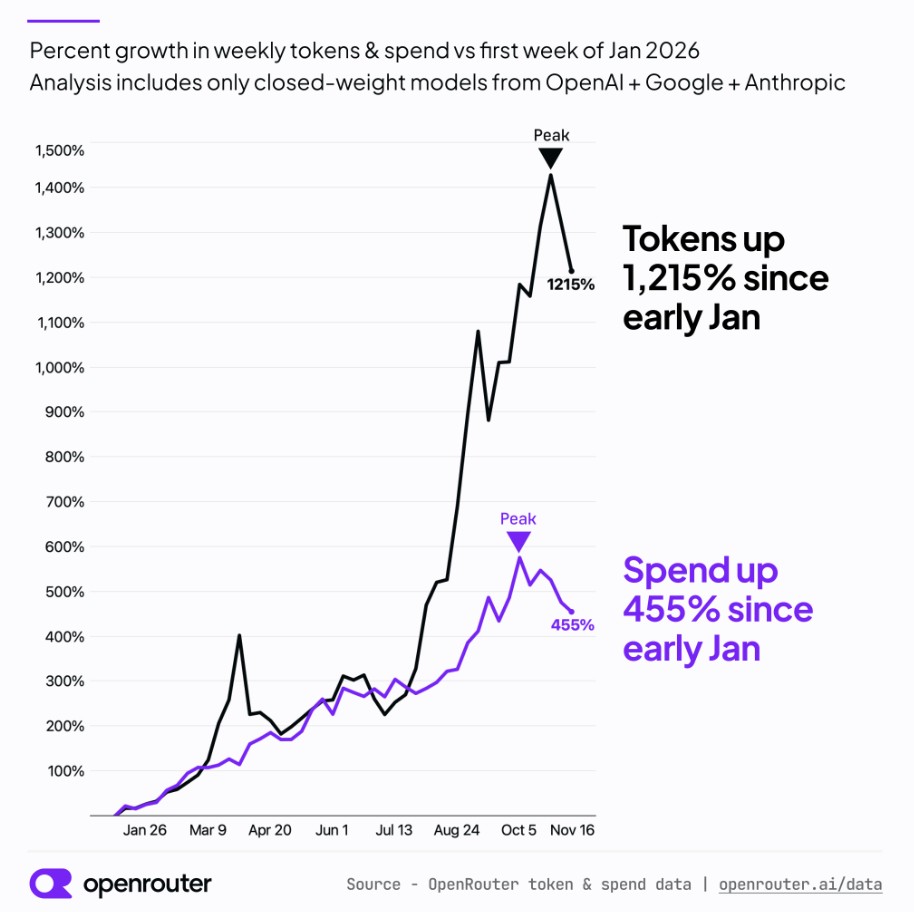
On OpenRouter, weekly token volume rose 1,215 percent since early 2026, while weekly spending grew 455 percent. Spending has fallen since its early-October peak. The chart covers only closed-weight models from OpenAI, Google and Anthropic. | Image: OpenRouter
Source: the-decoder.com
Ramp calculates its figures from model usage data and bills received from AI providers. OpenRouter tracks traffic routed through its API platform. Both sources show spending peaking in October, followed by a decline in spending and growth in usage. This reinforces the observed trend, but neither index represents the entire market. OpenRouter offers a particularly narrow view, reflecting the behavior of a specific group of users.
Provider shares and AI adoption
In the week ending November 15, 2026, Anthropic accounted for 58.7% of all token spending, according to the Ramp AI Index, up 1.7 percentage points from a month earlier. The company’s share of total token volume was even higher, at 59.4%. OpenAI accounted for 37.2% of spending and 37.7% of volume. Google received 1.4% of spending, while xAI (SpaceXAI) received 2.4%.
Kharazian wrote on X that Anthropic maintained this share on the day of its initial public offering. However, Anthropic’s token spending grew just 0.5% month over month in October, compared with 2.1% for OpenAI.
In October 2026, 56.8% of the US companies tracked by Ramp paid for AI products or services. That was one percentage point above September and 13.3 percentage points above a year earlier. Anthropic led in adoption among companies, at 44.8%; OpenAI’s figure was 40.6%.
Stripe also records a slowdown
The Ramp AI Index tracks demand—how much companies spend on AI. The Stripe index reflects the provider side: it tracks incoming payments for around 20,000 AI companies that use Stripe.
In the 52 weeks ending November 8, AI companies’ revenue grew 103%. But the median growth rate for an individual company was only 41%. This suggests that a few large providers are substantially lifting the overall result.
The slowdown is more pronounced over a shorter period. Annualizing growth over the past 13 weeks yields a rate of about 80%, down from 140% several months ago. Annual growth is 104% in the US and 67% in the EU. According to Stripe, AI companies are growing faster than traditional software developers: 103% versus 33% in the SaaS index.
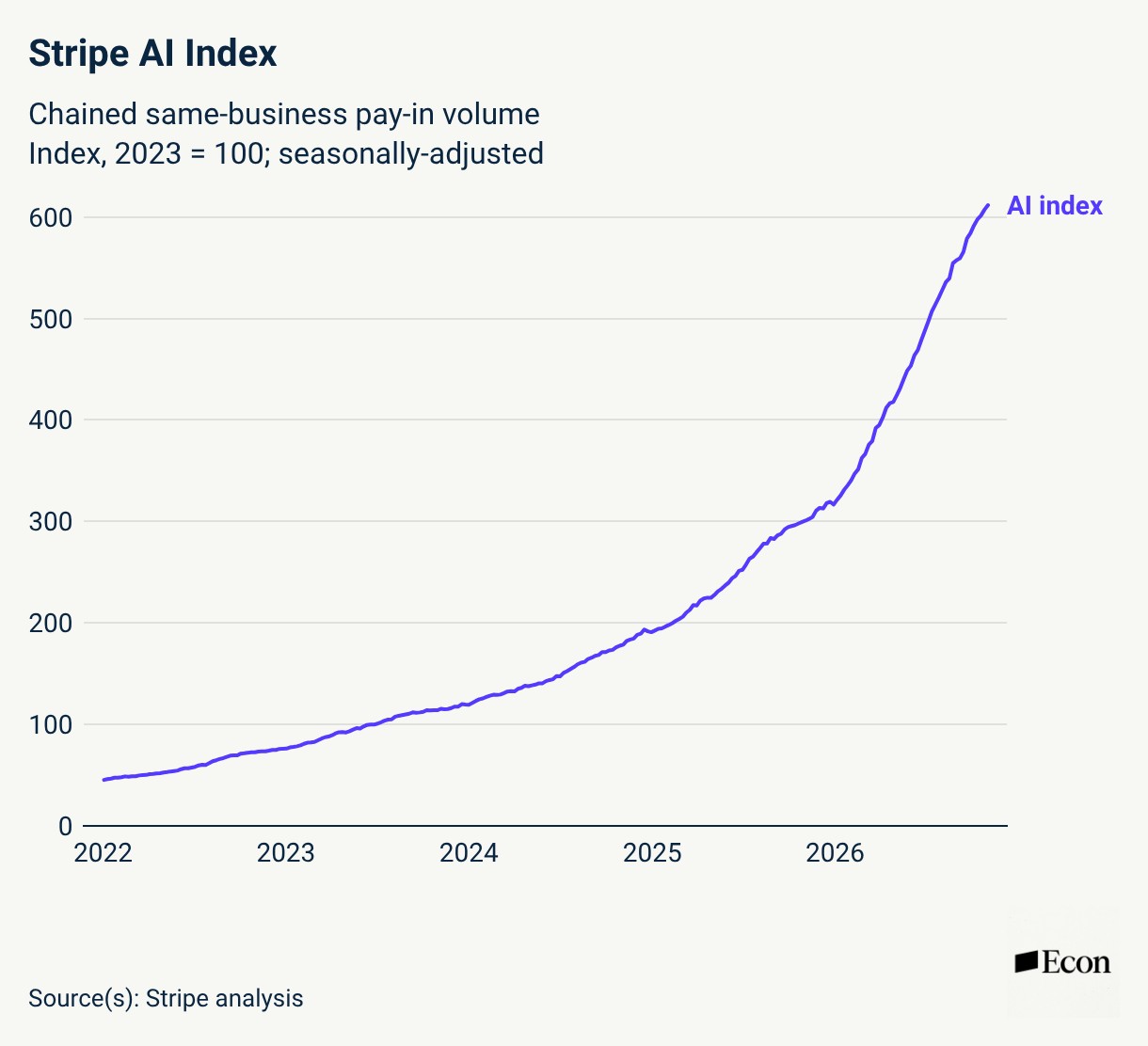
The Stripe AI Index shows rising incoming payments for AI companies since 2022. The increase steepens starting in 2025, and the index crosses 600 points in 2026. | Image: Stripe
Source: the-decoder.com
Stripe’s regional data show the growth in API payment volume in the US, UK, EU and the rest of the world from 2023 to 2026.
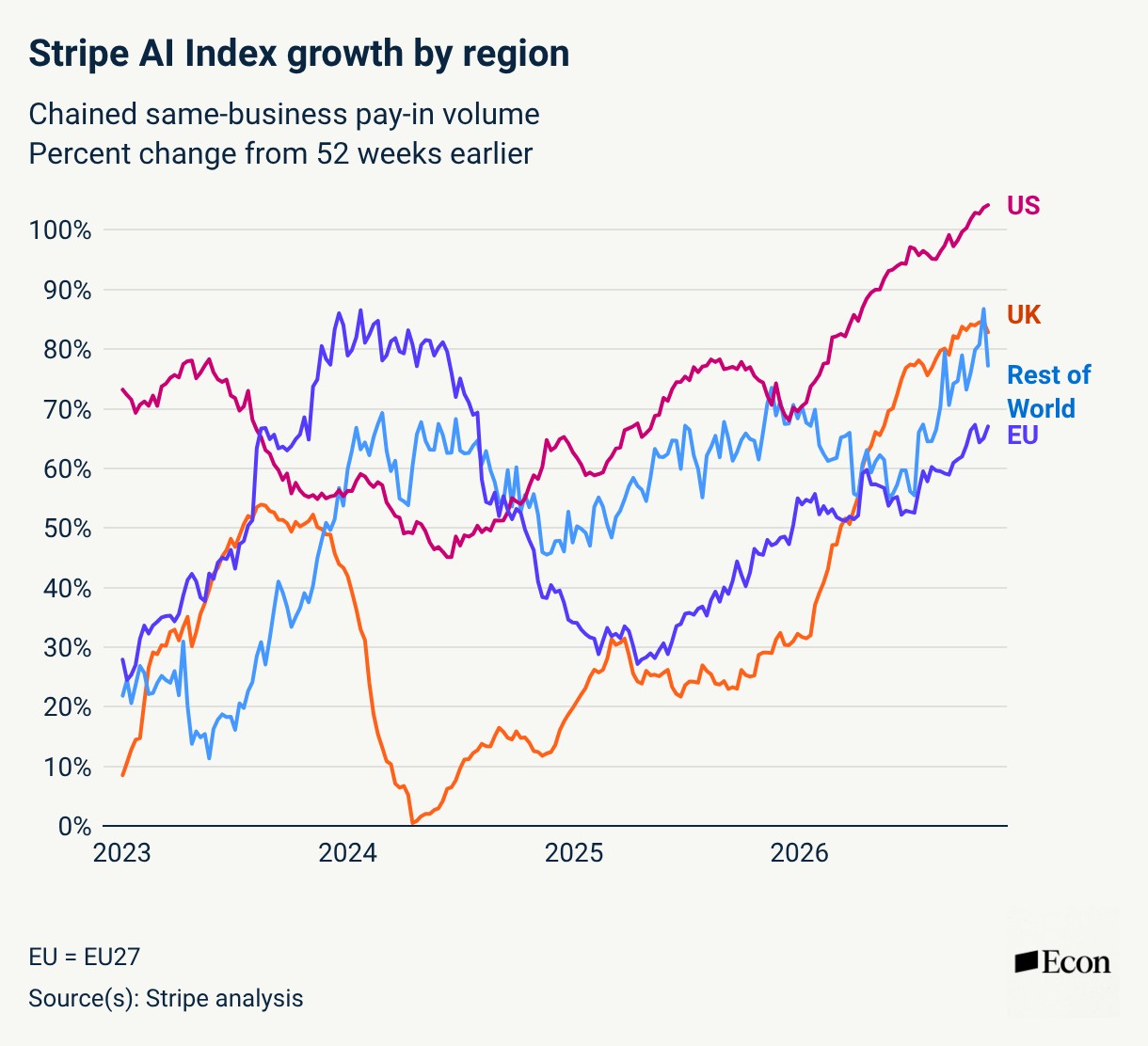
Payment activity among tracked AI companies rose about 104 percent in the US over the 52 weeks ending November 8, 2026. The UK followed at 83 percent, the rest of the world at 76 percent and the EU at 67 percent growth. | Image: Stripe
Source: the-decoder.com
Both indices show that the AI market is still growing rapidly, but at a slower pace. For Ramp, this shows up in falling prices and concentrated demand; for Stripe, in slower revenue growth among providers.
Further growth could come from more capable or reliable models, or from deeper integration of existing models into companies’ workflows. There is potential for this: AI has transformed the software development market in a matter of months. At the same time, the industry needs very high growth rates to justify its planned large-scale expansion of computing capacity.
Dataist’s take: the figures point to a divergence between AI usage and revenue growth. Token volumes are rising, but prices and spending are growing more slowly. This limits what can be inferred about the market as a whole: Ramp and OpenRouter measure different, narrow slices, while Stripe shows how much providers’ results depend on a few large companies.
Daily AI news
Every day we pick what actually matters in AI and explain it plainly — no hype, no filler. Subscribe if you want to follow where the industry is going.
Only what matters — every day
Follow on X