
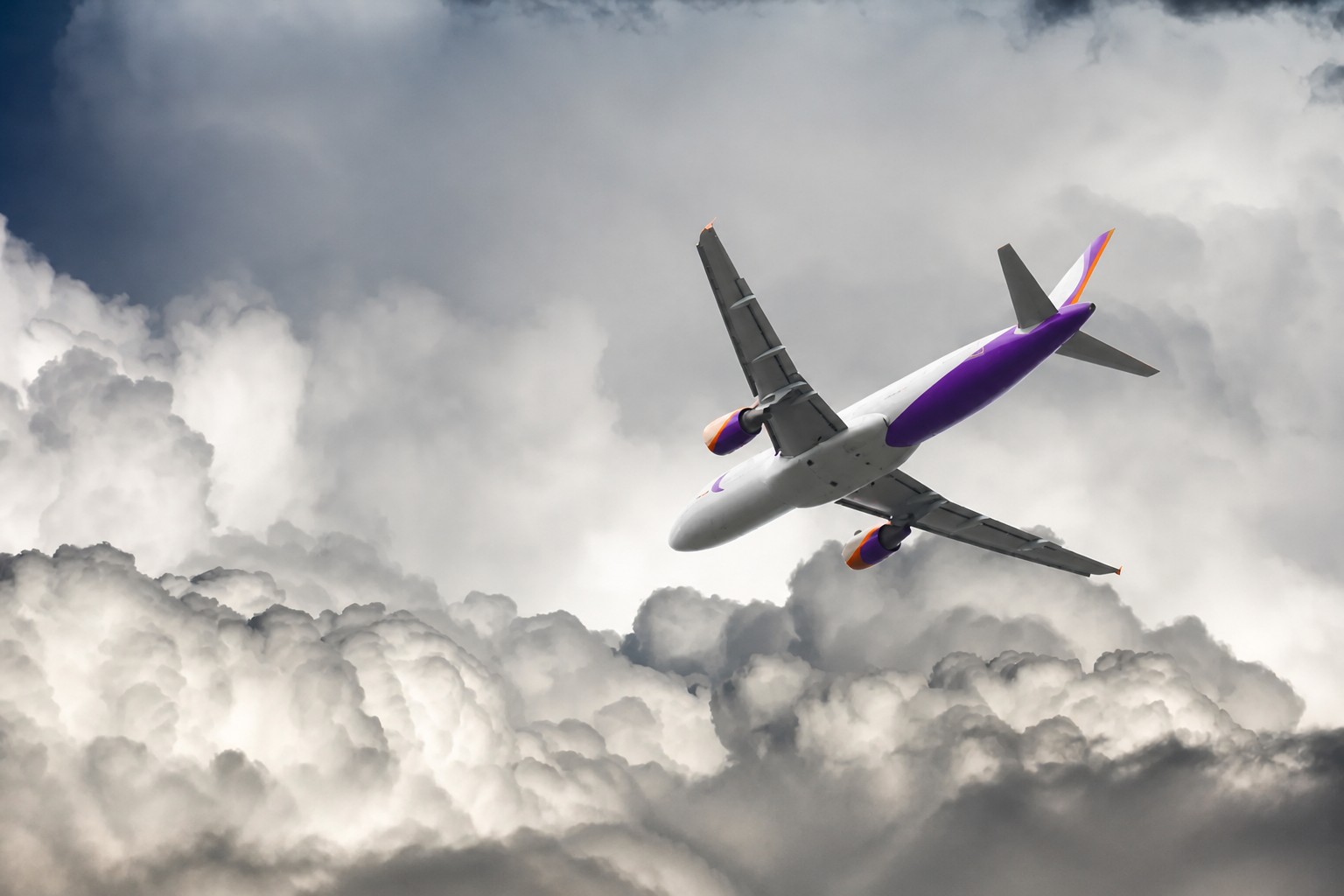
Turbulence is still difficult to predict: air currents shift across many scales, and small changes in temperature and wind speed can alter a forecast. But airlines and researchers are collecting more flight data and using machine learning to identify dangerous areas in advance. The SkyPath app, installed on more than 40,000 onboard devices, warns pilots of possible turbulence 10–15 minutes ahead. In the United States, $30 million has also been awarded to nine universities for turbulence research.
Data from aircraft could improve turbulence forecasts
From da Vinci’s observations to airline data
In the early 16th century, Leonardo da Vinci studied whirlpools and other complex movements in water. He made hundreds of drawings as he tried to understand why fluids move that way — including air and blood. Centuries later, turbulence remains an unsolved problem in classical physics. Michael Murillo, a professor of theoretical and computational physics at Michigan State University, calls it one of the hardest problems that airplanes have to fly through.
Gathering data for forecasts has become easier: the number of flights has grown, while communications and onboard computers have become cheaper. During one hour of commercial flight, an aircraft engine generates 20 terabytes of data, according to the International Air Transport Association. Aircraft also transmit GPS coordinates, altitude and speed. An electronic flight bag with navigation charts and manuals can send additional information when an internet connection is available. Satellites collect data too.
Between 2009 and 2023, more than 200 people in the United States suffered serious injuries in turbulence-related incidents, according to FAA data. Climate change adds to the challenge: it affects atmospheric conditions around jet streams and creates unstable wind shear. For pilots, this can mean sudden clear-air turbulence that is difficult to spot and predict. In the past, crews mainly relied on reports from pilots who had already encountered turbulence, while allowing for the possibility that conditions had changed.
How data helps locate turbulence
Over the past two years, physicist Larry Cornman’s years of research have begun to be applied in aviation through several projects involving the U.S. federal government and airlines. Cornman and an FAA air traffic controller found that mandatory transmissions of coordinates, altitude and speed can be used to detect unexpected turbulence. No new equipment or software needs to be installed on aircraft: forecasts are built from publicly available data transmitted by the aircraft themselves.
SkyPath, a company based in Tel Aviv, collects similar data. Its app uses accelerometers in onboard tablets and combines information from aircraft, even when they belong to different airlines. The data is anonymized before transmission to address competitors’ concerns about sharing information.
The SkyPath app is installed on more than 40,000 such devices, the company’s CEO, Maya Shpak, said. According to SkyPath, several major airlines, including American, use the technology. The app combines the collected data with weather forecasts and uses machine learning to estimate upcoming conditions in the air. It helps pilots avoid turbulence and warn passengers and crew 10–15 minutes before it hits.
A pilot named Eric, who uses SkyPath and asked WIRED not to publish his last name because he was not authorized to speak to the press, says the app is useful for warning passengers. But, like the researchers, he points to the limits of measurement: data cannot be collected everywhere at once. The data-collection system works better when many people use it; several major airlines already use the app, making it especially useful in high-traffic areas.
Why precise forecasts remain out of reach
Turbulence occurs across many small scales at once. The air around an aircraft breaks into vortices, which break into smaller ones, and all of them interact. Too many processes happen too quickly to account for them all in a mathematical model. A small change in temperature or wind speed can also greatly alter the movement of air over time. An error-free forecast would require a complete picture of the atmosphere at every moment.
Machine learning could help researchers make more accurate estimates of what will happen and where. Murillo also believes AI agents could support this work. In the fall, OpenAI said it had solved the Navier–Stokes problem: these equations underpin turbulence models. Murillo says that people used to be the only ones able to work on problems like these, but that has now changed.
Aviation does not need a complete explanation of turbulence to make flights smoother. It is enough to better understand the conditions that cause it and avoid sending aircraft into those areas.
Turbulence also affects research into fusion energy. In September, the U.S. National Science Foundation awarded $30 million to nine universities to establish a new center: Transformative Explorations in Multi-Physics and Engineering of Scientific Turbulence, or Tempest. It will study turbulence in the atmosphere, in the charged particles of a fusion reactor, and in clouds of gas in space. Murillo, the center’s director, explains that the swirling motion of superhot plasma allows heat to escape from the reactor and makes it harder to reach the temperature needed for atomic nuclei to fuse.
Physicist Larry Cornman cautions against expecting highly accurate forecasts: in the near future, he says, forecasts with 80, 90 or 100 percent accuracy are not realistic.
Dataist's take: Shared data is already helping airlines warn about turbulence in advance, but these systems depend on how many aircraft transmit information. Researchers still cannot fully predict the movement of air, so aviation’s goal is to identify dangerous conditions more accurately and choose routes with the risk in mind.
Daily AI news
Every day we pick what actually matters in AI and explain it plainly — no hype, no filler. Subscribe if you want to follow where the industry is going.
Only what matters — every day
Follow on X