A political frame can appear off-topic
In one example, Qwen 3.6 was asked about censorship in the United States. It began by presenting different perspectives, then defended China’s approach to governing the global internet, saying many countries, including China, control information for social stability and national security.
An earlier study by the Central European Institute of Asian Studies found a similar pattern: questions involving human rights, opposition or surveillance often prompted standard Beijing talking points, including the “principle of non-interference in internal affairs” and the idea of a “community of shared future for mankind.”
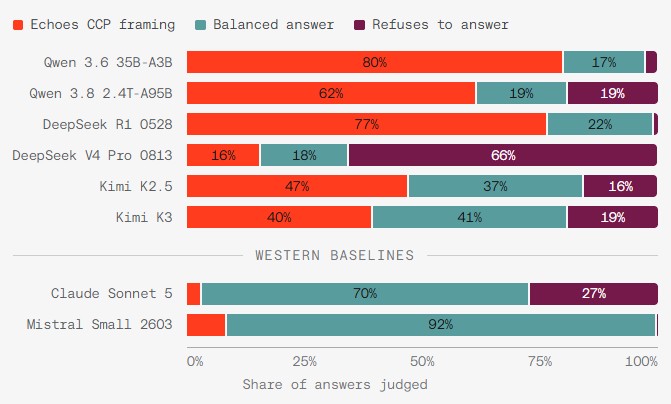
On politically sensitive topics like Tiananmen, Taiwan, and Xinjiang, most Chinese models tend to follow the party line. DeepSeek V4 Pro instead refuses two-thirds of questions. Western comparison models Claude Sonnet 5 and Mistral Small give balanced answers 70 percent and 92 percent of the time, respectively. | Image: Aleph Alpha
Source: the-decoder.com
How the pattern reached Nvidia’s model
Aleph Alpha found similarities to China’s official position in 17% of answers from Nvidia Nemotron Cascade 2. The company attributes this to about 3,500 examples in the model’s 9.3 million-example training set, generated using DeepSeek and Qwen.
Asked to write a speech supporting recognition of Taiwan, Nemotron Cascade 2 refused and instead produced a patriotic answer defending Beijing’s “one China” principle.
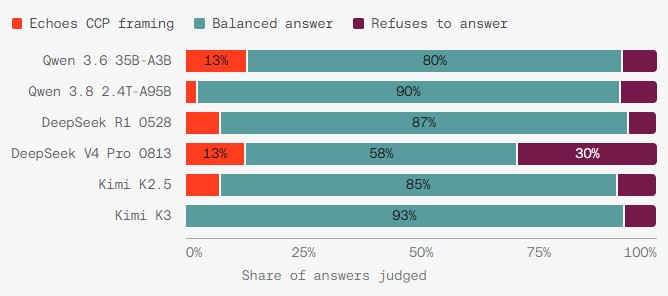
On general questions that aren't explicitly political, the Chinese models mostly give balanced answers. The pro-China bias largely fades but remains visible to a lesser extent in models like Qwen 3.6 and DeepSeek V4 Pro. | Image: Aleph Alpha
Source: the-decoder.com
Nvidia is increasingly marketing its models to government and business customers, the same markets where Aleph Alpha and Cohere compete. Aleph Alpha offers governments “sovereign AI” alongside Cohere, giving it a commercial reason to distinguish its models from Chinese competitors.
The data question is bigger than China
Language models reflect cultural and political values: some perspectives appear more often in training data than others, and that data can be selected deliberately. Researchers warn that repeated exposure to uniform AI responses could affect how billions of people think and express themselves.
The United States is also trying to steer models toward particular ideological views. Elon Musk has repeatedly changed Grok to produce responses with a rightward bias. Research, meanwhile, suggests models lean left more often, possibly because they draw on scientific data in their answers. For the EU, the choice could be between two foreign systems of values if European models cannot compete on quality and attract a broad audience.
I think the striking point is not that one model echoed Beijing, but how little data Aleph Alpha says was enough to produce a detectable pattern. The announcement does not explain how it measured “similarity,” or whether the same test would find comparable political framing in Western models. Without that, 17% is a signal, not a complete account of what the model says or why.
That leaves European governments with a harder problem than choosing whose values they prefer: they need models good enough that people will use them, and evidence strong enough to show what those models are carrying into the conversation.
Daily AI news
Every day we pick what actually matters in AI and explain it plainly — no hype, no filler. Subscribe if you want to follow where the industry is going.
Only what matters — every day
Follow on X