
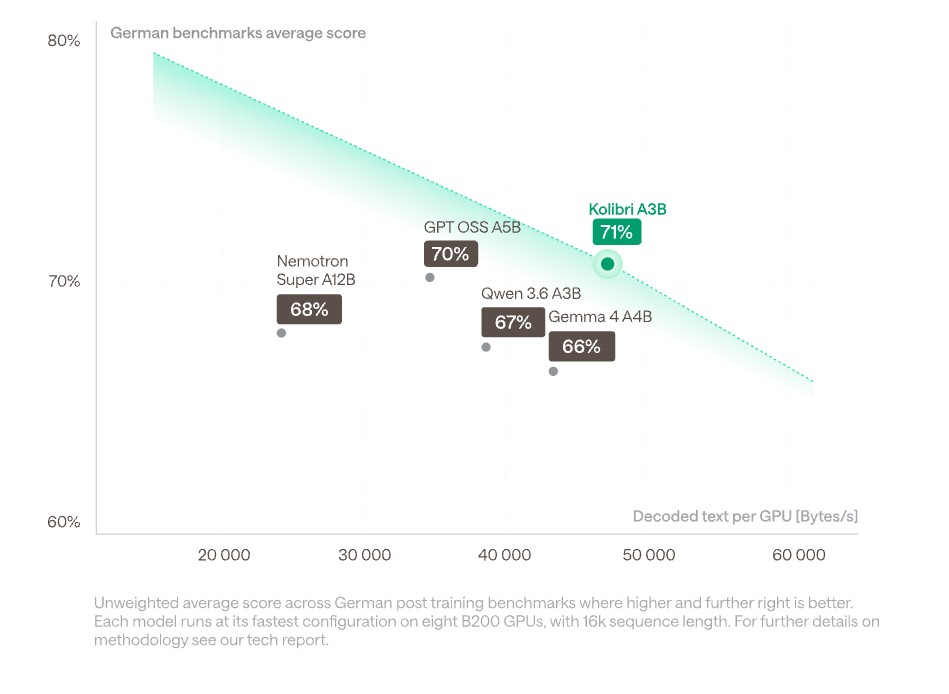
Kolibri scores 71% on German benchmarks while decoding faster than comparable models like GPT OSS A5B, Qwen 3.6 A3B, and Gemma 4 A4B. | Image: Aleph Alpha
Source: the-decoder.com
What the release offers
Kolibri combines a long context window with a relatively compact parameter count. That makes it notable as a model Aleph Alpha is presenting for institutional and industrial use, rather than as a general-purpose consumer product.
The company’s sovereignty framing rests on two concrete details: training took place in Germany and Finland, and the weights are openly available under Apache 2.0. Those facts make the model inspectable and reusable; they do not, by themselves, establish how it will perform in the sectors Aleph Alpha names.
What remains unproven
The announcement gives a clear account of where Kolibri was trained and how it is licensed, but not how it compares with other models on relevant tasks. I think that is the important gap: a million-token context window is a capacity claim, not evidence that the model can reliably use a million tokens for government, aviation or industrial work.
The release also leaves open what “developed with European laws and the EU AI Act in mind” means in practice. For buyers, the harder test will be whether the model’s capabilities and deployment terms meet their requirements—not simply whether its development was European.
Daily AI news
Every day we pick what actually matters in AI and explain it plainly — no hype, no filler. Subscribe if you want to follow where the industry is going.
Only what matters — every day
Follow on X