

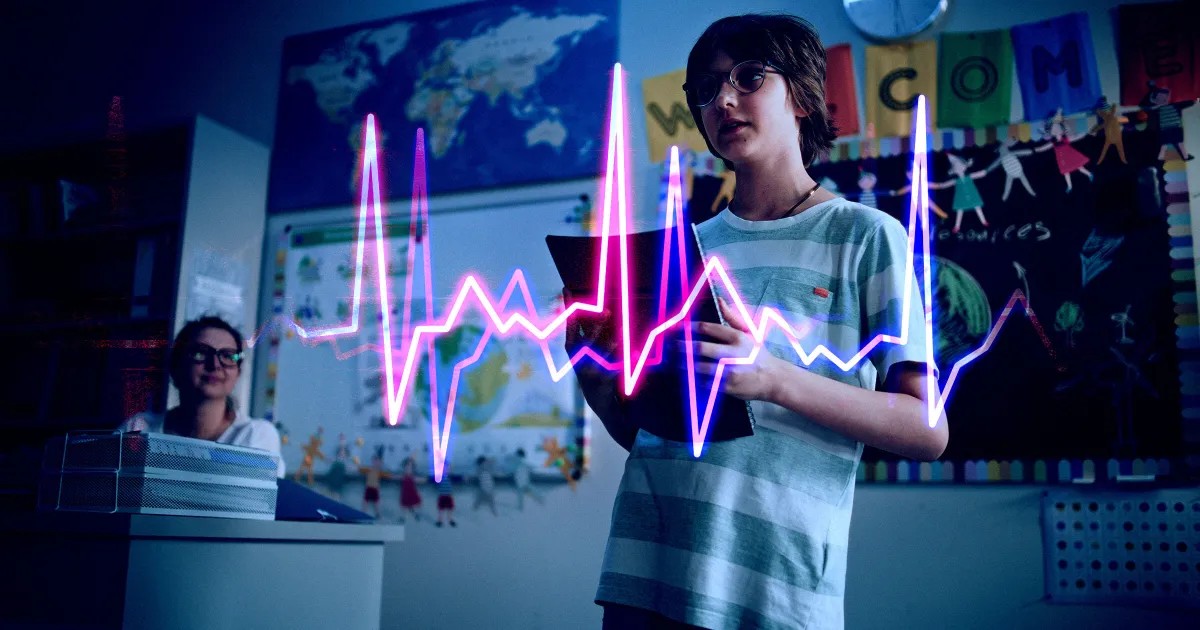
To win a place in the upper grades at Alpha School, a private US company running schools from kindergarten through 12th grade on an AI-led learning model, applicants sit in front of their classmates wired to a heart rate sensor while a pre-recorded video plays of their parents criticising them. Passing means holding your pulse within 10% of your own baseline. One student, whose resting rate was 80 beats per minute, had to stay under 88. The detail comes from the reporter Riley, who followed prospective students' social media accounts and documented an eight-week admissions "intensive" that reads less like orientation than hazing.
Source: futurism.com
That student finished with an average of 87 — through by a single beat. His hands shook for the rest of the day.
What educational purpose the test serves, and what happens to a student who fails it or fails the intensive outright, is not established. Alpha School did not answer Riley's query. One of the students said the eight weeks were meant to prove he deserved to study there.
The social media work came first. One task required a candidate to open a new account on X, formerly Twitter, reach at least 100 genuine followers, pay for X Premium, and post an unspecified number of replies to large accounts publishing substantive material. A student explained that replies along the lines of "Great post" did not count. Buying followers or spamming meant automatic failure.
Riley also found that Alpha School requires students to clean restaurant kitchens or gas station bathrooms without pay, presented as a test of grit and willingness to work. Two students confirmed the assignment included filming themselves doing it and narrating as they went. Any complaint or negative remark on camera was an automatic fail. The menu of available jobs included:
mucking out stables;
scraping grease traps after a restaurant closed;
washing dumpsters;
cleaning gas station toilets.
Students were also offered the chance to finish an entire unit of a standard Advanced Placement course with no teacher, using only AI chatbots, and sit the exam within five days. A 14-year-old wrote that he additionally had to spend three days in an unfamiliar stretch of wilderness with nothing but three bags of rice and a tent.
Asked to comment on the material, Alpha School's representatives accused the journalist of daring to write about minors' activity on social media. A representative said Riley should weigh the ethics of disclosing information about minors and that anything published had an obligation to protect their identities.
That response is the most revealing thing the school has said. Presented with a description of children being monitored for physiological distress in front of an audience, the institution's stated ethical concern was the reporter's conduct. It is not a denial. It does not dispute the heart rate test, the unpaid shifts, or the wilderness assignment. It relocates the ethics question onto the person asking it — a move that only works if nobody notices the school never answered the first one.
The other thing worth holding onto is how little AI is actually doing in any of this. Of everything described, exactly one item is academic: finish an AP unit with chatbots in five days. That is a test of how good the chatbots are, not of how good the school is, and the school's contribution is mainly the deadline. The rest — the follower count, the grease traps, the pulse threshold — is a compliance regime. A model that claims AI can compress schooling has to explain what fills the space it frees up, and here the answer appears to be unpaid labour and endurance trials.
The educator and journalist Audrey Watters, writing about Riley's piece, said Alpha School's promises have always looked mostly like selling snake oil, and that the idea of AI delivering fast, high-quality education resembles science fiction more than reality. She added that what is happening at Alpha School cannot be explained away as simply ignoring unfavourable forecasts in the hope that luck holds for a chosen few and the industry turns back in the school's direction. Her assessment is that the project has no moral compass at all.
Schools that promise a radical shortcut have always needed a second product to sell alongside it, because parents who buy the shortcut still want to believe their children are being hardened by something. Alpha School has found one. The heart monitor is not a failure of the AI model; it is the part of the model that the AI cannot do.