

Google DeepMind has released AlphaGenome 2, a model for genomic research that estimates how DNA variants affect individual human cell types. It analyzes a cell’s state, gene activity, DNA packaging and chemical marks on DNA. In tests, AlphaGenome 2 identified almost twice as many significant variants as its predecessor. The model is available for non-commercial research through an API; commercial users have closed early access.
AlphaGenome 2 links genetic variants to specific cell types
Every cell in the body has the same DNA, but different cell types switch different genes on and off. A heart muscle cell and an immune cell therefore use the same sequence in different ways. Predicting these differences remains an open challenge in genomics. Google DeepMind trained AlphaGenome 2 on more than 107 million single-cell profiles from 68 human and mouse tissues. The model is intended to help researchers identify cellular mechanisms behind disease.
From tissues to individual cells
The previous AlphaGenome took a DNA sequence one million letters long and predicted its properties across thousands of experiments involving different tissues. According to Google DeepMind, this approach spread the model’s capacity across many tasks and made it harder to capture subtle differences between closely related cell types.
AlphaGenome 2 works conditionally: alongside a DNA sequence, it receives information about a specific biological state and predicts effects for one cell type. The model evaluates not only gene activity but also the physical packaging of DNA in the nucleus: its predictions can show which parts of the genome are accessible. It also predicts DNA methylation — chemical marks that help switch genes on and off.
The model can reconstruct missing data from a single measurement. For example, if researchers know only a cell’s gene activity, AlphaGenome 2 can estimate additional properties, including how tightly particular regions of DNA are packed. This helps researchers decide which laboratory experiments to run next.
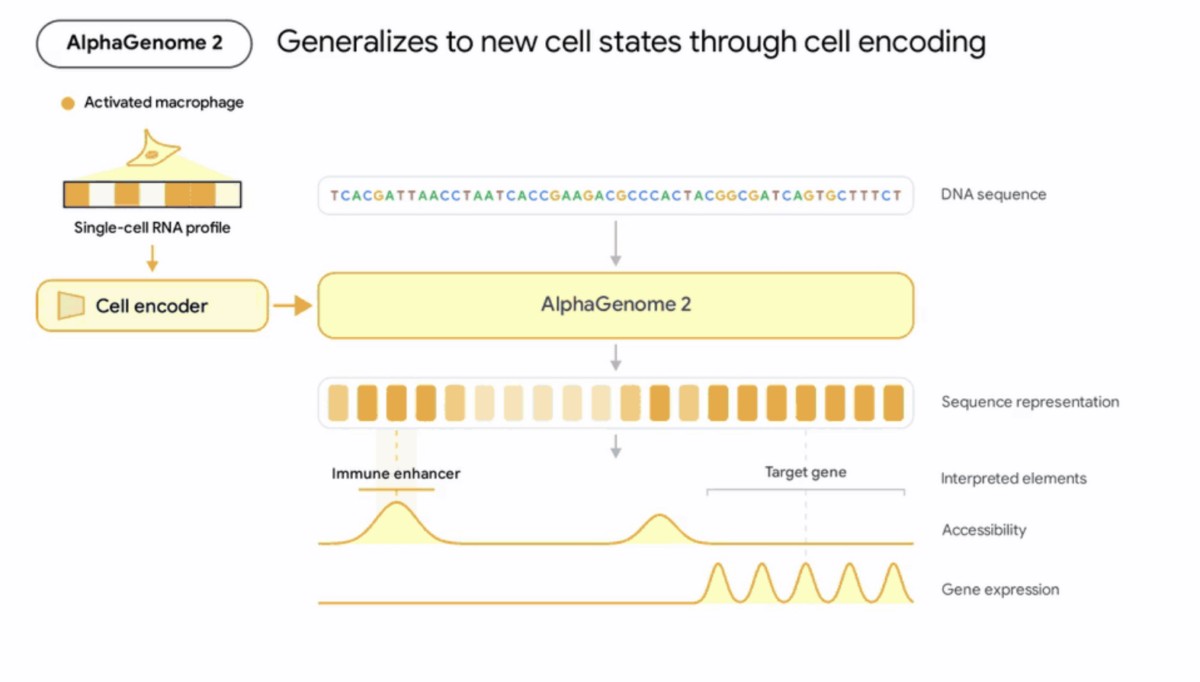
AlphaGenome 2 no longer calculates DNA effects broadly across many tissues at once but instead targets a specific cell state fed in as an additional condition. | Image: Google Deepmind
Source: the-decoder.com
More accurately identifies disease-linked variants
On the TenK10K benchmark, which includes 28 primary immune cell types, AlphaGenome 2 identified about 30% of causal variants. In 43% of cases, it also correctly predicted whether a variant increased or decreased gene activity. A fine-tuned version of AlphaGenome 1 scored 16% and 23%, respectively. The new model also describes continuous changes more accurately — for example, the maturation of blood stem cells into red blood cells.
Using computation, AlphaGenome 2 reproduced a mechanism of inflammatory bowel disease previously described in a study. The model identified a specific DNA variant in a regulatory region located far from the gene: it selectively increased ETS2 activity in intestinal macrophages, with little effect on other cell types and genes.
The model’s architecture lets researchers apply it to new experiments without retraining. They can provide gene activity data from just a few dozen cells, after which the model estimates a cell state it has not encountered before. DeepMind says that on these tasks, AlphaGenome 2 often outperforms specialized models trained directly on the data.
Using data from a study of an mRNA vaccine against COVID-19, AlphaGenome 2 distinguished vaccine-activated T cells from resting cells. It also showed that a gene variant associated with severe COVID-19 disrupts cell function mainly in the activated state. The effect would go unnoticed in resting cells.
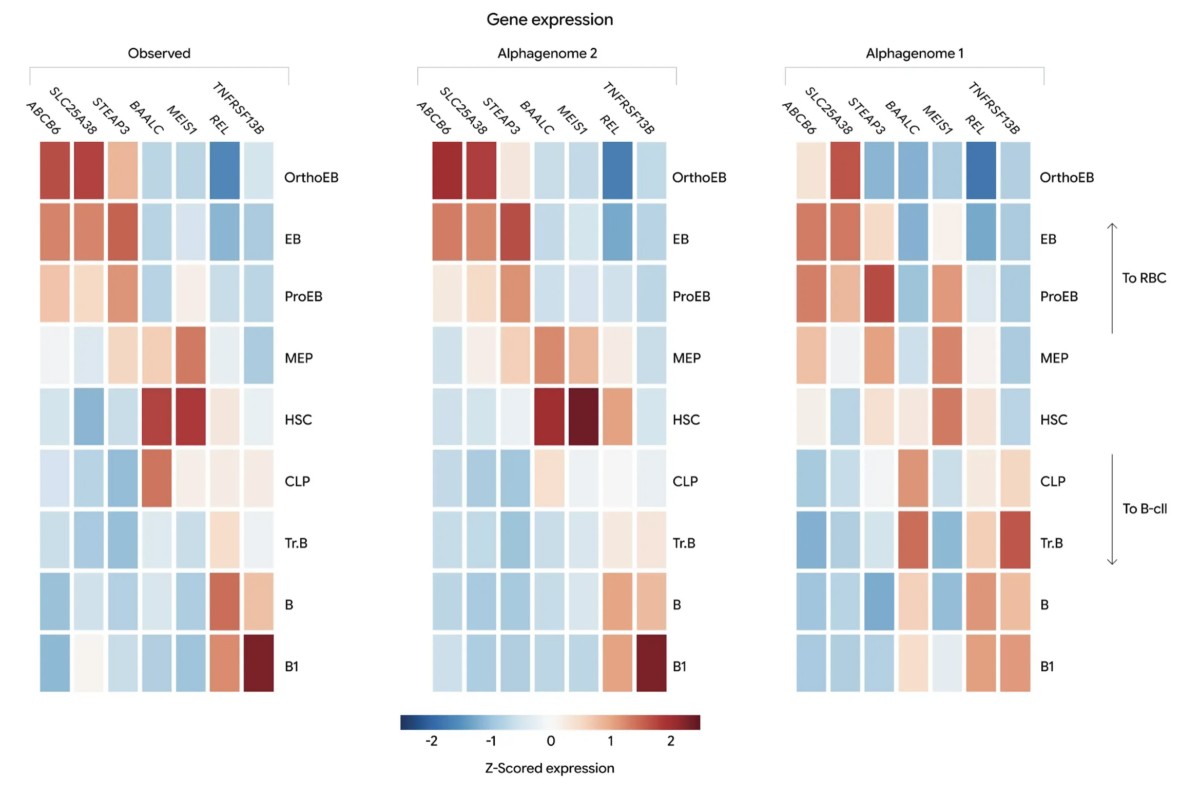
For red blood cell maturation, AlphaGenome 2's predictions (center) are much closer to the observed measurements (left) than those of the fine-tuned predecessor (right). | Image: Google Deepmind
Source: the-decoder.com
From genetic research to target discovery
DeepMind has precomputed predictions for hundreds of cell and tissue states, including to support AI-assisted drug development. The data are also intended for analyzing genome-wide association studies — GWAS. These studies link DNA regions to traits such as height or type 2 diabetes, but often point only to a broad area of the genome. AlphaGenome 2 helps narrow down the search for causal variants and identify the cell types affected — for example, brain astrocytes or specific immune cells. When the model is sufficiently confident, it also predicts whether a mutation increases or decreases gene activity.
AlphaGenome 2 is available through an API for non-commercial research. Commercial users have closed early access; the model is not approved for clinical diagnosis. DeepMind also plans to add dedicated AlphaGenome 2 features to Google’s AI agent development platform, Antigravity, soon. The plan is to combine the model there with tools such as Gemini 4 to automate research workflows.
Dataist’s take: AlphaGenome 2 helps link genetic variants to the cells where their effects appear, sharpening the findings of genomic research. The model is still intended for research: it is not approved for clinical diagnosis.
Daily AI news
Every day we pick what actually matters in AI and explain it plainly — no hype, no filler. Subscribe if you want to follow where the industry is going.
Only what matters — every day
Follow on X