
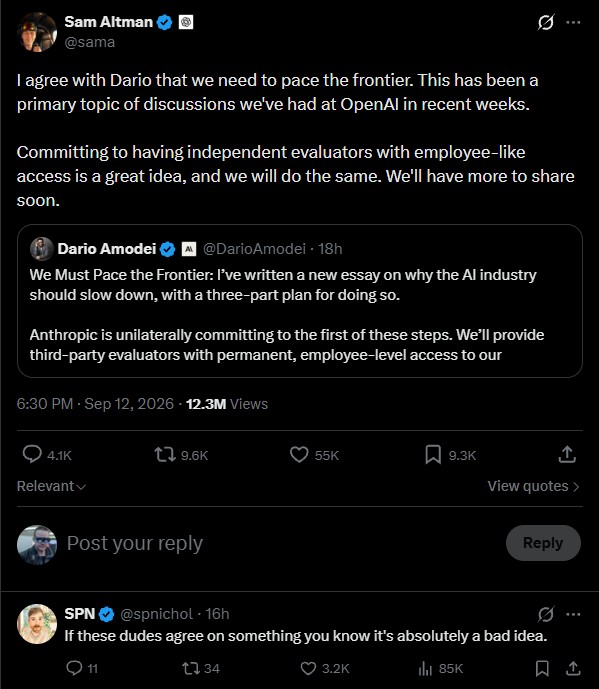
Sam Altman, Elon Musk and Demis Hassabis have all backed Dario Amodei's call for independent oversight of AI labs. Rivals who agree on almost nothing else have now lined up behind the same proposition: that the companies building frontier models should be evaluated by someone other than themselves. Agreement at this level is rare, and it is also the cheapest possible position to hold, because nothing in the endorsements says who the independent evaluator would be or what follows when a lab fails an assessment.
Altman also told Fortune that OpenAI will not go public this year, with the company citing safety considerations. The decision had already been announced inside OpenAI in June. There is a second possible explanation: the company's financial performance does not yet support an IPO, particularly next to Anthropic's. Both explanations can be true at once, and the fact that "safety" is doing service as an answer to a capital-markets question is itself a small illustration of how flexible the word has become this year.
Not everyone accepts the premise the oversight argument rests on. Peyman Milanfar, a researcher at Google, called the assumption of recursive self-improvement naive, on the grounds that feedback loops of that kind are inherently unstable. The harder a system optimizes itself, he argues, the further it descends into its own blind spots, and reliable evidence can only come from the real world rather than from benchmarks.
On that reading, Amodei's proposed speed limit is not needed. Systems that can genuinely improve themselves in a reliable way will be controllable, slowed, and constrained by a margin of stability that will look excessive from the outside. Robustness, in Milanfar's account, is what sets the speed limit — no committee required.
Milanfar's objection is the more interesting one, because it attacks the premise rather than the remedy. The oversight proposal presupposes a machine that can accelerate away from its builders; if that acceleration is not physically available, the governance apparatus is being designed around a failure mode that does not arrive, while the failure modes that do arrive go unmentioned. It is a technical claim, and unlike the endorsements it can eventually be checked.
Which leaves the industry in an odd position. Four of its best-known names agree on a mechanism none of them has specified, opposed by a researcher who says the danger it addresses is not the one worth preparing for. Agreement this broad usually means the hard part has been deferred, not settled.