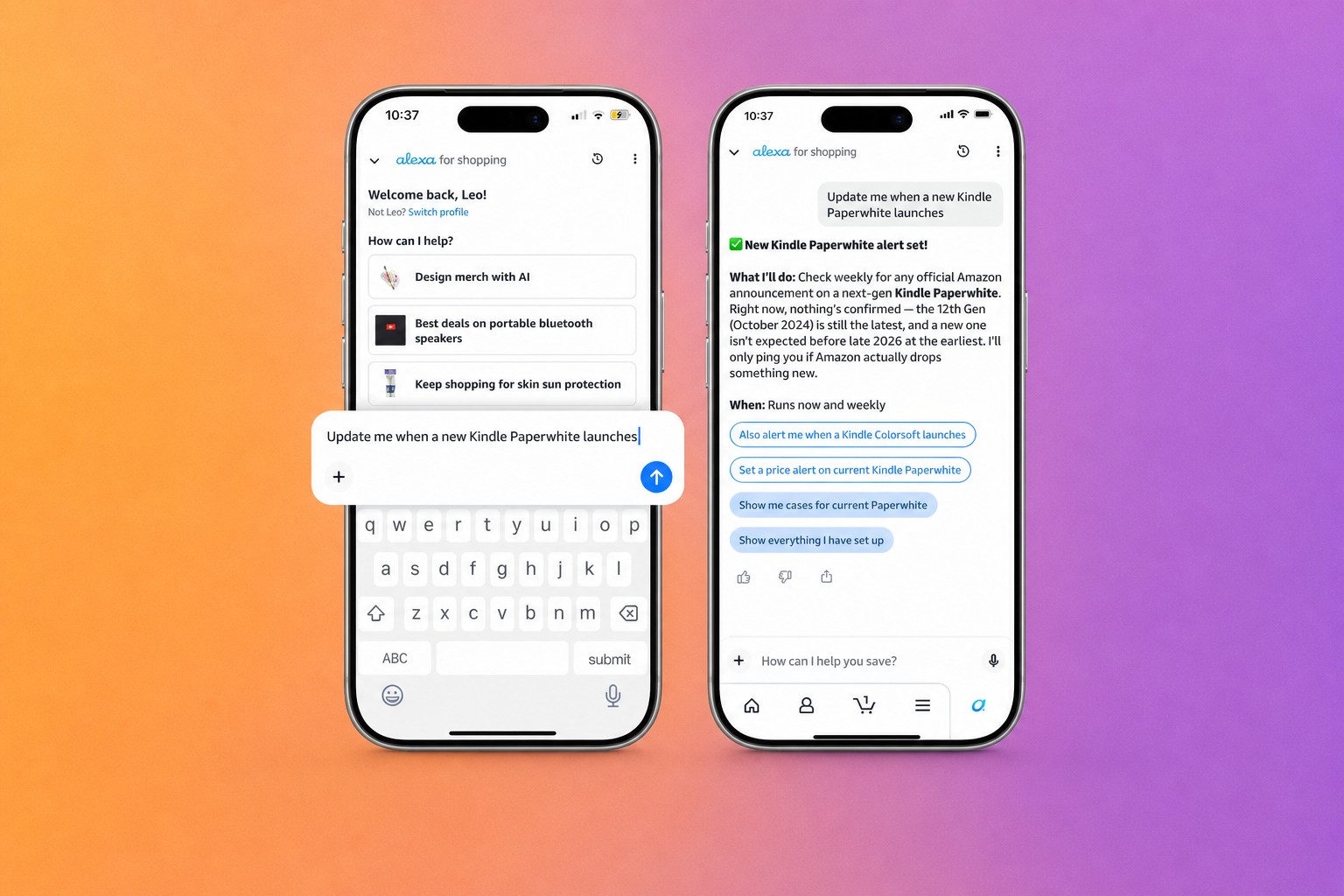
Amazon has given Alexa a new job: spotting the moment that turns a person into a buyer. A feature called Notify me when lets a user register an event worth watching — a new product from a brand they follow, a new season of a show, a tour announcement, a new book from an author they like, a new device from a tech company — and the assistant reports back when it happens. Amazon says it may later create such alerts automatically, or offer them while a customer is browsing products. The mechanic is simple. The change in posture is not: Alexa has stopped waiting to be asked.
Look at what the five watchable events have in common. None of them is a product page or a price. Each is a release: a drop, a premiere, an on-sale date, a shipping date. These are the moments when a customer's intent is at its sharpest and shortest-lived, and until now Amazon only found out about that intent when someone typed or said something. Now the assistant is positioned at the front of the sequence rather than the end of it.
The other half of the loop already exists. Alexa tracks prices: a user can ask to be told when an item drops to a set amount or reaches a set discount, and the assistant will buy it automatically if the condition is met. Amazon also uses Alexa to assemble personalized offers, write shopping guides, rebuild a cart from things the customer bought before, track a product's price history, show AI-generated reviews in search results and on product pages, turn handwritten lists into cart items, and compare products side by side.
Put those pieces next to the new one and the shape is clear. Amazon now has a system that can decide something is about to become relevant to you, tell you about it, and — in the price-tracking case — complete the purchase without further input. The load-bearing sentence in the announcement is not the feature itself but the note that Amazon may generate these alerts on its own. As described, the watchlist is user-authored, which makes it feel like a utility. Once Amazon writes the watchlist, it is a recommendation engine with a notification channel attached, and the difference between the two is the whole product.
Notably absent from the description: any account of whether the notifications are ranked, capped in number, or purchasable. A brand releasing a product has an obvious interest in being the event that pings a customer's speaker, and nothing here says whether that slot is earned by the customer's stated preferences or by something else. For a company whose advertising business sits inside the same storefront, that is not a small omission.
There is a real distinction between the two kinds of alert Amazon is now running. A price-drop notification serves a want the customer already had and was waiting on. A tour-announcement notification supplies the want. Amazon has been very good at the first for a decade; the second is the part it has never been able to automate, and it just wired it into the device in the kitchen.