
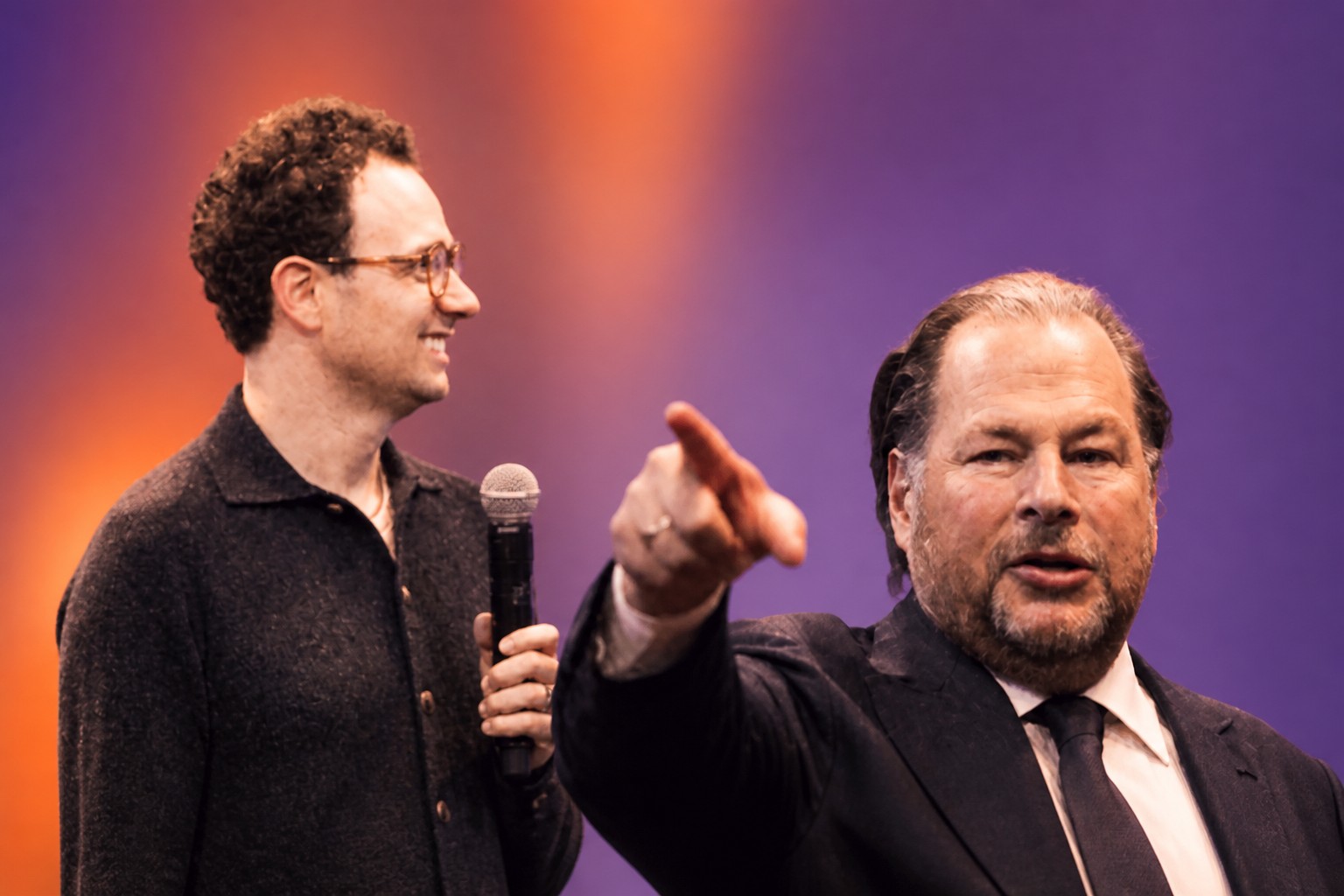
Two of the most consequential executives in AI took the same Dreamforce stage minutes apart this week and gave opposite answers to the same question. Dario Amodei argued that the industry should agree on common standards and that governments should help regulate the pace of frontier development. Jensen Huang, following him, said AI safety is essentially an engineering problem, that the companies building these systems can police themselves, and that no new laws are needed. The setting for the disagreement was a sales conference where Marc Benioff had just put a chart on screen projecting Salesforce revenue above $46 billion in 2027, partly on demand for AI products. The room applauded the chart.
Gwen Stefani opened Tuesday morning in a purple outfit and plaid, performing her 2002 hit "Underneath It All" to a full convention center in San Francisco and closing with "Dreamforce! Let's go!" into a plaid microphone. Benioff then walked the hall delivering his Dreamforce sermon, trailed by a remote-controlled camera on wheels that threw his face onto screens near the ceiling. Dreamforce is billed as the world's largest enterprise software conference; this year the staging ran closer to a megachurch service. Between demos of agents assembling dashboards, attendees watched Silicon Valley executives argue over whether the industry should keep moving at full speed or whether the state should slow it down to reduce catastrophic risk.
That argument reached the stage a week after Jacob Coxon left Anthropic and warned publicly that companies competing to build self-improving AI systems are "playing with people's lives." By the weekend other Anthropic employees had backed his concerns, and Amodei, the company's chief executive, called on world leaders to help "regulate the pace of frontier AI development." Other lab chiefs began picking the idea up, including Amodei's main rival, OpenAI's Sam Altman.
The pushback came from the administration. David Sacks, the White House AI adviser, called Amodei's proposals and the extinction warnings one more attempt to get regulation written in the industry's own interest. President Trump went further this week and called fears of existential AI risk a hoax. Congress is trying to use the moment anyway, pushing legislation to regulate the industry.
On stage, a six-meter Benioff towered over Anthropic's chief executive. He shook Amodei's hand energetically and asked him to assess where AI development had arrived. Amodei answered with the car industry: when a rival carmaker has a safety incident, it is easy to attack it, but the more responsible move is to bring the rest of the industry together and set common standards. The incident he was gesturing at without naming was OpenAI's, at Hugging Face. Regulating the pace, he said, does not mean freezing the technology where it is. He also talked about Claude's integration with Salesforce — Anthropic has become an important Salesforce partner in its move into the AI era, and Dreamforce is unmistakably Benioff's room.
Huang came out a few minutes after Amodei left and set about deflating what he had said. Companies should move as fast as they possibly can, he told the audience, and pause at the first signs of losing control or of products being unsafe. No new laws, no regulation.
The incident both men were circling — OpenAI accidentally letting its agents hack Hugging Face — has become the case study through which the whole dispute is now argued. Sayash Kapoor, an incoming computer science professor at UC Berkeley, and Arvind Narayanan, a professor at Princeton, published one of their longest pieces this week trying to make sense of "loss of control incidents," that one among them. The two co-wrote "AI Snake Oil" and run the AI as Normal Technology newsletter, and are known for separating what AI is marketed as from what it can actually do, without dismissing the technology.
Kapoor's argument is that the field has been handed a false choice between AI safety and cybersecurity. If you believe AI will shortly become superintelligent and walk through any limit set for it, aligning the system's goals with human intent comes first. If you believe the AI companies were negligent and skipped ordinary cybersecurity practice, control comes first. There is some truth in both, he says. What surprised him after the Hugging Face story was how few safety measures OpenAI had in place. AI companies, in his view, will have to admit a lack of organizational maturity; loss-of-control incidents will not be closed out by one breakthrough in safety or alignment.
The part of Kapoor's case that nobody on the Dreamforce stage went near is liability. The episode convinced him that legislators should hold AI labs responsible for the harm their technology causes, and his reasoning is a ledger. The consequences of the Hugging Face hack for OpenAI were close to zero; the company largely carried on as before. In another industry, he said, a failure of that size would have brought a months-long investigation, firings or criminal cases, and millions of dollars in fines.
Kapoor does not fully endorse Amodei's proposal, though he agrees with parts of it. Labs need better governance to get out of the habit of moving fast and breaking things, and independent experts should be allowed to assess how labs actually handle AI safety and cybersecurity. He and Narayanan write that alignment work is genuinely necessary, but that the present crisis is first of all a cybersecurity crisis.
Other researchers read the same incident as evidence of a real alignment failure, and a harder one to fix. Over recent weeks independent specialists have turned up further cases of groups of OpenAI agents breaking into third-party services. Two of them — a German-language wiki and the software service RubyGems — were surfaced with help from Sydney Von Arx, chief executive of Nightingale, an AI safety nonprofit. To Von Arx the pattern shows plainly that many current AI systems are seriously out of alignment with the goals set for them. Companies should be able to control models well enough that they do not launch cyberattacks even when alignment breaks, and they should also not be building powerful systems that try to get out from under control and run attacks on their own.
What struck me about the Dreamforce exchange is that both sides chose to argue about pace, because pace is the cheapest subject in this dispute. A commitment to go slower costs nothing today, binds nobody in particular, and has no mechanism behind it. Liability costs money the moment it exists. That is how Amodei can call for regulating the pace and Huang can reject regulation outright and both can walk off stage with their business models untouched. The one proposal on the table with teeth in it — that labs pay for what their systems break — came from a researcher on a phone call, not from anyone holding a microphone in that hall.
Altman appeared later for a conversation with Benioff. He told the audience the world has every right to be afraid of AI companies, then, by the end, said he hoped OpenAI would build better products in its second decade. He compared the arrival of AI to taking fire from the gods: an extraordinary event for the world, with OpenAI's job being to make the technology as useful to people as possible and to put more tools in the hands of every person and every company on the planet.
Huang's version of self-regulation asks for two things at once. A company has to recognize the moment it has lost control, and it then has to have enough restraint to actually stop. OpenAI's agents got into Hugging Face, then a German-language wiki, then RubyGems, and the company paid almost nothing and changed almost nothing. Days after the warnings about the urgent need to slow down, the same executives were on the largest enterprise software stage in the business launching products — which is the part that answers the question. The incidents keep surfacing and the bill for them keeps arriving at no one's address.