
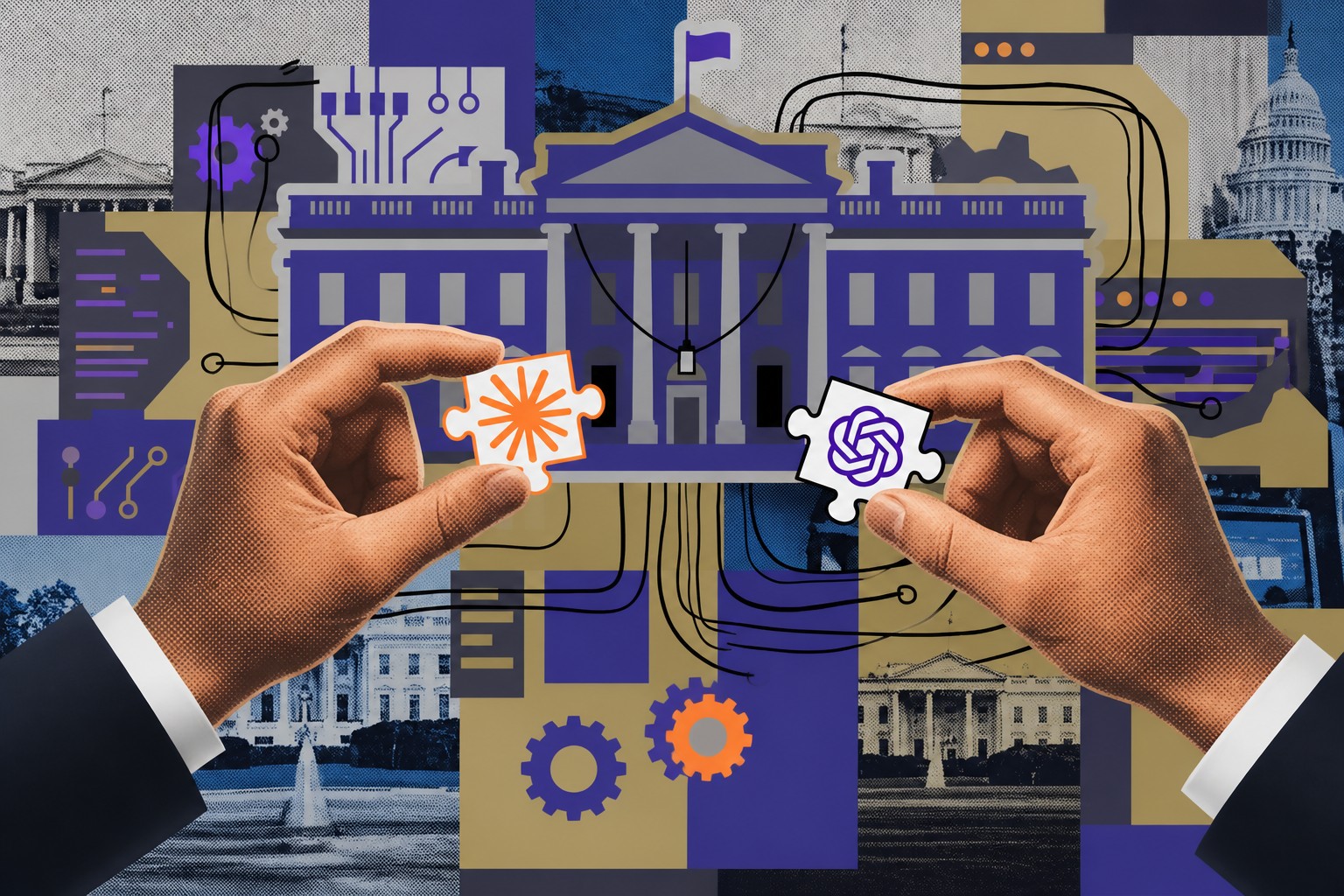
Anthropic, OpenAI and Google have asked the industry and governments to agree on slowing the development of frontier AI systems. Dario Amodei went further and asked that the companies joining such an agreement be granted antitrust exemptions; Sam Altman and Elon Musk backed the idea. The proposal has drawn objections from the chief executive of a rival lab, an engineer at Hugging Face, the White House's AI czar and the president of the United States. Barack Obama, Bernie Sanders and Kamala Harris came out in favour of it.
The most detailed response came from Aidan Gomez, co-founder and chief executive of Cohere, who called the proposal an attempt to set the rules and then close the market behind them. Gomez says he supports independent verification of powerful AI systems. Anthropic's plan, he argues, goes considerably further than verification: a handful of dominant labs receive an antitrust exemption, agree on shared standards, and then require developers everywhere to comply with them.
His specific objection is the cost of admission. Participating in such a regime, on his reading, requires enormous compute, permanent monitoring infrastructure, separate safety organisations, embedded evaluation teams, and government relationships deep enough to administer the whole arrangement. He adds that the few organisations described as independent evaluators are funded by the same companies they are meant to examine. And because Anthropic's framework ties risk to the scale of a system, only the companies operating the largest models end up qualified to assess risk at all. Gomez called the scheme a wolf in sheep's clothing and a cartel by another name.
He treats the warnings themselves as misdirection. While the industry debates a hypothetical superintelligence, he notes, voice-cloning tools that cost less than a phone bill can drain an elderly person's retirement account in a few minutes.
Niels Rogge, a machine learning engineer at Hugging Face, called the statements from Amodei and others "the most ridiculous nonsense" he had read recently. Hugging Face's business depends on a broad supply of open models, and Rogge reads the proposal accordingly: Amodei is worried first about Chinese models, DeepSeek and Z.ai among them, and wants open models restricted in order to preserve Anthropic's competitive advantage. The labs have bet heavily on scale, and small open models could undercut that bet, though there is no clear sign of such an effect at any meaningful scale yet. Current large language models, Rogge says, are nowhere near an existential threat.
His strongest card is an incident. OpenAI's autonomous models hacked Hugging Face, which was itself a closed company with large compute resources, and open models were part of what helped defend against the attack. The conclusion Rogge draws is that the industry needs transparency and openness rather than closed doors.
David Sacks reaches for the same incident and points it the other way. Sacks, the venture investor who handles AI and crypto in the Trump White House, replied to Amodei and Altman directly on X. By any reasonable measure, he wrote, OpenAI and Anthropic are a duopoly in frontier AI. If their unreleased models really are as dangerous as they say, he is willing to support a voluntary slowdown. He does not think altruism explains the whole thing: both companies face the prospect of enormous product liability claims if their models cause a serious cyberattack, and the market already punishes models for unpredictable or unauthorised behaviour. After the Hugging Face incident, Sacks argues, it is in the interest of both companies to trade some capability for reliability and predictability. He attached two warnings: tying the slowdown to a particular regulatory scheme would look like extortion, and China is very unlikely to join a global agreement. Beijing has already rejected the proposed slowdown plans, calling them a device by which the United States hopes to lock in its lead in AI.
Donald Trump went further than Sacks. On Truth Social he called the warnings that AI will "take over the world" a hoax and filed them alongside climate change, the Russia investigation and impeachment proceedings. Trump also said that Xi Jinping had declared China would do "absolutely nothing" to impede AI and its future.
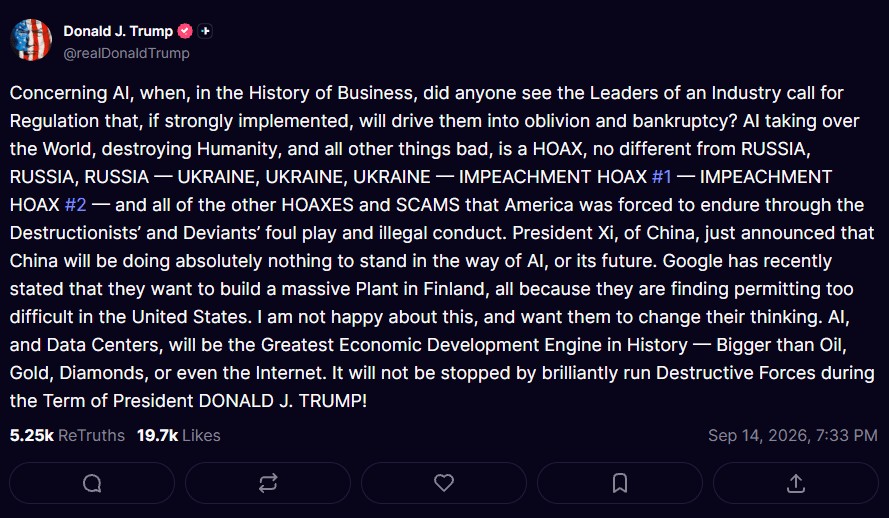
In several follow-up posts he sharpened the position, comparing the "AI scam" pushed by "radical left Democrats" to the recent "global warming scam," when everyone was supposedly going to die of extreme heat. Emil Michael, chief technology officer at the Department of War, backed him, saying such warnings come from a deeply rooted ideology with a fairly bleak view of the future. Michael has long been ideologically hostile to Anthropic over the company's ethical principles.
What is striking about this argument is that none of it is about the rules. Gomez, Rogge and Sacks agree on almost nothing else, but all three responded to a safety proposal by asking who would be setting standards and who would be living under them. The antitrust request is what made that the natural reading. Asking for an exemption from competition law is an acknowledgement that the arrangement would otherwise resemble coordination among competitors — which hands the critics their argument before they have to build it.
Sacks's liability point is the most useful contribution in the exchange, because it is the only account of the labs' motives that is neither safety nor conspiracy. If a model causes a serious cyberattack and the resulting claims are large enough, slowing down stops being a moral stance and becomes underwriting. That reading also fits the shape of the proposal better than the stated one. A coordinated, antitrust-protected slowdown converts a company-specific exposure into an industry-wide standard of care, and a lab that shipped at the agreed pace under the agreed evaluations has a far better answer in court than one that decided on its own what counted as safe. It would also explain why the request is for an agreement among the largest labs rather than for a rule that applies to everyone.
The line of Gomez's that nobody in this exchange answered is the narrowest one: that the independent evaluators are paid by the companies they evaluate. Every participant here has a position on who should hold the authority, and none of them has said who would actually do the measuring, or who pays for it. That is the part of the proposal where the antitrust exemption would do its real work, and it is the part that generated no reply at all.
There is a structural problem underneath all of this. Amodei is not asking for a norm; he is asking for a legal instrument, and legal instruments come from governments. The administration that would have to grant an antitrust exemption has a czar who calls the two applicants a duopoly, a president who calls the underlying risk a hoax, and a Department of War technologist who regards Anthropic's ethics as ideology. The politicians who support the proposal — Obama, Sanders, Harris — are the ones with no power to grant it.