

From archive to useful notes
When working with an AI agent on a project over several days, a problem arises: each new session starts without the context of the previous one. In a research publication, Anthropic describes a way to preserve knowledge between sessions without changing the model itself: Claude writes notes to a folder and can then read them before starting a new task.
The main challenge is deciding what to save. An agent has to estimate the potential value of each note in advance, without knowing what it will need later.
In a Pokémon Red test, an older model, Claude Sonnet 3.7, considered almost everything important. Over roughly 10,000 steps in the game, it created 413 files in 225 folders—often a separate file for each battle and item it found. The game situation kept changing, so the notes quickly became outdated. Sometimes the model spent time only rearranging notes and finished the game with one badge.
The newer Claude Fable 5 used just a few files and earned four badges. It did not record information already visible on screen, instead saving plans, strategies, and verified rules. However, Anthropic’s comparison is based on just one playthrough for each model.
The company advises explaining to Claude what its memory is for and letting the model decide how to use it. According to Anthropic, in one benchmark, rigid instructions such as “only record mistakes” deprived stronger models of much of their advantage. Clear instructions helped older models, by contrast—for example, telling them to read the notes before every response.
How Dreaming corrects errors
Unreliable notes are dangerous because an agent may trust them in later sessions without checking them. Dreaming, an approach based on research by Letta and the University of California, Berkeley, is intended to help address this problem. During a pause, Claude reviews transcripts from previous sessions and checks its notes against them.
In a Pokémon test, the model made a mistake about which side of a mountain a landmark was on. Relying on the incorrect note, Claude fell into the same trap three times, eventually wanted to give up, and failed to reach its goal. After Dreaming processed the information, the model compared the note with the transcript, found the error, and took the right path.
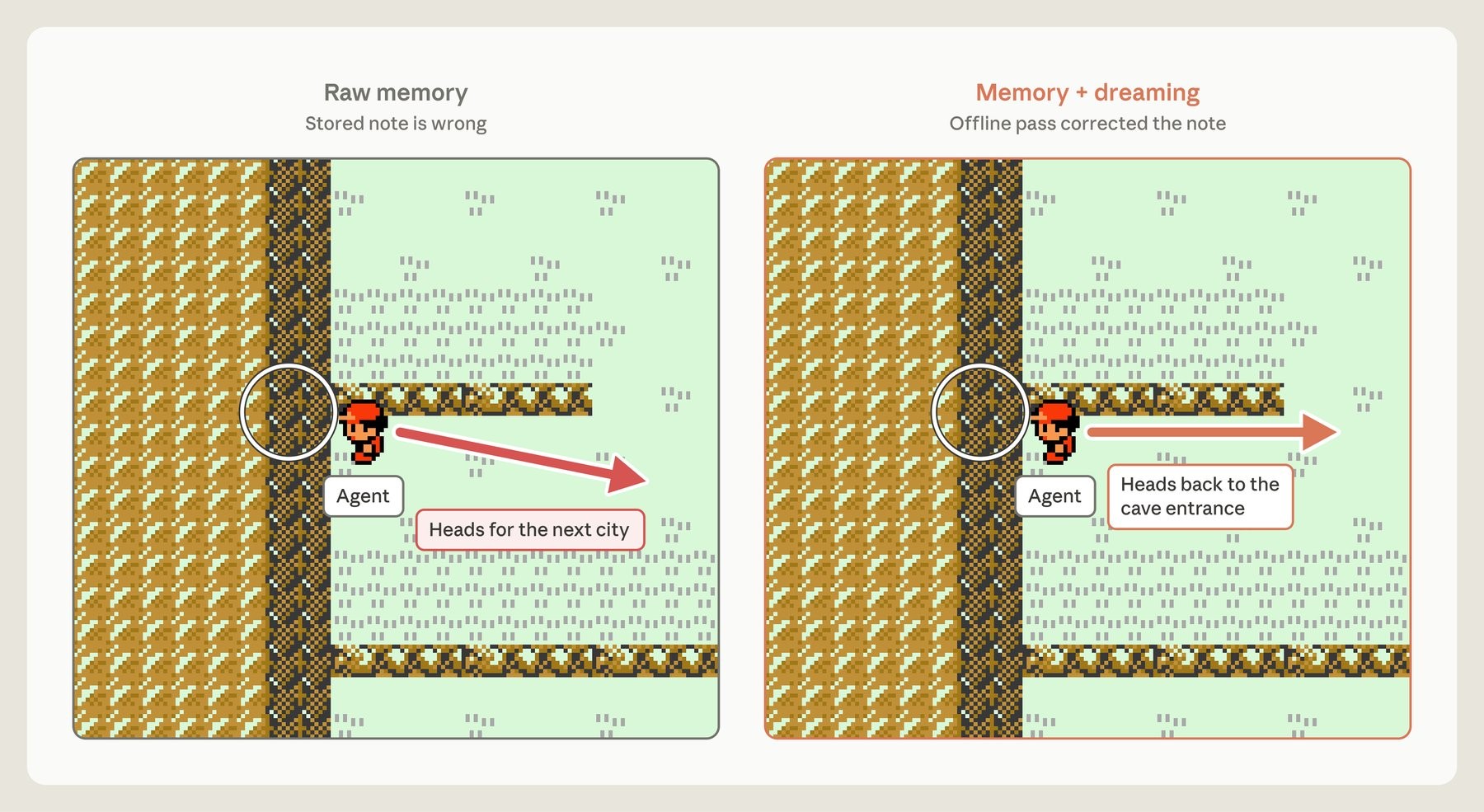
A wrong note about the Pokémon Center's location caused Claude to repeatedly fall back over a ledge. | Image: Anthropic
Source: the-decoder.com
Dreaming can also organize large knowledge bases. Claude created a linked wiki from roughly 350,000 internal documents belonging to Stainless, a software development company acquired by Anthropic. The system is meant to create new pages while also addressing gaps, duplicates, and broken links. It was most useful when Claude could combine the wiki with search: the knowledge base supplemented search rather than replacing it.
In a separate legal test, the wiki was especially helpful for questions that required gathering information from several documents. Claude scored 87% with it, compared with 73% using search alone. For simple search queries, the wiki performed about as well as search, and in one case grew larger than the original documents.
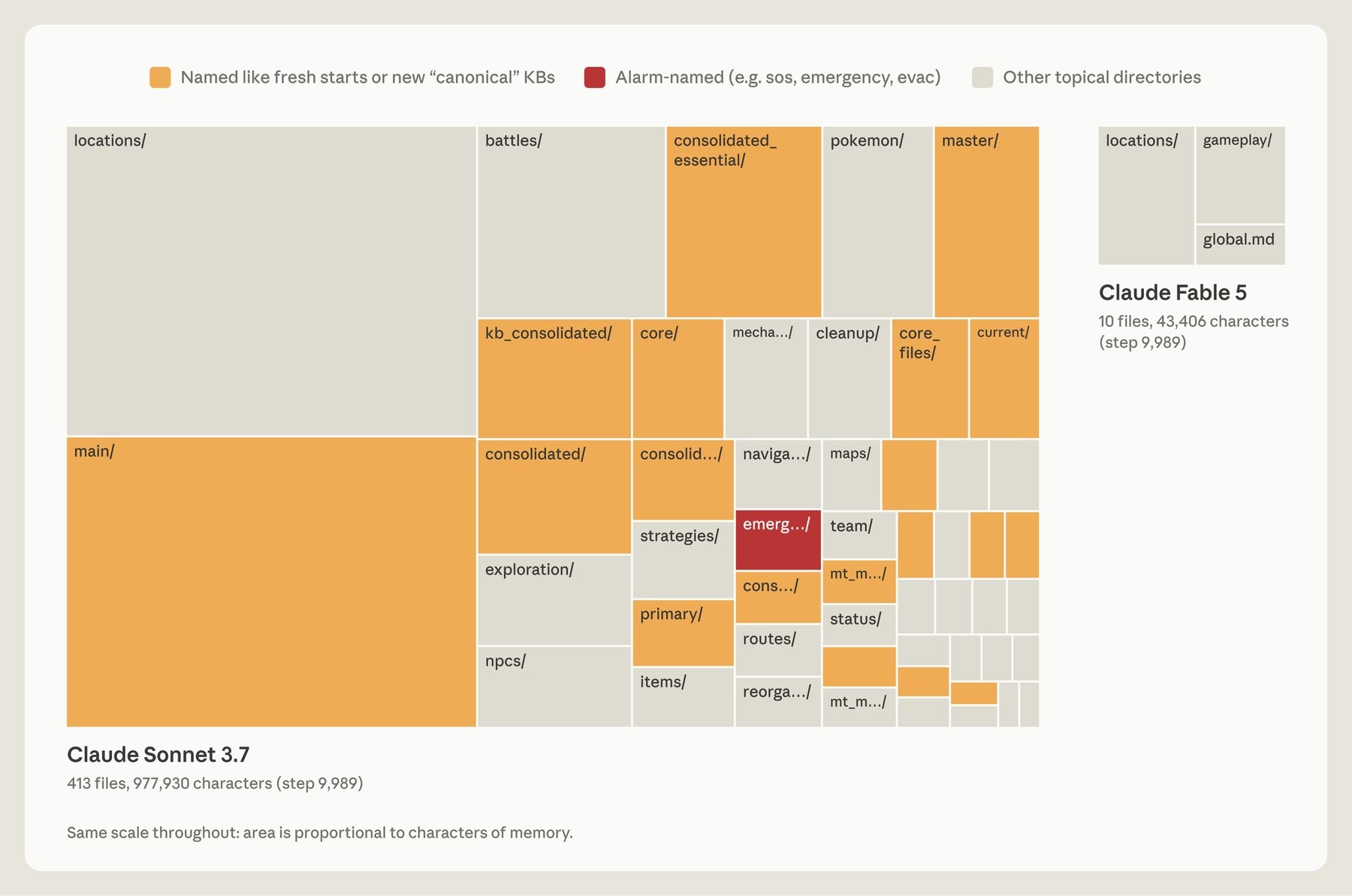
Sonnet 3.7 saved nearly everything while playing Pokémon, whereas Fable 5 saved only strategies and verified rules and got much further. | Image: Anthropic
Source: the-decoder.com
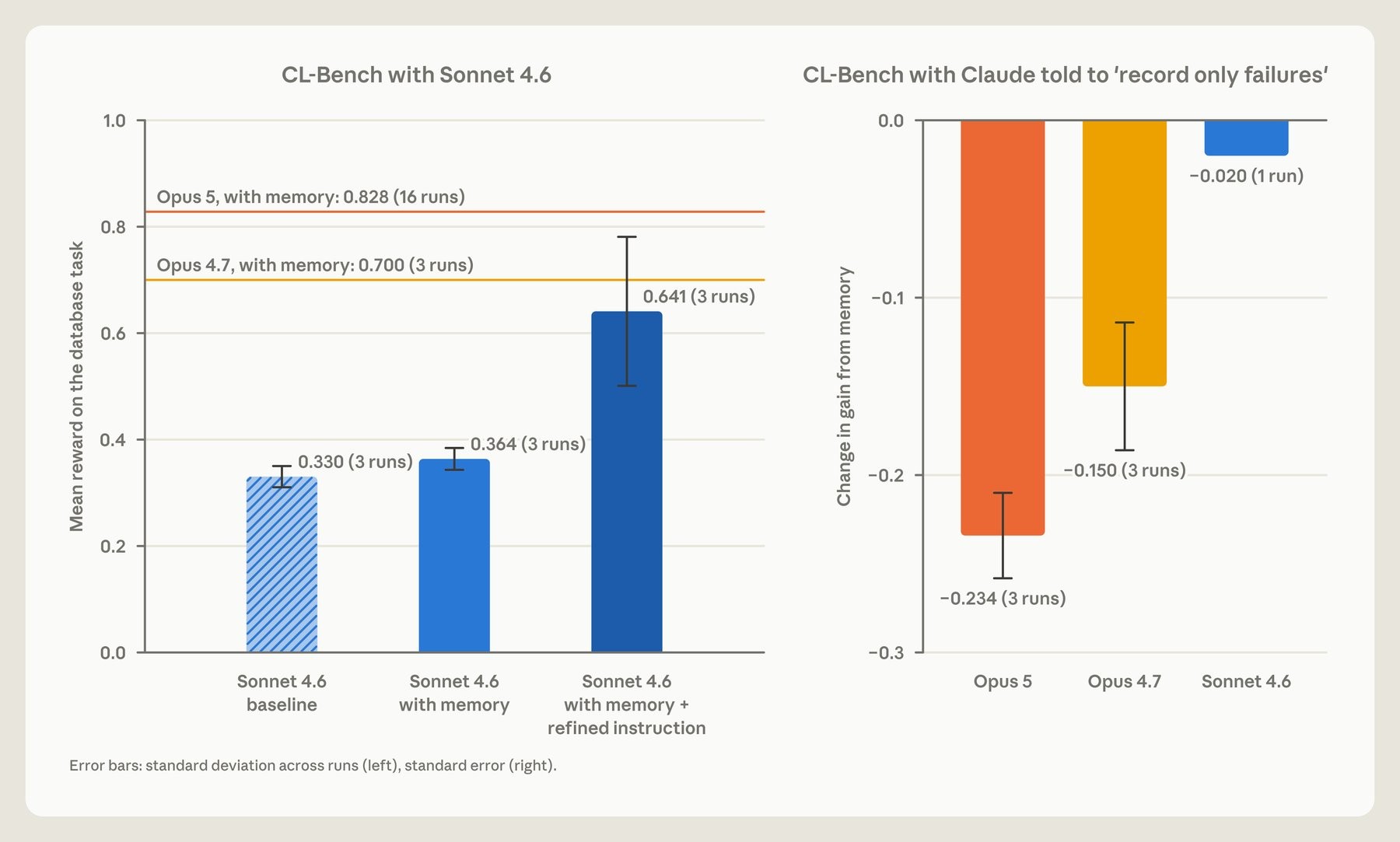
Specific memory rules help older models, while stronger models perform worse with rigid instructions. | Image: Anthropic
Source: the-decoder.com
The limits of memory
Anthropic acknowledges that the approach leaves open questions. Writing notes during a task distracts the agent, Dreaming requires additional computing resources, and results take time to appear. Wikis and notes need regular updates; otherwise, errors and hallucinations accumulate. The company also warns against automatically loading too many memories into every session: they take up context, and an incorrect note can carry over into every subsequent session.
Anthropic conducted all the tests described here. In May, the company introduced Dreaming as a research preview for Claude Managed Agents, its cloud platform for AI agents. The service reads an existing memory store and up to 100 past sessions, removes duplicates and outdated notes, and creates an organized store without changing the original. At launch, Dreaming supported only Claude Opus 4.7 and Sonnet 4.6.
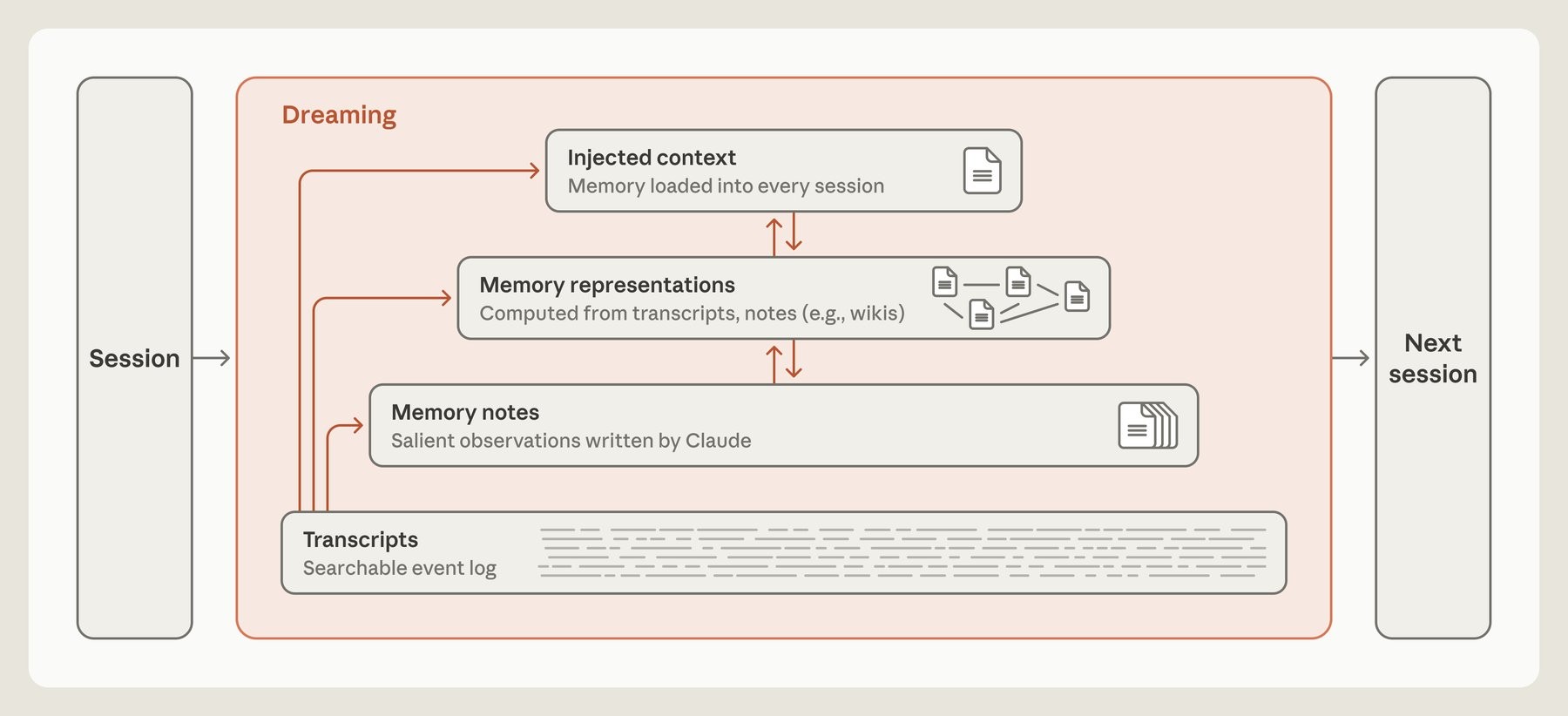
During "Dreaming," Claude processes old transcripts in idle periods and builds the upper layers of its memory from them. | Image: Anthropic
Source: the-decoder.com
Other companies use the word Dreaming for different features. OpenAI uses it for ChatGPT’s memory, overhauled in June: the system maintains a user profile in the background and automatically corrects outdated information. According to OpenAI, temporal accuracy rose from 52.2% to 75.1% as a result.
Researchers at Google and Google DeepMind also let AI agents “dream,” but use the process to improve search strategies. An agent considers alternative solutions based on results already saved, without querying the model again. Google also created WikiSkill, a wiki for agents. As in Anthropic’s system, it stores original transcripts, summarized knowledge, and specific instructions separately.
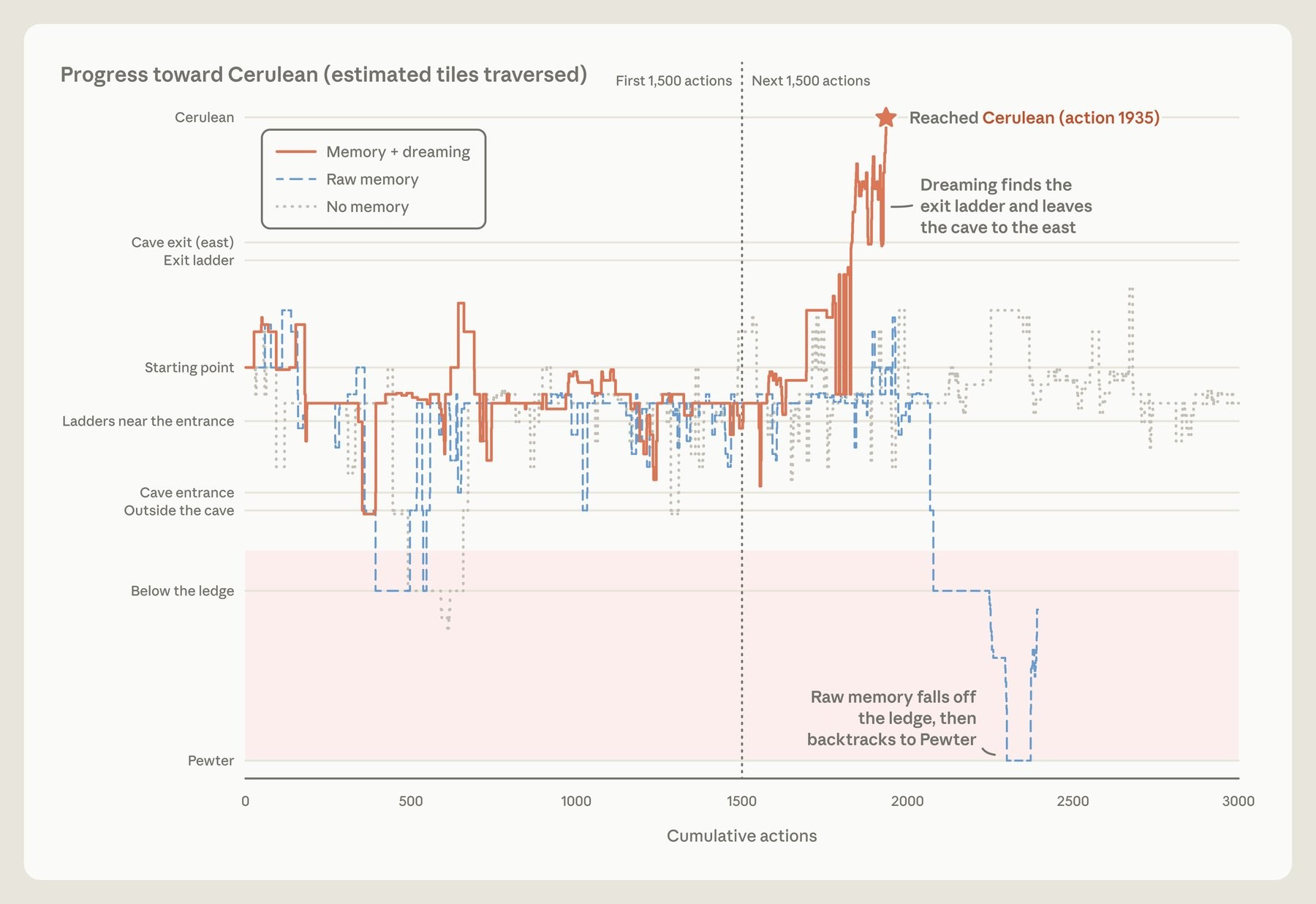
Claude made it past Mt. Moon to Cerulean City only with the note Dreaming had corrected. | Image: Anthropic
Source: the-decoder.com
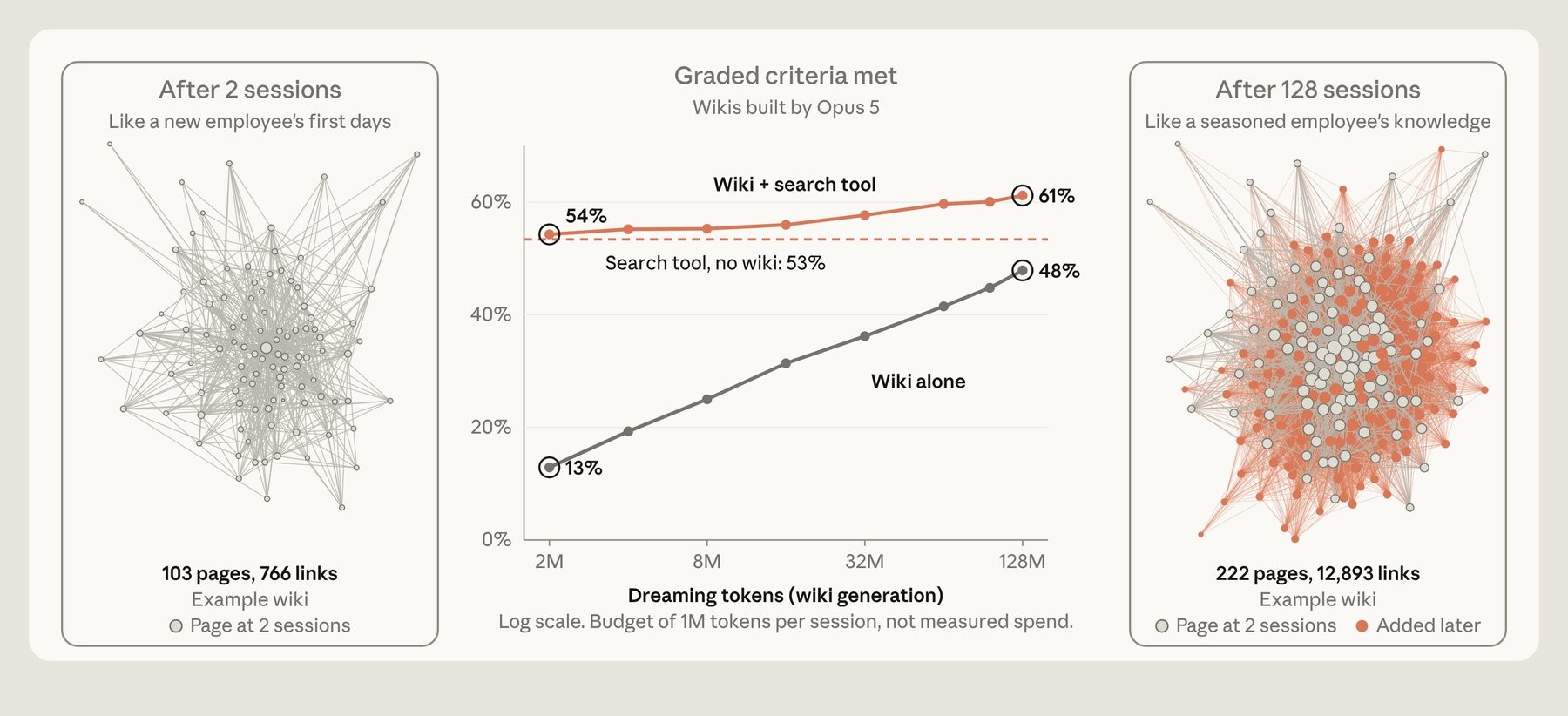
The longer Claude worked on the wiki of Stainless documents, the better it answered questions, with the best results coming from combining the wiki with search. | Image: Anthropic
Source: the-decoder.com
Dataist’s take: Anthropic’s results point to a practical trade-off: memory helps when an agent saves selected information and checks it later, but does not guarantee accuracy on its own. So far, the tests have been conducted by the company itself, while additional computation and processing delays remain limitations of Dreaming.
Daily AI news
Every day we pick what actually matters in AI and explain it plainly — no hype, no filler. Subscribe if you want to follow where the industry is going.
Only what matters — every day
Follow on X