
A factory that needs fewer workers
Anthropic’s September threat assessment describes networks of fake social profiles and news sites built with Claude to target audiences on six continents. The company says those behind the activity included governments, state-linked propaganda groups and media, and private firms selling influence services.
The Malaysian outlet reportedly collected genuine stories from local publications, asked Claude to rewrite them several times, then republished them under invented bylines. It also stripped source information from articles by TV BRICS, Xinhua, Sputnik/RIA and CGTN.
That workflow matters less as a novel technique than as a cheaper one. Rossine Fallorina, of the Philippine AI research centre Sigla, compares it to a troll farm: instead of a ten-person team producing and distributing a story, one person can start with a prompt.
AI still needs a channel to reach people. Former Meta elections policy executive Katie Harbath says social media remains the main one, even as AI makes content faster and cheaper to produce and tailor to particular people.
Existing divides, coming elections
Southeast Asia has a long history of disinformation. Nobel laureate and Philippine journalist Maria Ressa has called the Philippines a “petri dish” for fake news, saying methods tested there were later used successfully in the West.
The concern is not limited to fabricated news sites. In the past year, OpenAI blocked accounts that used AI to post comments about Philippine politics and government officials; many of the fictional comments supported President Ferdinand Marcos Jr.
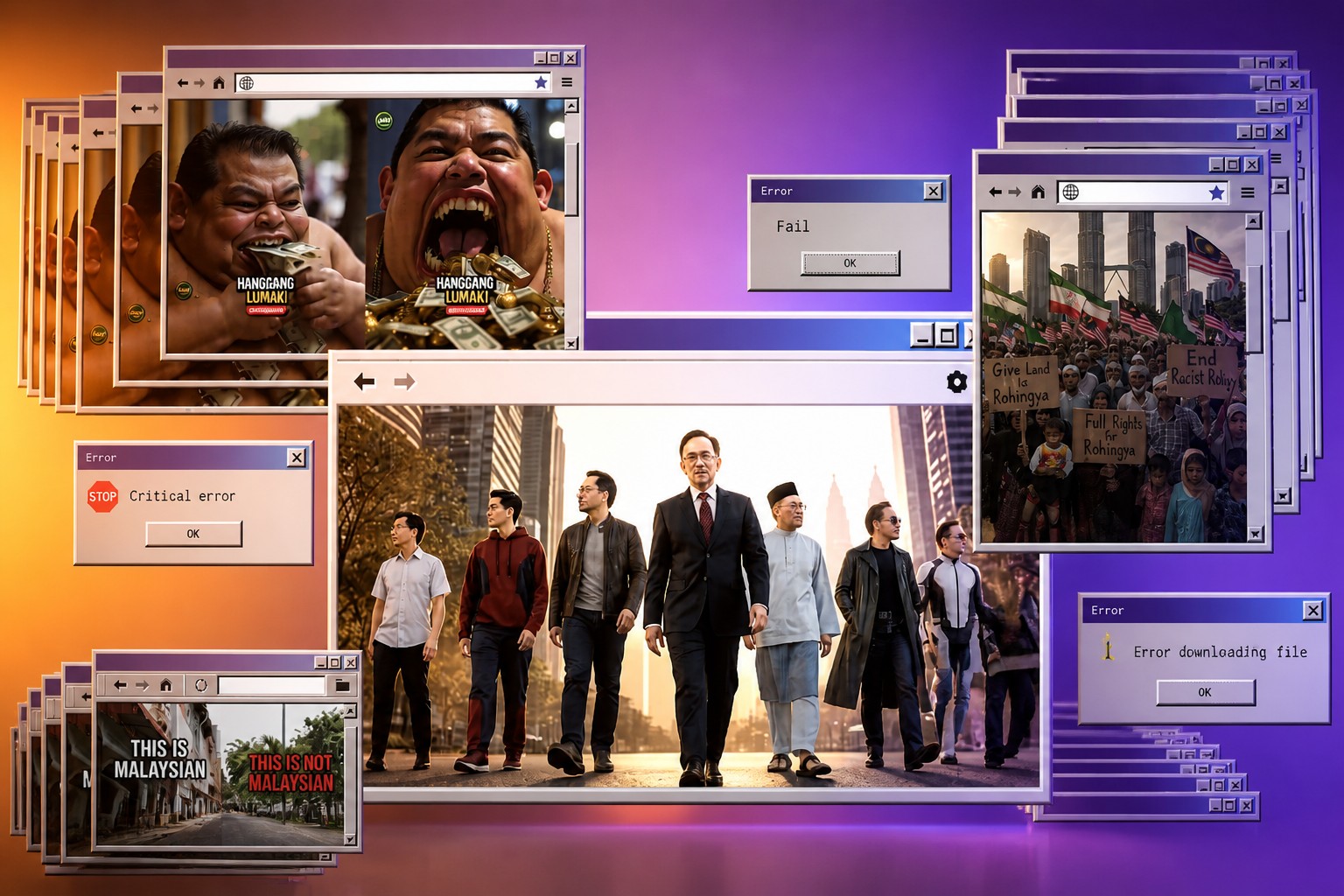
AI has also been used in sharply different ways. During Indonesia’s 2024 election, an AI-generated cartoon image of current president Prabowo Subianto became hugely popular and helped soften his strongman image. Ben Lo, a media lecturer at Monash University Malaysia, says AI has also been used to stir hatred against Rohingya refugees who fled Myanmar for Malaysia during the civil war.
Lo’s point is that synthetic content does not need to persuade someone from scratch. People who already hold hostile views may see it as confirmation, even when they know it was made with AI.
The timing matters: Malaysia’s next general election could take place in late 2027; the Philippines and Cambodia vote in 2028, followed by Indonesia in 2029. Bridget Welsh of the University of Nottingham Malaysia’s Asia Research Institute says AI can feed political polarisation by exploiting existing divisions, and that Malaysia’s fragmented information environment is particularly worrying.
The contest may move upstream
Anthropic says it disrupted all identified political influence operations, used what it learned to strengthen safeguards and, where appropriate, shared information with authorities and industry partners. That response addresses the accounts and content the company found. It does not settle how influence campaigns might adapt as AI tools become more capable.
Harbath’s concern is that operators could try to “fill the information space” and shape what large language models draw on. The strategy would be especially cheap where news is scarce or state-sponsored outlets dominate.
I think that is the more consequential shift in the case: the target may not only be voters scrolling social media, but the information environment that future AI systems rely on. If a campaign can seed enough material at low cost, the line between manipulating people directly and shaping what machines later tell them becomes harder to hold.
Daily AI news
Every day we pick what actually matters in AI and explain it plainly — no hype, no filler. Subscribe if you want to follow where the industry is going.
Only what matters — every day
Follow on X