
How Anthropic is reducing its reliance on CUDA
Nvidia’s strength lies in the combination of its hardware and CUDA software ecosystem. That ecosystem ties developers to the company’s chips: moving models to a different architecture takes considerable time and effort, so many organizations do not attempt it.
Anthropic co-founder and head of compute Tom Brown said the company had committed to working with multiple types of chips from the start. At the time, most in the industry considered that investment unjustified. Each type of chip requires its own software and inference stack, which are expensive and time-consuming to build. Anthropic invested in this work for years and, Brown said, built up substantial expertise.
Moving Claude to AMD chips
In the past, bringing up a new hardware platform took months and required dozens of engineers. This year, Anthropic used AMD GPUs for the first time and assigned its frontier model Mythos to the port. According to the company, Claude was running on AMD three days later, with minimal human intervention. Mythos wrote or ported almost 100% of the compute kernels on its own.
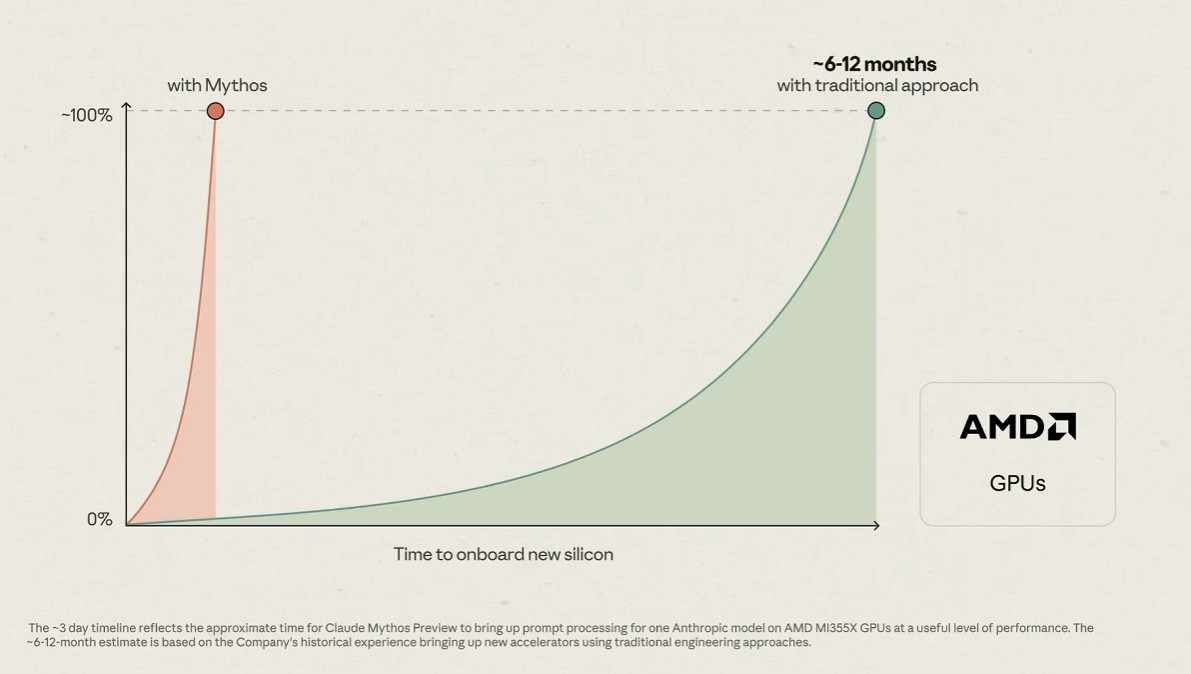
With Mythos, Anthropic brings new hardware to a usable performance level in about three days, instead of the six to twelve months traditional engineering approaches need to onboard new accelerators. The figures refer to prompt processing of an Anthropic model on AMD MI355X GPUs. | Image: Anthropic
Source: the-decoder.com
A move to a new platform usually took six to twelve months; with Mythos, Anthropic says, it took about three days.
If those figures are accurate, AI substantially reduces the cost of adapting software—a long-standing advantage for Nvidia that has been considered one of its most important. Companies may find it easier to choose providers based on price and hardware availability.
With chip supply constrained, multiple platforms make it possible to match hardware to the task: some chips are better suited to training models, others to inference. Nvidia currently earns margins above 70%, thanks to its dominant position in the AI chip market—an unusually high level for a hardware business.
Anthropic combines computing resources from different providers, architectures and sites into a shared pool, where they can be substituted for one another. The company says it gets more out of every dollar spent on compute than any other frontier-model lab.
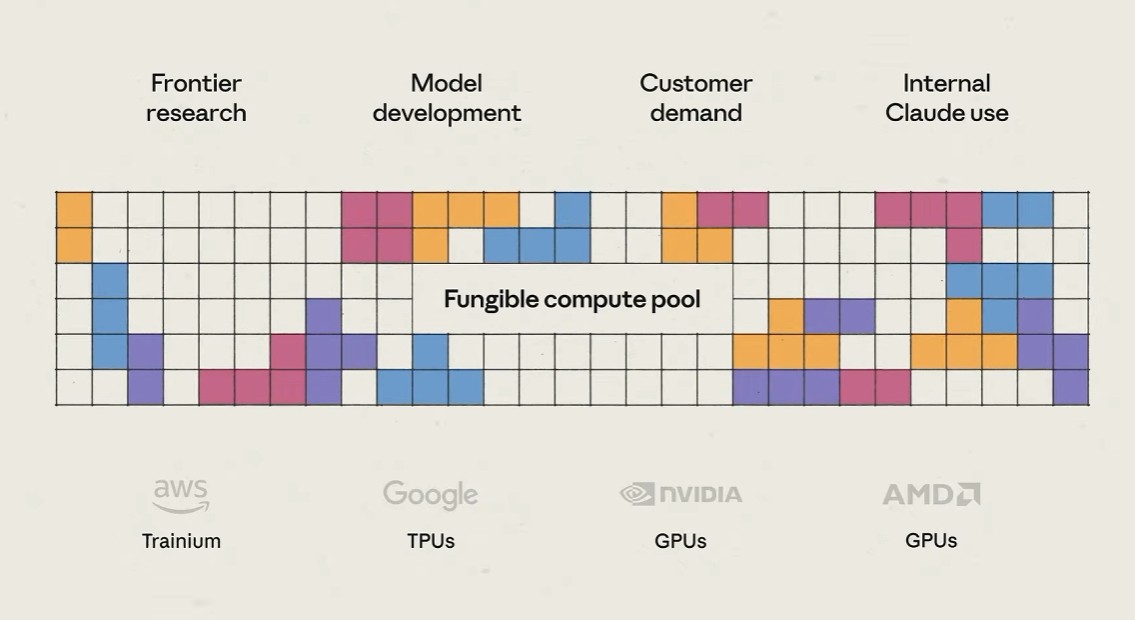
Anthropic allocates computing capacity from a fungible pool across four hardware platforms—AWS Trainium, Google TPUs, Nvidia GPUs, and AMD GPUs—for tasks such as research, model development, customer demand, and internal Claude usage. | Image: Anthropic
Source: the-decoder.com
Anthropic’s pool includes AWS Trainium, Google TPUs, Nvidia GPUs and AMD GPUs. The company allocates work across them for frontier research, model development, customer demand and internal Claude use.
Compute breakthroughs and in-house data centers
Alongside its work with different chips, Anthropic is counting on so-called “compute multipliers”—research breakthroughs that deliver more performance from the same physical computing resources. The company says these improvements reinforce one another: each new breakthrough increases the impact of those that came before.
Over time, Claude is supposed to find ways to make computing more efficient on its own. That would amount to recursive self-improvement, a concept widely discussed in AI research but not yet demonstrated in practice.
Anthropic is also expanding its own data center capacity through a program called “Anthropic Direct.” Rather than only buying compute as a cloud service, the company leases chips and installs them in purpose-built data centers. The goal is to reduce the total cost of ownership.
The claims about model porting and compute efficiency come from an Anthropic presentation to investors and have not been independently verified. They show that at least one major lab sees CUDA’s dominance as surmountable, and views models themselves as a possible tool for reducing dependence on hardware.
Nvidia and AMD investments
Both of the largest GPU makers have financial agreements with Anthropic.
In November 2025, as part of a $45 billion deal with Microsoft, Nvidia committed to invest up to $10 billion in Anthropic. According to Anthropic’s S-1/A registration statement, filed with the U.S. Securities and Exchange Commission on November 10, 2026, Nvidia is also participating in a conditional private placement totaling $26 billion. Seven technology companies are buying shares at the initial public offering price.
In July 2026, AMD announced a strategic investment of up to $5 billion in Anthropic. In return, Anthropic plans to deploy up to two gigawatts of AMD Instinct MI455X GPUs in rack-scale Helios systems. The first phase, planned for one gigawatt, is due to begin in the first half of 2027.
Dataist’s take: Anthropic’s results should still be treated as company claims; they have not been independently verified. If the company really can speed up porting to this extent, that could make it easier to choose hardware based on price and availability, but it does not eliminate the need to build separate software stacks for different chips.
Source: the-decoder.com
Daily AI news
Every day we pick what actually matters in AI and explain it plainly — no hype, no filler. Subscribe if you want to follow where the industry is going.
Only what matters — every day
Follow on X