

Anthropic recommends revisiting prompts for Claude Opus 5.5
Effort settings and model choice
Anthropic recommends dropping phrases such as “think hard” or “think carefully.” The company says Opus 5.5 reasons on its own without these requests, adjusting the depth of its reasoning to the task and the selected effort level. In tests, responses without these phrases started faster, with no measurable decline in quality.
Such wording emerged in the early years of reasoning models, before adaptive reasoning became common. About a year and a half ago, it could sometimes improve answer quality or influence a router’s choice of model.
Anthropic recommends starting at Medium, the default level. The company’s internal tests showed that Opus 5.5 at Medium performed at the level of Opus 5 at High. Higher effort levels cost more and do not always improve results. Switch to High if Medium is not enough; the setting can be changed in the model menu next to the send button.
Anthropic says teams that used the cheaper Sonnet for routine tasks and reserved Opus for complex projects should reconsider that approach. A more capable model may complete a task in fewer steps, partly offsetting its higher per-token cost. According to the company, regularly running Sonnet at Extra High or Max costs about as much as using Opus 5.5.
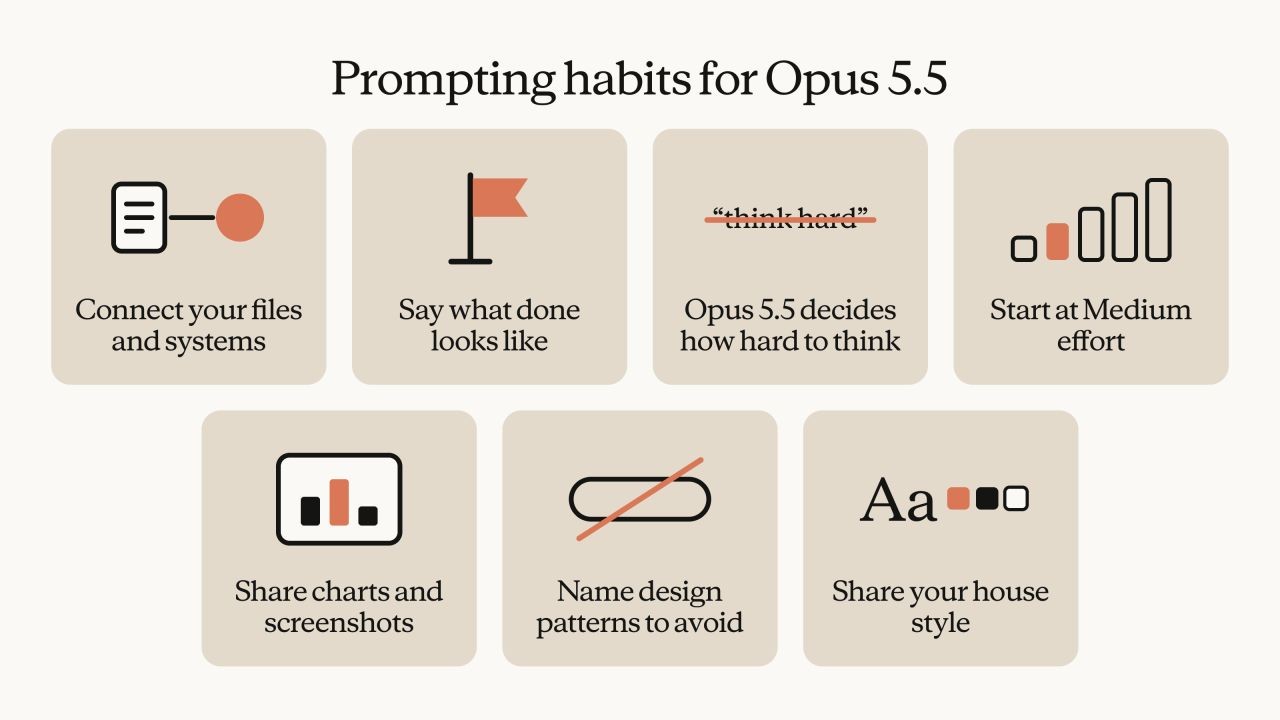
Anthropic's prompting tips for Opus 5.5 include connecting files and systems, describing the desired end result, dropping "think hard," starting at Medium effort, sharing diagrams directly, naming unwanted design patterns, and sharing your own house style. | Image: Anthropic
Source: the-decoder.com
Describe the full goal
Instead of giving instructions one at a time, Anthropic recommends stating the goal, the desired output format and the conditions under which the model should ask clarifying questions upfront. The company says Opus 5.5 handles multi-part tasks better than its predecessor. The model can increasingly take over exchanges that users previously managed themselves, and in some cases does so more effectively — effectively clarifying the task from the initial request.
The company recommends attaching diagrams and tables as images or files rather than retyping them. Workarounds required by earlier models, such as manually entering values from a chart, are no longer necessary.
If the goal is a finished document or spreadsheet, Anthropic recommends asking for the final output rather than a draft. According to the company, Opus 5.5 often completes this kind of task in one pass. Image reading has also improved: even at the lowest effort level, the model read values from dense charts more accurately than Opus 5 at the highest level.
Be specific about unwanted styles
For design tasks, Anthropic recommends naming specific elements to avoid — such as a cream background or pill-shaped buttons — rather than broadly banning “generic design.” The company says general instructions simply replace one default style with another.
When Claude is connected to a user’s files and systems through connectors, results become more precise: the model can retrieve the information it needs on its own.
Dataist’s take: Anthropic’s recommendations shift work with Opus 5.5 away from step-by-step control and toward clearly describing the goal and desired result. But the performance and cost comparisons are based on the company’s internal tests, so the data presented do not show that Opus 5.5 will be more cost-effective for every task.
Daily AI news
Every day we pick what actually matters in AI and explain it plainly — no hype, no filler. Subscribe if you want to follow where the industry is going.
Only what matters — every day
Follow on X