

When coordination becomes overhead
Anthropic says many agent systems follow a fixed pipeline: infer intent, segment users, route them through different recommendation paths, then hand control to an orchestrator. Models can now perform much of that work within a specific task, the company argues.
Anthropic calls the pattern a “Conway’s law” for agents: system architecture starts to mirror the organization that built it. Each team adds a subagent, and the collection grows into hundreds of overlapping agents without shared standards. Teams then add conflicting rules to the system prompt, producing what Anthropic calls a “Frankenstein prompt.”
For many tasks, the company says, a cleaner setup is enough: a focused system prompt, four or five simple tools for working with data, and fixed constraints on response format.
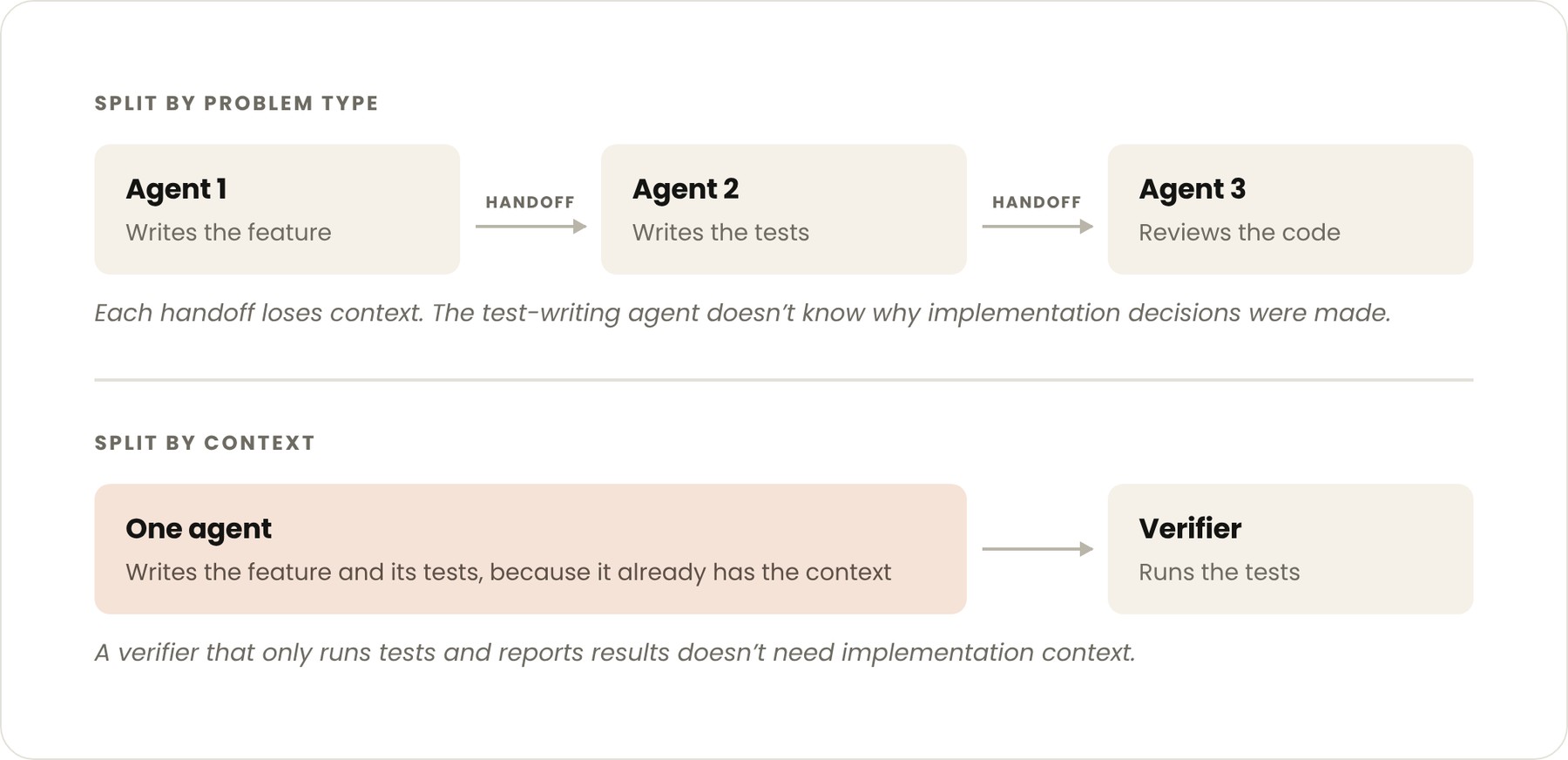
In the multi-agent workflow, context gets lost at every handoff between feature writing, test writing, and code review. In the single-agent workflow, one agent writes both the feature and the tests because it already has the context, while a separate verifier only runs the tests and reports results. | Image: Anthropic
Source: the-decoder.com
Anthropic has cut Claude Code’s system prompt by more than 80% for newer models, in part because skills and tools can be loaded only when needed. The company also says newer models report their progress and check their work, potentially making some extra layers of oversight unnecessary.
That does not make subagents obsolete. Anthropic says they remain useful when evaluations show that a single agent’s quality suffers from context-window limits, when tasks need to run in parallel across separate context windows, or when an agent struggles to choose tools.
The company has published migration tools on GitHub to help teams identify their existing workflows, compare alternatives and test a suitable design. It warns against merging agents without checking what they do: in one support-agent test, consolidation reduced latency but broke a working process. The main agent began answering on its own instead of routing the request to the right specialist.
Source: the-decoder.com
Consolidate carefully
Anthropic’s proposed alternative is to package team workflows as skills, load tools on demand through search, and give a small central team responsibility for the system prompt and overall quality. But tool choice can deteriorate when descriptions exceed 30–50, so teams still need to keep their skill libraries from growing unchecked.
Reference material, including recommendations, product specifications and metric definitions, can live in knowledge bases that agents search when needed, or be included in skills as reference files. Anthropic advises against fetching context with code and inserting it directly into prompts.
The case against agent sprawl also fits recent research. In a Vals study, agent teams worked faster than single agents but did not produce higher-quality results. Increasing the group from 10 to 30 or 100 agents did not improve results, while costs rose substantially. OpenAI developer Eric Provencher has also questioned the value of agent swarms, saying they “almost certainly” create unnecessary costs.
My read is that Anthropic is making a useful distinction between parallel work and organizational duplication. More agents can buy speed, but the support example shows how easily consolidation can erase a handoff that mattered. The announcement leaves open how teams should decide which workflows are safe to simplify; the answer appears to depend on testing the behavior, not counting the agents.
Source: the-decoder.com
Daily AI news
Every day we pick what actually matters in AI and explain it plainly — no hype, no filler. Subscribe if you want to follow where the industry is going.
Only what matters — every day
Follow on X