
Anthropic’s “Working with AI” report examines nearly 300 cases of AI adoption at 58 companies in the United States. The researchers conducted 66 in-person interviews, covering startups and companies in law, construction, finance, healthcare and manufacturing. Respondents reported increased output or quality of work in 55% of cases, but 19% of projects have yet to deliver business value. The main obstacles arise inside companies: employees have to check too many AI responses, colleagues resist change, and adoption requires expert review.
Anthropic finds what is holding back AI adoption in companies
The authors stress that the sample is not representative of the entire market: all the study participants are Anthropic customers. Still, the report shows how AI works in real-world projects. Among cases with no clear business value, 6% were stalled by internal obstacles, time savings were consumed by checking results in 5%, and the impact remained unclear in 8%.
External factors were mentioned rarely: regulation came up four times and customer skepticism 13 times. The main difficulties arose within the companies themselves.
Checking responses and friction among colleagues
Participants most often said that people had to check too much AI output: the problem was mentioned 49 times. Employee resistance came up 43 times, while mandatory expert review and testing were mentioned 42 times. In one case, an AI agent added an extra “S” to an API call and derailed a carefully prepared software release.
AI can speed up one part of a job while other departments struggle to keep up: this kind of gap was noted 20 times. An industrial equipment manufacturer found that AI could easily translate product interface text into 10 languages. But the company then turned the feature off: it had no staff who could respond to customer inquiries in those languages.
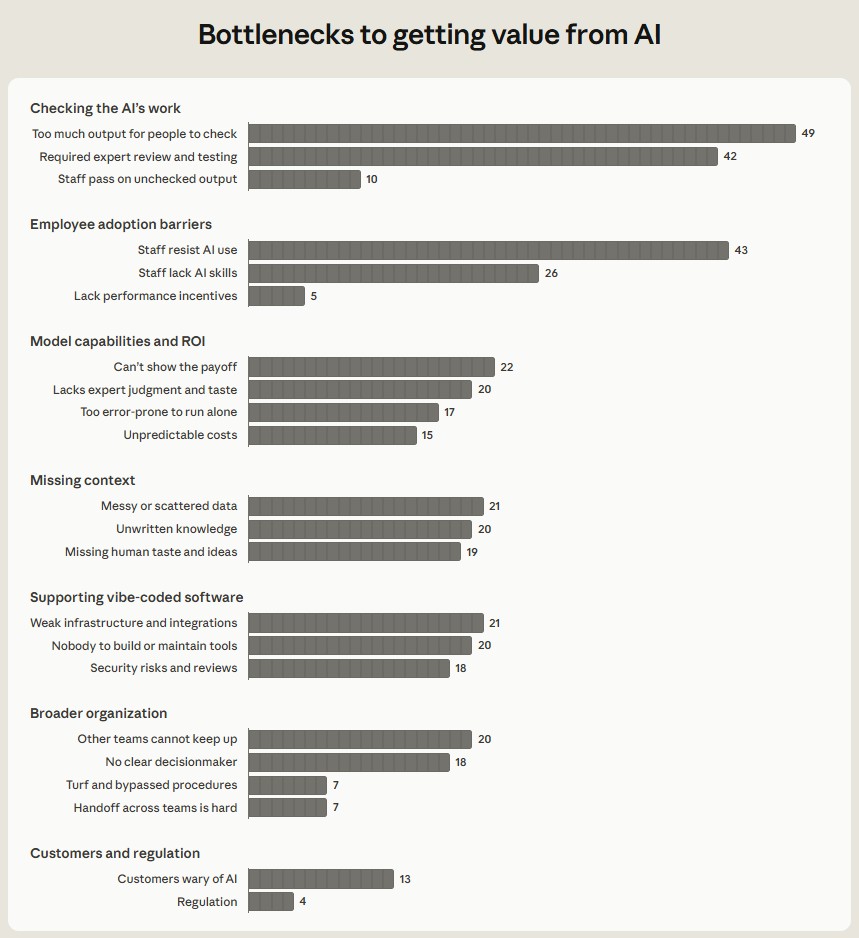
Too much AI output for humans to review is the top bottleneck at 49 mentions, followed by employee resistance (43) and required expert reviews and testing (42). | Image: Anthropic
Source: the-decoder.com
Uneven adoption also creates tension in day-to-day work. Advanced users send colleagues large volumes of AI-generated text. The report uses the terms “Claude grenades” and “Claude cannons” for such cases: for example, an employee sends the IT department seven pages of AI-written instructions for no particular reason.
Some skeptics respond by refusing to read AI-prepared emails. One executive summed up the situation this way: a mediocre engineer with AI becomes a threat to society.
The authors compare these observations with the debate over so-called “workslop”—superficial content created by AI. In a study by BetterUp Labs and Stanford Social Media Lab, 40% of US workers said they regularly receive such material from colleagues. Each instance takes nearly two hours on average to deal with, and trust within teams declines.
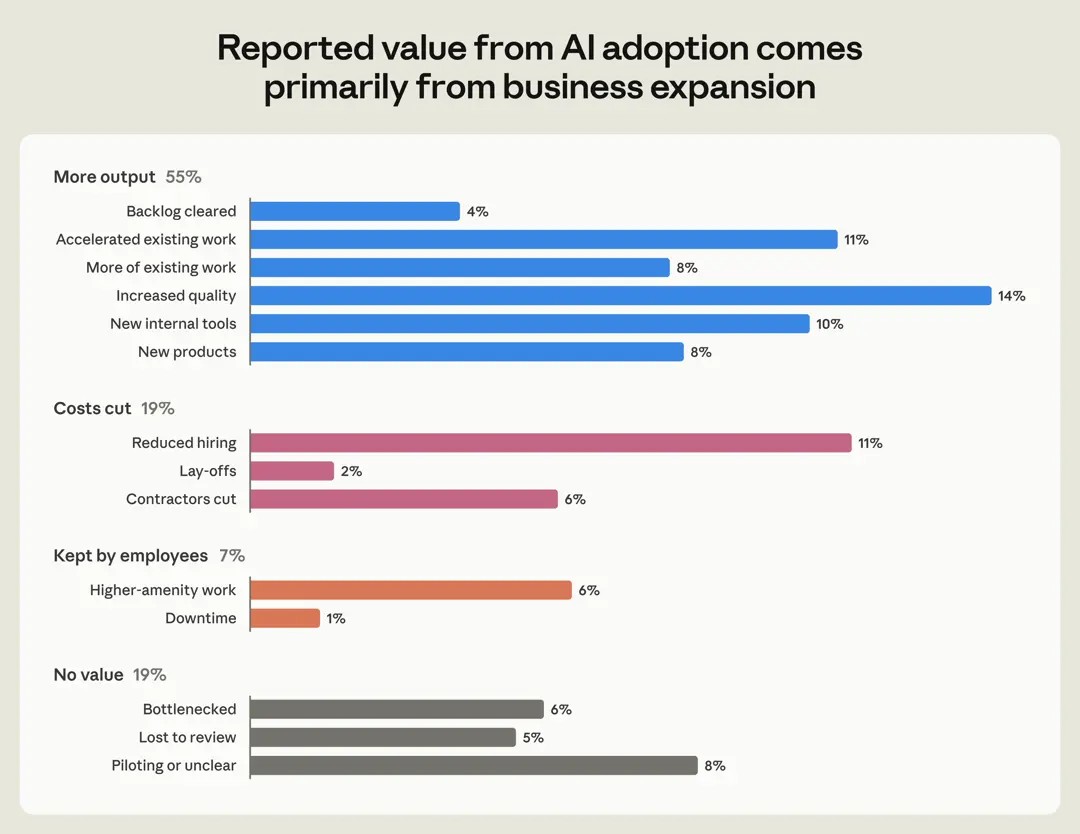
Respondents report higher output or better quality in 55 percent of the AI deployments studied. Another 19 percent still deliver no business value, because of internal bottlenecks and heavy review workloads, among other things.
Source: the-decoder.com
Fears about jobs fuel resistance
In the Anthropic study, employee resistance was the second most frequently cited problem, with 43 mentions. It is especially pronounced when management rolls out AI from the top down to automate entire workflows.
Only two of the 58 companies reported direct layoffs due to AI automation. Another five companies dismissed employees who refused to use AI. The impact on hiring is already evident: two-thirds of companies have started hiring fewer people. Nine companies also reduced their use of outside contractors, mainly in software development, customer support, design and legal services; many of these roles were based overseas.
Workers with the necessary skills face a contradiction: they are expected to use their expertise to build and review AI systems that could make their own jobs unnecessary. One employee told the researchers that by supporting this work, they were effectively building their own coffin. A female executive said she woke up at three in the morning, anxious about her career, and asked Claude how to protect herself from being replaced.
Fear leads to both open resistance and quiet delays. One company wanted to speed up application reviews with AI and cancel 90% of planned hires. But reviewers dragged their feet: some spent more than 10 minutes on a case, even though two would have been enough.
At one law firm, employees who handled conflict-of-interest checks opposed the AI process. After it was introduced, they had to deal with complex potential conflicts that had previously been referred to lawyers. The firm eventually abandoned the agent and returned to its old process.
Time savings don’t always go to the company
Some employees keep the time they save with AI for themselves. In roughly one-tenth of the cases studied, the result was more enjoyable work or simply less work. One dissatisfied executive observed that employees deliberately hide AI’s impact: they want to spend the 10 hours a week they save walking the dog.
Employees are also concerned about increased monitoring. Several companies use AI to track staff in detail, for example by generating hourly productivity and error reports each day or automatically evaluating customer calls. One executive called this the “panopticon effect.”
Top-down automation projects are often fragile. Expensive custom tools can become outdated within months as models improve, or turn into applications that almost nobody uses. One executive compared investing in such projects to trying to hit a moving target with a dart.
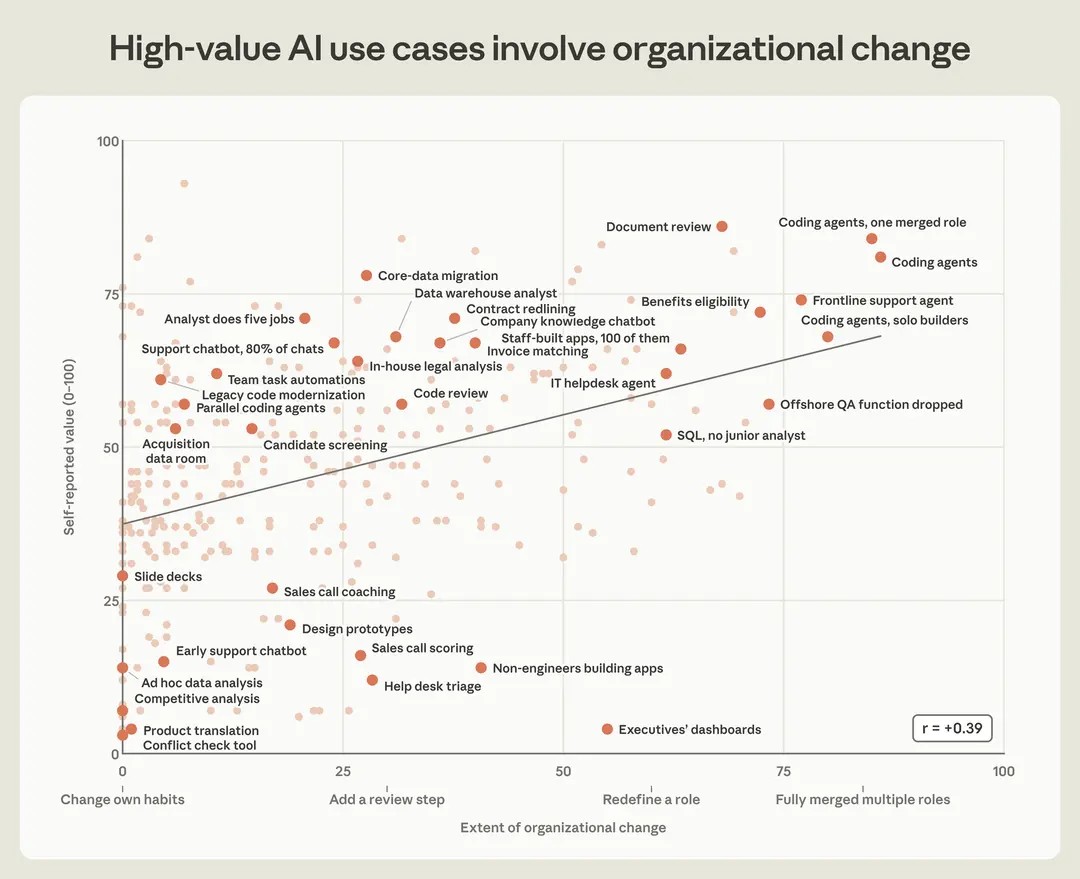
AI deployments with higher self-reported value often come with bigger organizational changes. Simple uses such as presentations or ad hoc data analysis require little restructuring, but respondents often rate them as less valuable. | Image: Anthropic
Source: the-decoder.com
Custom applications need support
Simply giving employees AI tools and expecting them to work out how to use them is not enough, Anthropic’s researchers say. Nontechnical staff really are achieving notable results through “vibe coding”—creating tools with ordinary text prompts. For example, an accountant built an app to automate an audit of employee retirement contributions that had taken 80 hours.
But such projects often never make it into production. Several months later, the accountant’s prototype was still not in use: an outside contractor was supposed to prepare the final version. Companies often lack stable technical infrastructure—a problem mentioned 21 times—and specialists to support and maintain it, reported 20 times.
The head of operations at a large law firm considered building custom dashboards for recruiting. But in his assessment, off-the-shelf software costing $30–100 a month is easier to maintain.
Security risks are also growing: they were mentioned 18 times. One data protection executive warned that every employee is now creating programs, increasing the number of potential attack points every day. At the same time, individual employees usually lack the authority to change how responsibilities are divided across the company.
Significant impact requires changing how work is organized
Anthropic’s data links more extensive organizational changes with higher AI value as reported by respondents. Simple tools embedded in day-to-day work without changing processes—for example, presentation tools and quick data queries—often deliver only modest gains.
The report describes three approaches to changing how work is done. Some companies expand roles: one employee or a small team takes charge of an entire workflow, reducing coordination costs.
Others shift employees to tasks AI cannot yet perform: strategic decisions, working with customers and quality control. The third approach is to create shared, secure data and IT infrastructure so nontechnical staff can work with organized data. This issue was mentioned 21 times.
The researchers acknowledge that none of these approaches rules out layoffs. But the report’s overall conclusion remains the same: the main difficulties in adopting AI do not stem from weak technology, but from companies trying to fit new tools into an old way of organizing work.
The “AI Radar #2” report examines why productivity gains visible in benchmarks may not show up in financial results. According to its analysis, generative AI users save an average of 5.4% of their working time. The authors note that it remains unclear when, or whether, this potential will show up in measured productivity indicators.
Dataist’s take: the report shows a gap between the time individual employees save and the value a company gains. To achieve a noticeable impact, it is not enough to hand people tools; often, the workflows themselves have to change. But reorganization does not guarantee job security, and a sample made up of Anthropic customers cannot be treated as a picture of the entire market.
Daily AI news
Every day we pick what actually matters in AI and explain it plainly — no hype, no filler. Subscribe if you want to follow where the industry is going.
Only what matters — every day
Follow on X