

Anthropic has built a model of how AI reshapes the US labor market between 2026 and 2030, and the most revealing thing in it is where the company's own chief executive lands. In May 2025, Dario Amodei warned that up to half of all entry-level office jobs could disappear by 2030 and that unemployment could rise to 10–20%. Anthropic's model runs three scenarios — modest, moderate and extreme. Amodei's numbers sit in the extreme one.
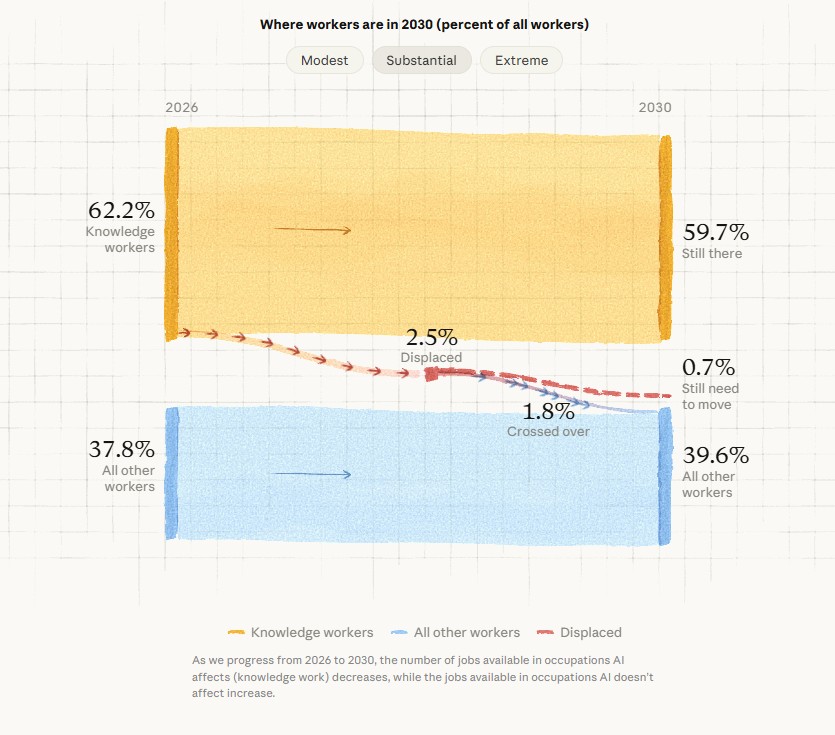
Anthropic's forecast of US labor market change from 2026 to 2030 under the moderate scenario. The share of knowledge workers falls from 62.2 to 59.7% of the workforce, the share of other occupations rises from 37.8 to 39.6%
Source: the-decoder.com
Look at what the middle case actually contains. Knowledge workers go from 62.2% of the workforce to 59.7% over four years, while other occupations rise from 37.8% to 39.6%. That is a move of roughly two and a half percentage points, and it is a move between categories, not into unemployment. The moderate scenario describes the composition of American work shifting — fewer desk jobs as a share of the total, more of everything else. It does not describe a labor market falling over.
The gap between that chart and the rhetoric around AI and jobs is the story. Anthropic has effectively published a distribution in which its own founder's most quoted public prediction is the tail — the least likely of three futures, or, put less politely, the alarmist one.
There are two ways to read that, and they are not equally flattering. The generous reading is that Anthropic's research function is independent enough to contradict the chief executive in print, which is rarer at AI companies than it should be and worth crediting. The other reading is that a 10–20% unemployment forecast has stopped being useful to have attached to the company's name, and a three-scenario model is a tidy way to demote it. Nobody has to retract anything. The forecast simply becomes scenario three.
I lean toward the second. Amodei's May 2025 warning did a job: it positioned Anthropic as the lab honest enough to describe the damage its own products might cause, at a moment when that was close to the most credible thing an AI executive could say. More than a year on, the same sentence is a liability rather than a credential — it names a cost, in public, in numbers, for a technology the company is asking customers to adopt. A model that keeps the warning on the page while marking it the least likely of three outcomes lets Anthropic hold both positions at once.
What the model does not say is who the 2.5 points are. A share moving between two categories on a chart is, at the level of a person, a career that ended and another that had to be started, usually at a lower wage and with no employer paying for the transition. The moderate scenario reads calm because it aggregates. And nothing in what was published indicates which of the three scenarios Anthropic is planning its own business around — the forecast a company acts on is more informative than the forecast it releases.
History has not been kind to technology executives who confidently predicted which jobs would disappear for other people. Anthropic has now put its founder's version of that prediction in the tail of its own distribution while continuing to build the systems that determine which tail the decade lands in.