
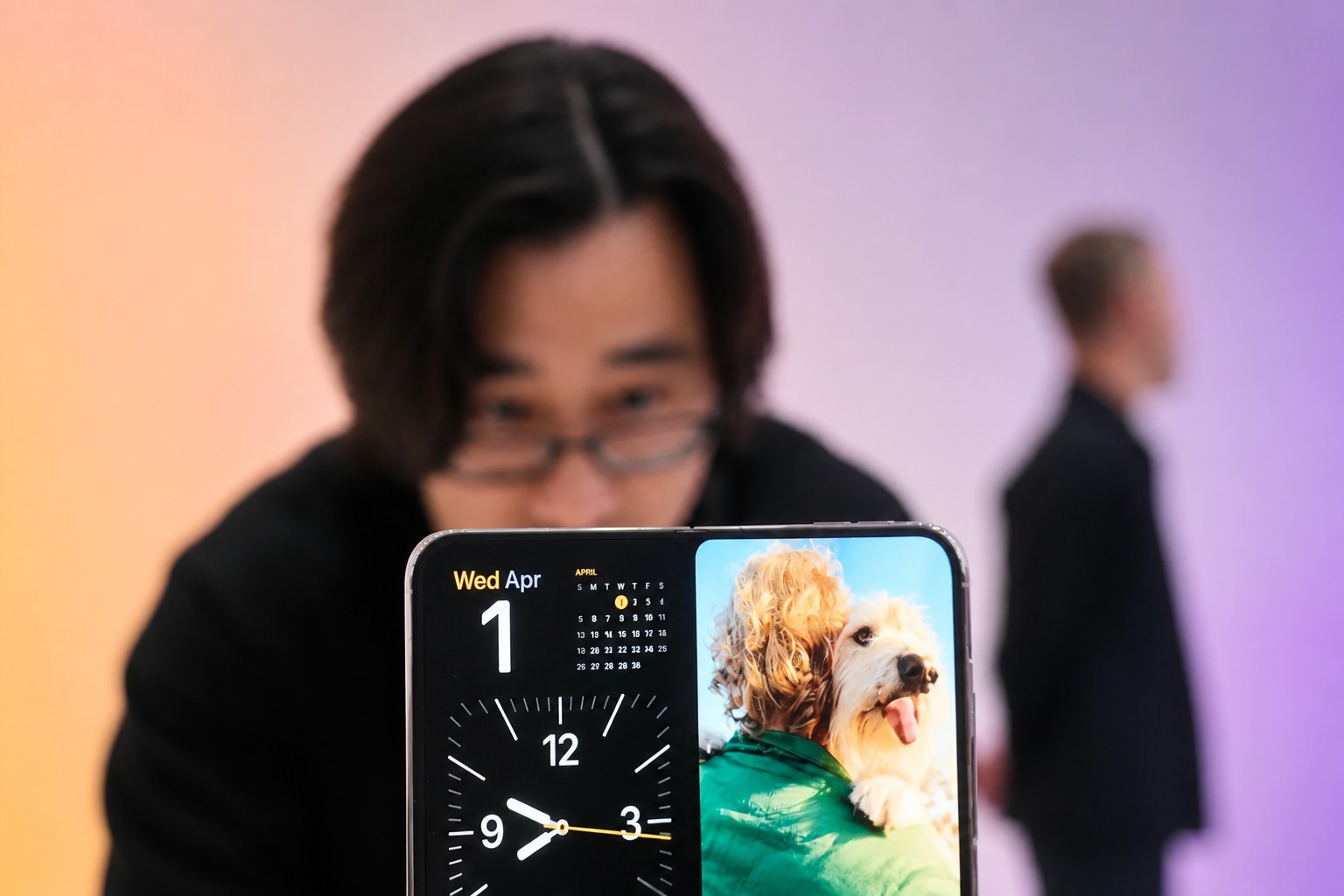
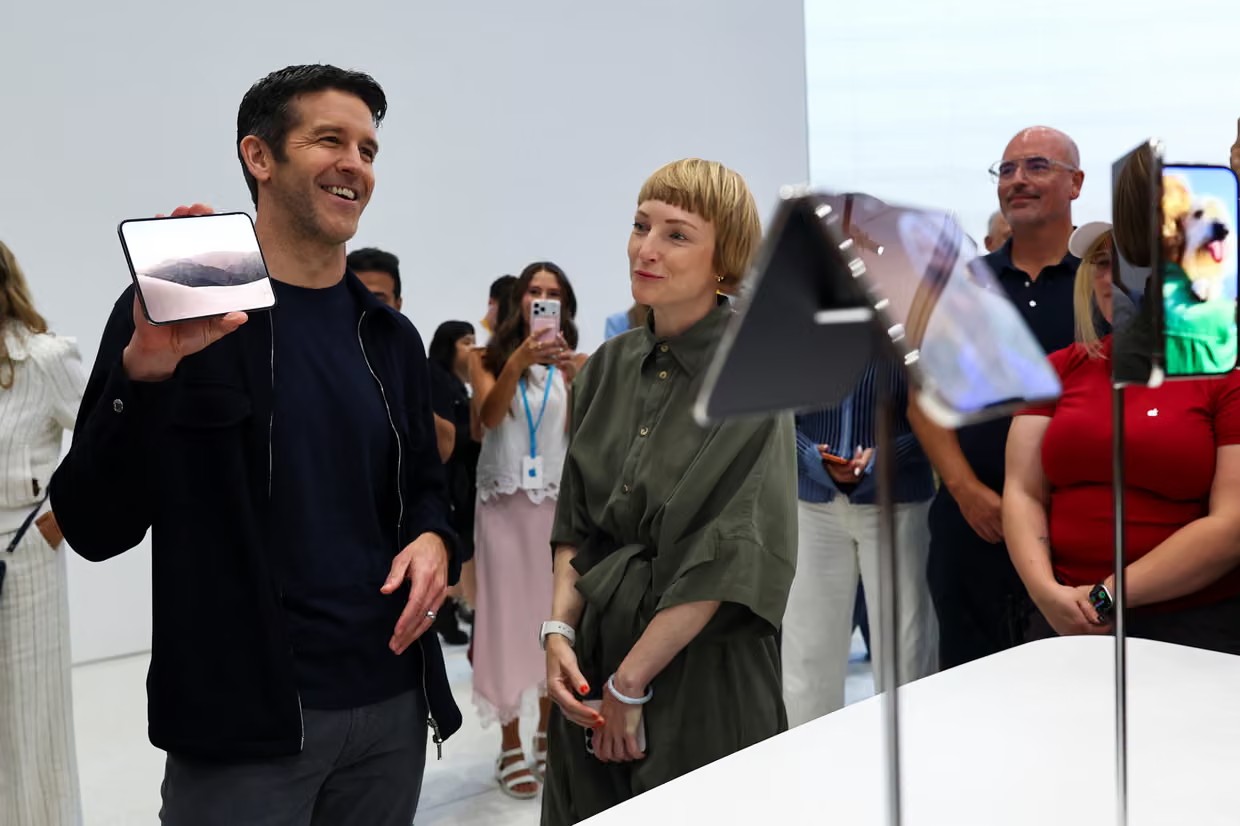
Apple introduced its first foldable phone, the iPhone Duo, at an event called Surprise and Shine at its Cupertino campus in California. It starts at $1,999 and goes on sale October 23. Competitors have been shipping foldables since the late 2010s, so Apple arrives at the category last — and in the same month it changed chief executives. The launch is the first serious test of John Ternus, who took the job on September 1 after Tim Cook's departure and stood on the keynote stage in that role for the first time.
Folded, the Duo is the size of a passport. Opened, it doubles the screen area. Apple's case for nearly $2,000 is an iPad-style display carrying an iPhone's portability and camera. Ternus said the Duo has a new design but keeps the familiar capabilities of an iPhone, and that the device should be simple to use and open up new scenarios.
He framed the folding form through what he called an "intelligent personal hub," and said Apple considers the iPhone better suited to that role than any of its other products. Rival foldables, he added, often feel like two phones joined together, and vertical scrolling on them remains awkward. The Duo, he said, will change how people experience foldable phones.
That is a narrow argument for a first product in a seven-year-old category: not that folding is new, but that everyone else folded badly. Apple has been in a position to make it for a while. Bloomberg reported that the company began testing foldable display prototypes in early 2021, at a point when it had no plans to ship such a device. Five years of prototyping produced a phone whose pitch is refinement.
The more conventional part of the lineup came first. Apple showed the iPhone 18 Pro at $1,199 and the iPhone 18 Pro Max at $1,299, then spent time on the AI features built into them. The assistant, called Siri AI, can reach into third-party apps and already works with more than 300,000 of them.
One new feature reads a photo and determines whether it was taken by an iPhone camera rather than generated by AI. It is called Apple Reference Image, and an Apple executive compared it to a "digital negative" — a confirmation that the original image was not synthetic. Of everything announced, this is the smallest item with the longest shadow: a company that sells cameras is now shipping the claim that its cameras can prove what they saw.
Source: theguardian.com
Apple executives said both new Pro models get substantially longer battery life — up to 45 hours on the iPhone 18 Pro Max and up to 36 hours on the iPhone 18 Pro. No comparable number was given for the Duo, which is the phone with two screens' worth of surface and the only one with a hinge.
The rest of the hardware filled out over the keynote and, Apple said, the next few months. Fifth-generation AirPods cancel noise 50% better than the AirPods 4 by the company's account, run up to five hours, and start at $129. The Apple Watch Series 12 and Ultra 4 were presented as health and fitness devices with wider sensing and higher accuracy. A feature called Health Age reads heart health, sleep, mental state, musculoskeletal health, metabolism, hearing and nutrition, then scores the wearer against their actual age.
The watch also gets something called audio intelligence. It records the conversations around the wearer through the day and takes notes, producing a transcript of whatever was said 15 seconds ago for anything they missed, and at the end of the day a summary called Siri Recap. Apple said the recordings stay on the device and the collected data is protected with end-to-end encryption.
Here is what I think the day was actually about. The Duo is a statement, not a bet. Foldables are a small share of the phone market, Apple's own results show demand for ordinary iPhones holding up, and the iPhone's basic shape has been fixed since 2007. A $1,999 device that changes the shape is exactly the product a new chief executive wants on stage in his first month — visible, expensive, and not load-bearing for the quarter. The watch is the bigger change, and it was introduced as a convenience.
Because the question the announcement did not take up is not where the recordings live. Apple answered that one, and it is the wearer's question. The person sitting across the table is not wearing the watch, did not agree to the encryption, and has no obvious way to know a transcript of the last 15 seconds exists. A device that listens to a room all day makes a decision on behalf of everyone in the room, and on-device storage does not address it.
On his first day, Ternus wrote to employees that he was looking forward to the products already in development and to the ones Apple has not thought of yet. He called leading the company an honor, thanked staff, and told them a major launch was a week away. That launch turned out to be a product his competitors imagined in the late 2010s and his own engineers prototyped in 2021. The ones nobody has thought of yet are the ones he will be measured on.