
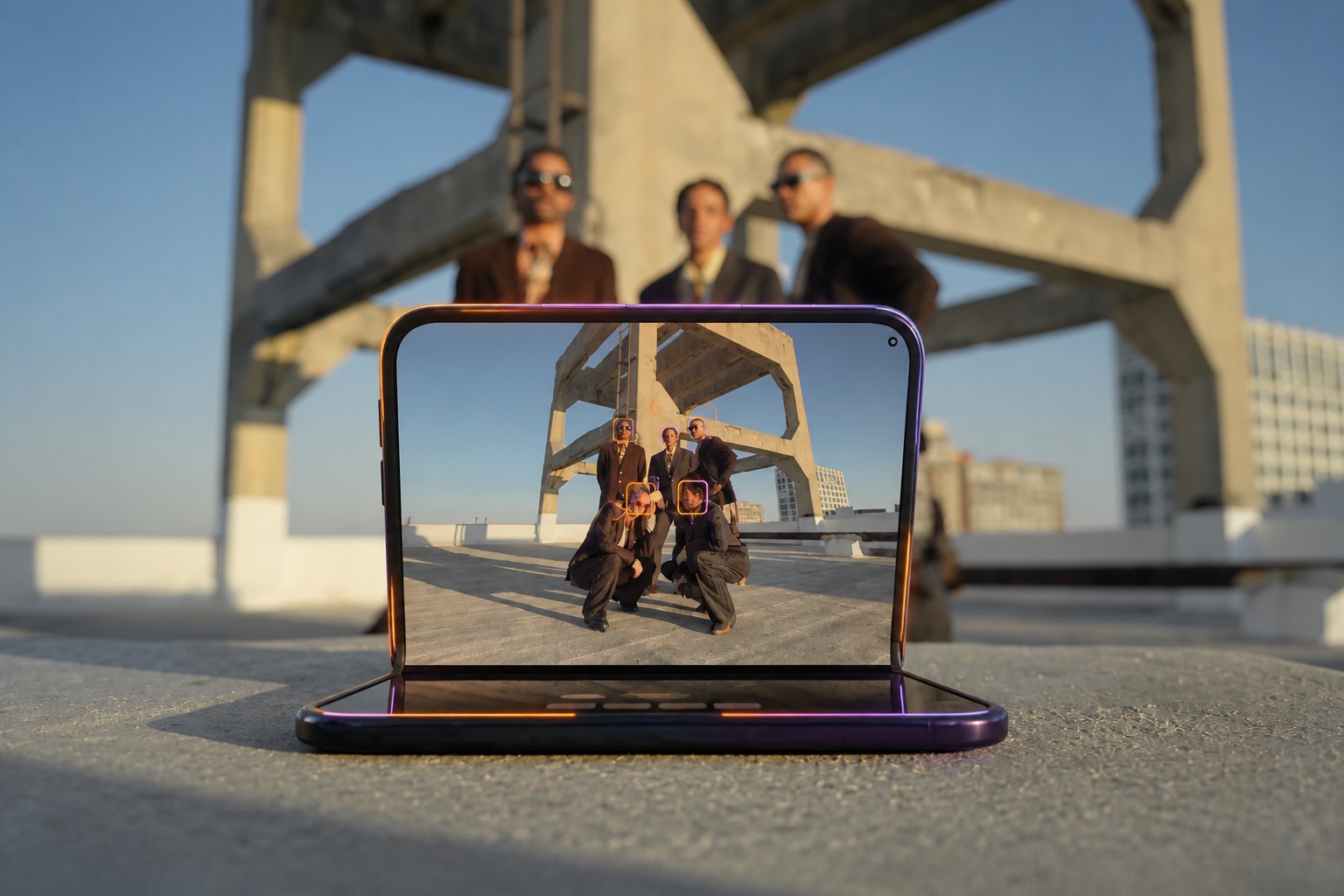
Apple says the hinge in its foldable phone, the Duo, is assembled with help from machine learning on the factory floor. According to Johny Srouji, the company's hardware chief, AI algorithms match each individual hinge to the housing it fits best, so the two align correctly. A confocal laser then scans the surface of each part step by step, and a 3D printer lays down as many as 25 microlayers of a purpose-made photopolymer to remove the residual waviness left in the surface. The hinge itself was redesigned.
The problem being solved is real and well documented. A folding phone takes roughly twice the wear of a conventional one, because every open and close is a mechanical cycle a slab phone never performs. That is why so many foldables lose structural integrity over time and end up compared unfavourably with ordinary handsets. Apple says it has built protections into the Duo aimed squarely at that failure mode.
Two other measures come with the phone. A nanotexture coating, which Apple says noticeably cuts glare and reflections, and a multilayer lamination scheme meant to extend the device's working life.
Set against Apple's recent history, the framing here is what stands out. The company has spent the last stretch of its public life defending AI as a consumer-facing feature. Here AI appears in a different role entirely: not something the buyer touches, but a tool in the plant, sorting parts. That is a safer claim to make and a harder one to check.
It is also, stripped of the label, a familiar manufacturing technique. Matching a component to the mating part it pairs with best is selective assembly — factories have done it for decades with engine bores and pistons. Calling the matching step AI tells you that Apple is running a model over measurement data rather than a lookup table; it does not tell you how much tighter the resulting alignment is. The engineering I would actually credit in this description is the rest of the sequence: confocal scanning of every unit, followed by additive correction of up to 25 photopolymer layers on the parts that need it. That is per-unit metrology and per-unit compensation on a mass-market consumer device, which is expensive and unusual, and it is doing the work the word AI is getting the credit for.
Notably absent from the announcement is any number attached to the outcome. The problem has a figure — roughly twice the wear of a normal phone — while Apple's remedies are described entirely in qualitative terms. No cycle rating, no comparison against the first generation of any rival's hinge, no figure for how much of that doubled wear the redesign removes. A company confident in a durability claim usually ships the test result alongside it.
There is a second question the process raises on its own terms. If each hinge is matched to one specific housing, the pair is no longer freely interchangeable, and I would want to know what that implies for repair — whether a replacement hinge can be fitted to an existing body without giving up the alignment the matching was for. Nothing in what Apple has said addresses it either way.
Whether any of this keeps the Duo in good physical shape over years of use is unknown. What Apple has actually disclosed is the cost structure it accepted to get there: scanning and correcting every part individually is not how you build a cheap phone. The durability claim will be settled by the first cohort of owners who put a year of hinge cycles through it, and the manufacturing story will not travel down the product line unless the economics survive contact with a device that has to sell in volume.