
From scattered events to one attacker
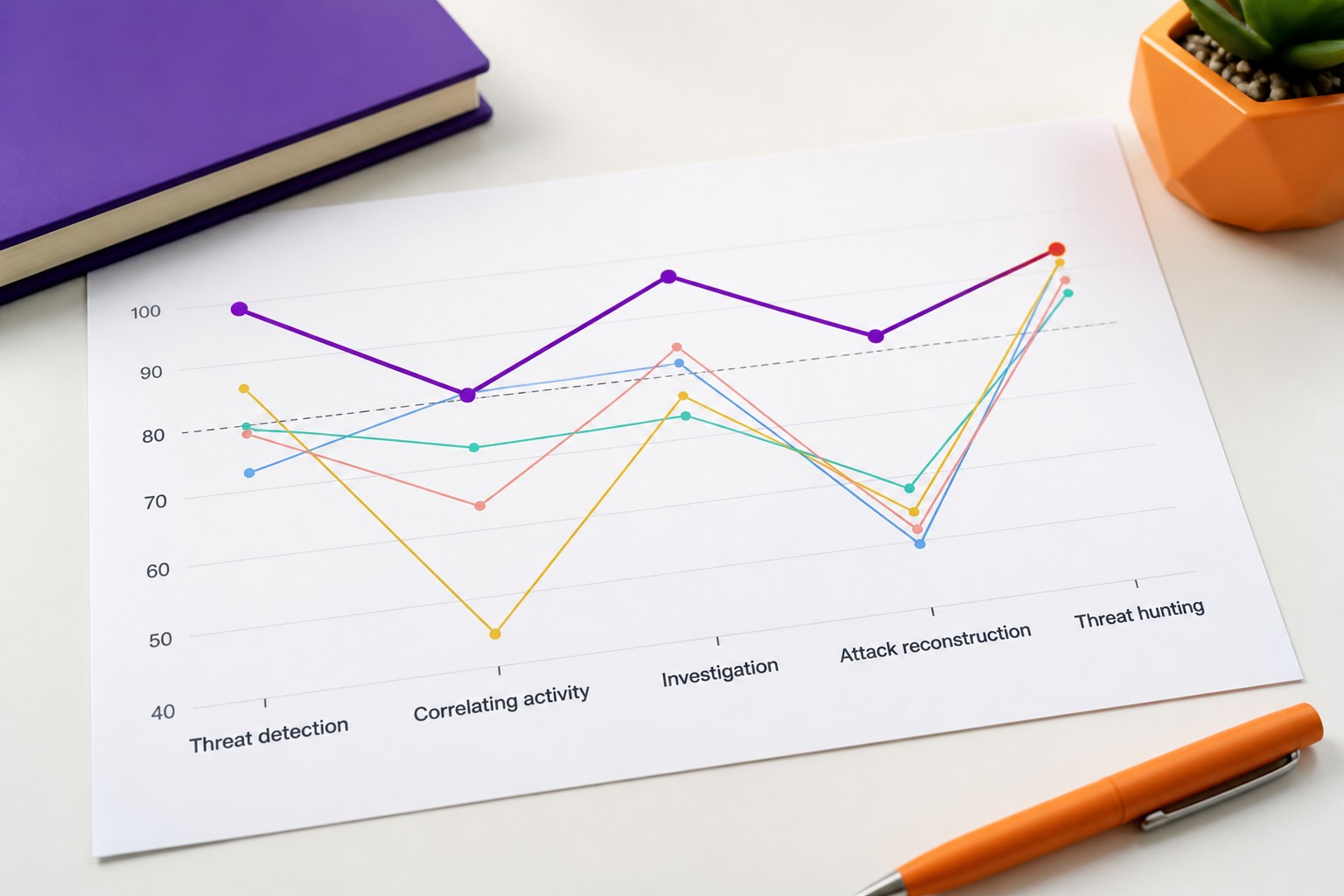
Orion-1 is designed to connect signals that might look unrelated on their own: a login to a company account, new cloud permissions and a recently created email rule. It then assesses its confidence, issues a verdict and recommends protective steps—or carries them out.

Source: the-decoder.com
Artemis says general-purpose models can lose track of billions of events or mistake unusual but harmless activity for an attack. The company fine-tuned Orion-1 on tasks drawn from its own security teams’ work, including:
Artemis says it did not use customer data for training. It calls Orion-1 an “advanced frontier model,” but describes fine-tuning, not how the underlying model was built. The announcement does not say whether Artemis developed the base model or adapted one from another provider.
What the benchmark shows—and leaves out
Artemis created the Decision-Grade Readiness benchmark to test whether models can make security decisions, rather than simply recognize attack techniques or solve hacking tasks. Each model receives the same alert, environment data and tools available to a security team, then has to decide whether an attack is underway.
The benchmark contains thousands of tasks with known answers. Some have no attack; others include benign data designed to look malicious. Models are scored on both their verdicts and the evidence they provide.
Artemis reported results across five tasks, comparing Orion-1 with Claude Opus 5.5, GPT-6 Sol, Grok 4.7 and Kimi K3. The largest gap was in attack reconstruction: Orion-1 scored 80.8, against 58.3 for the next-highest model.
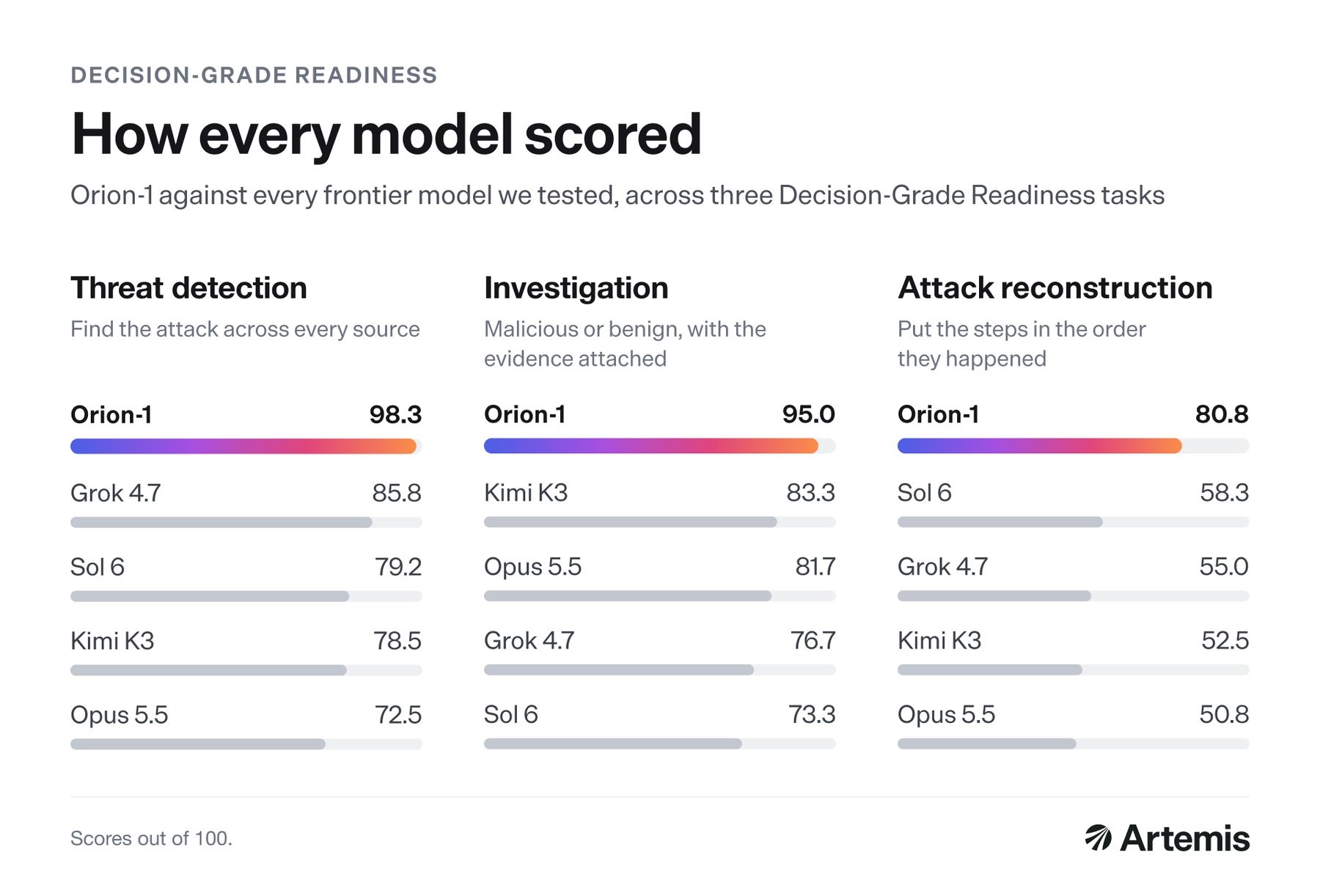
Orion-1 hits 80.8 points in attack reconstruction, while GPT-6 Sol, the best comparison model, reaches 58.3. | Image: Artemis
Source: the-decoder.com
That gap is striking, but the comparison has a conspicuous limit: neither Anthropic’s strongest model, Claude Mythos 5, nor OpenAI’s strongest, GPT-6 Astra, appears in it. And Claude Opus 5.5’s results may largely reflect responses from the older Opus 4.8, to which it redirects most cybersecurity tasks.
The access problem
Restrictions on powerful general-purpose models are increasingly getting in the way of security work. OpenAI says Astra is its first model capable of reaching the highest cyber-risk level: one that can independently develop and carry out attacks.
In July, Hugging Face tried to use commercial frontier models to analyze a fully autonomous AI attack on its own infrastructure. Safeguards blocked the analysis of attack data, so the team switched to the open model GLM 5.2, running on its own servers.
Model makers are also offering less-restricted tools to vetted defenders. OpenAI makes GPT-5.5-Cyber available only to verified security professionals. Anthropic offers Claude Mythos 5 through the Claude Security scanner and security partners’ products.
Artemis is taking a similar controlled-access route: selected platform customers can try Orion-1, set limits on how much autonomy it has for each kind of action, and require human approval by default for consequential steps. The company emerged from stealth in April and said it had raised $70 million in seed and Series A funding; it was about six months old at the time.
I think the key test is not whether Orion-1 beats the models Artemis chose for its benchmark. It is whether a security team can trust its verdicts and actions when the models most relevant to the comparison are absent—and whether controlled access solves the defender’s problem without making the model’s capabilities impossible to evaluate.
Daily AI news
Every day we pick what actually matters in AI and explain it plainly — no hype, no filler. Subscribe if you want to follow where the industry is going.
Only what matters — every day
Follow on X