

Inevitability as a political tool
Populism grows when people feel that progress has already decided their future. Present that future as settled, and citizens lose a role in shaping it — along with trust in the institutions meant to represent them.

Source: theguardian.com
The alliance between Donald Trump and technology executives is advancing an AI reality disconnected from citizens’ wishes. They argue that winning an ill-defined race to build “god in a box” requires faster development and fewer safeguards. Australia’s government has chosen to seize the momentum rather than try to control it from the sidelines.
The country is positioning itself as a supplier of data to US technology companies, much as Saudi Arabia supplies oil. Vast data centers are being built in the desert, powered by renewable energy. The plan is to turn solar electricity into AI tokens and export them to Asia, creating a new industry expected to support broader prosperity.
There is logic to this strategy if inevitability is your premise: without it, Australians are told, the country could become a dependent state of Silicon Valley. But that argument can crowd out the costs of the industry being built.
The doctrine of inevitability asks people not to examine those consequences or weigh the trade-offs, but to accept them. That appearance of democracy is prompting a backlash in the US, where Steve Bannon’s right-wing supporters and Bernie Sanders’s left-wing supporters have joined forces to oppose large-scale data-center construction.
Australia’s counterpressure
In Australia, resistance has appeared in consumer campaigns, creative-rights disputes and local opposition to data centers.
Australians use some AI tools extensively, yet remain among the world’s most skeptical populations and are wary of technology executives acting without restraint. GetUp’s successful campaign against Coles’ partnership with Palantir showed how vulnerable familiar brands can be when they work closely with such companies. Palantir licenses software to the US military, which bombs children, and to immigration agencies that track people.
Authors and artists whose work was used to train models that could devalue their future careers are also asserting their rights. They reject an amnesty for using their work and demand compensation, along with a lasting way to control the terms on which their creations are used.
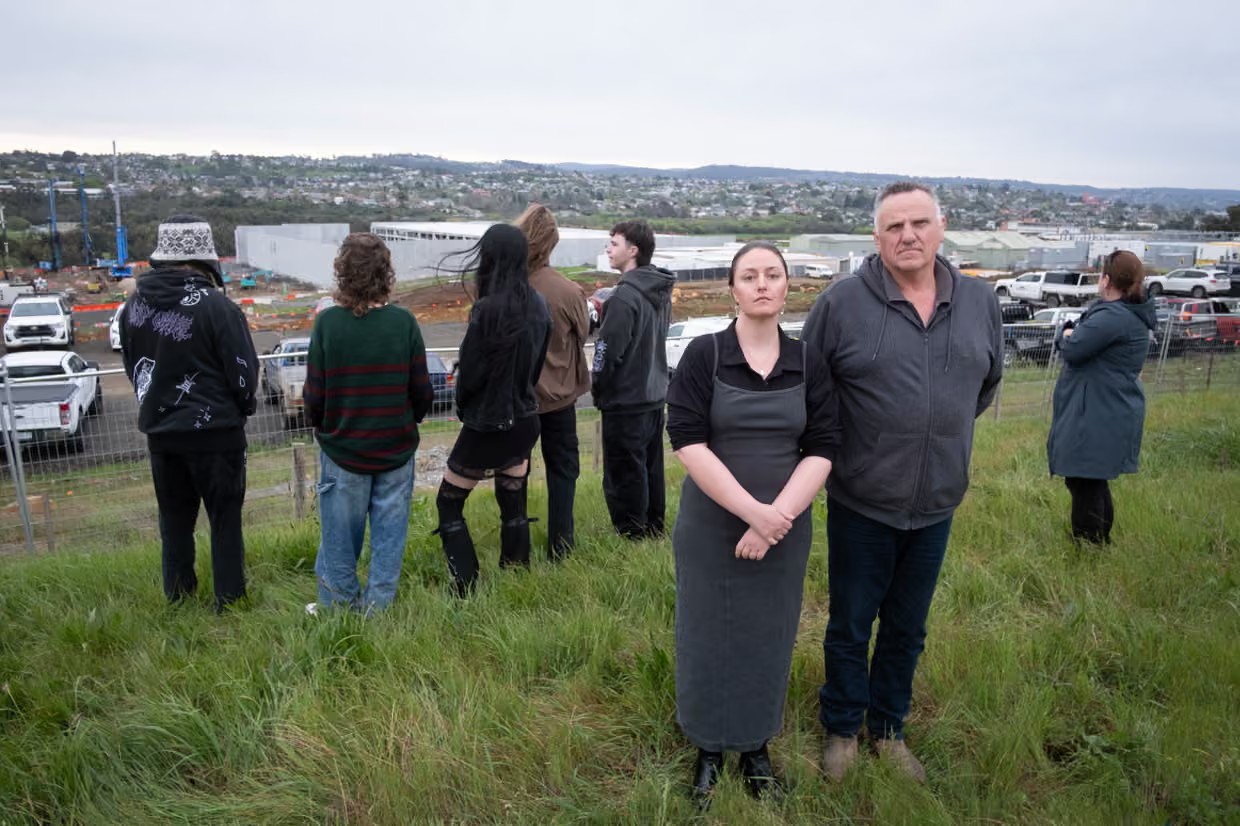
Kayla Thompson with members of a group campaigning against a Firmus AI datacentre at St Leonards, Tasmania. Photograph: Sarah Rhodes/The Guardian
Source: theguardian.com
The failed Firmus IPO may be a more revealing signal. It was meant to be Australia’s largest listing since Telstra. The company’s decision not to go public came after it abandoned a data-center project in Sydney — the first major project halted by local pressure. There may have been several reasons, including accusations of greed, but rising opposition to data centers is likely to have made some investors reconsider the prospects for building them at scale.
Consumers, creators and local communities are contesting the claim that this path is inevitable. Together, their actions show that democratic resistance has not run out of force. But the companies pushing this agenda have deep resources and influence, and are prepared to defend their interests with the persistence of an AI agent out of control.
The right to decide
The deepest threat to democracy is not only the harm that untested, unregulated technology can cause. It is the sense that people cannot influence what is happening to them. I think that distinction matters: opposition to a particular tool can be defeated, but a belief that decisions have already been made can hollow out democracy itself.
In the coming weeks, Australia’s parliament will debate privacy reform, a digital duty of care, data-center standards and rules for how the state uses technology on citizens. Workplaces will debate AI, employee surveillance and job displacement. Schools and social circles will have to decide whether to use bots and agents — and whether to use them at all.
Lewis acknowledges that these arguments can be exhausting and dispiriting. That, he writes, is what technology executives and their highly paid supporters are counting on: that people will tire and retreat into consumer services designed to satisfy every desire.
But Australians can still use elections to demand that those seeking to lead the country challenge the idea that this course is unavoidable. I think the harder task is making that demand count in the everyday decisions now moving from parliaments and workplaces to schools and communities.
Peter Lewis is non-executive chair of Essential, a progressive strategic communications and research company that conducted qualitative research for the Labor Party at the last federal election. He hosts the weekly podcast Burning Platforms. His columns carry the Proudly Human mark.
Daily AI news
Every day we pick what actually matters in AI and explain it plainly — no hype, no filler. Subscribe if you want to follow where the industry is going.
Only what matters — every day
Follow on X