
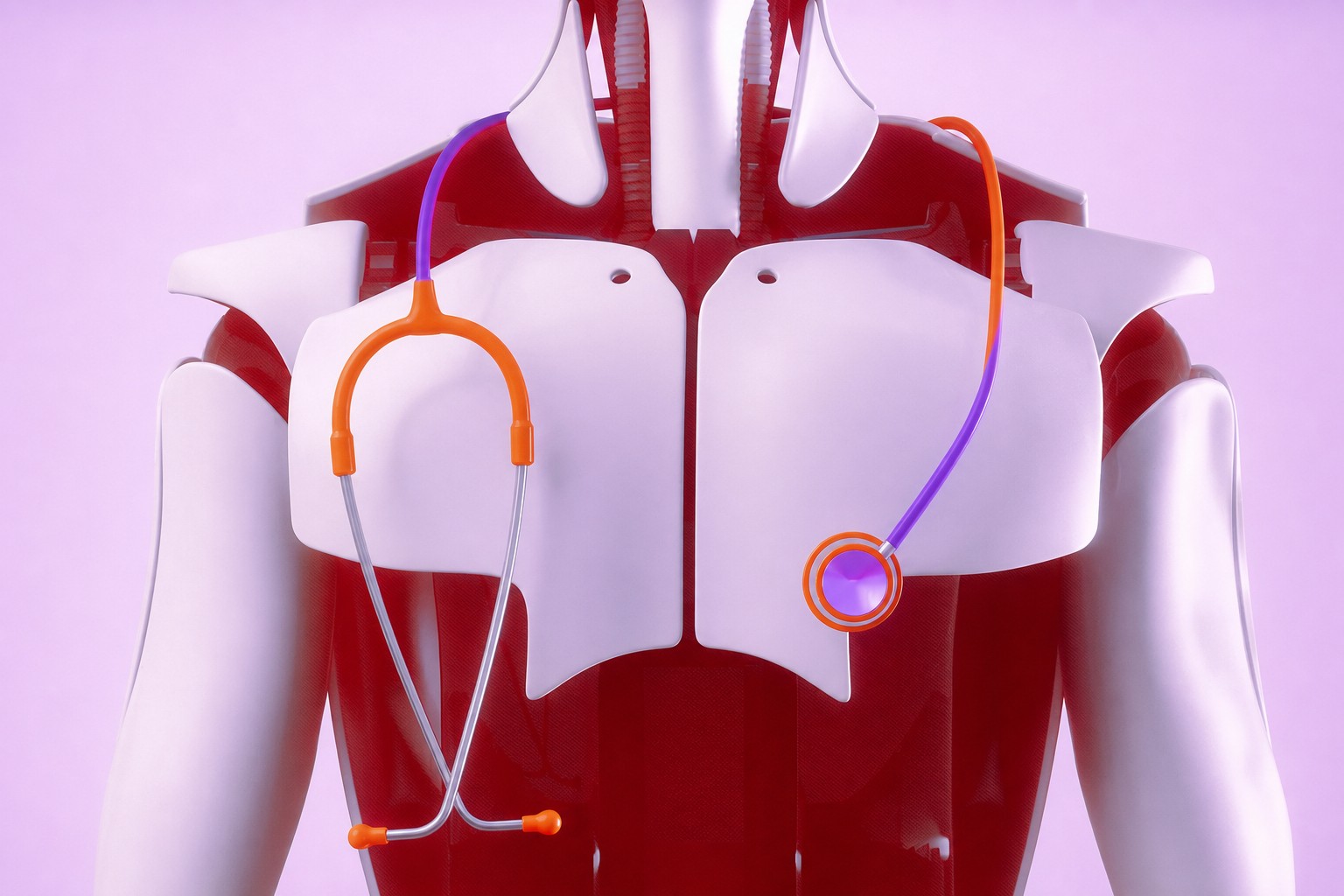
A paper published this month in the journal of the American Medical Association argues that autonomous AI — with no clinician in the loop at all — will outperform both doctors and doctor-plus-AI teams on five core clinical tasks, and that the crossover point is around 2030. Among the authors are Ezekiel Emanuel, who chairs medical ethics and health policy at Penn, and the investor Vinod Khosla. The AMA's own chief executive has publicly disputed it. The question mark in the title is not hedging: the authors' answer is yes.
The five tasks are not a narrow slice of the job. Taking a history, reaching a diagnosis, deciding which tests to order, prescribing treatment, and managing chronic disease is close to everything a physician does outside the operating room. The medical field has been converging on a hybrid model, in which doctors work alongside well-trained software. The paper's thesis is more aggressive than that: in some cases the best outcome comes from the AI alone, and clinicians should sometimes decline to intervene, because human participation can drag the system's performance down.
The authors say a review of every AI-in-medicine study published since January 1, 2024 points toward that crossover, and that "superior autonomous AI" will probably beat humans working with AI in many settings by 2030. They acknowledge the forecast is alarming. They make it anyway.
What gives the paper its weight is who signed it. Emanuel — brother of Ari and Rahm, and a well-known oncologist — spent years not believing AI could perform the central functions of medicine. He met Khosla at conferences through the 2010s, where Khosla repeatedly told him that by 2035 AI would do 85% of a doctor's work. Khosla has been making that case for a long time: a 2012 piece in TechCrunch titled "Do We Need Doctors or Algorithms?", then a 101-page treatment of the same argument in 2016. Emanuel thought it was impossible. The work, he believed, was too complex.
About a year ago his friend Robert Wachter, who runs the department of medicine at UCSF, sent him the galleys of his book "The Giant Leap." Wachter described a future in which top-tier medicine is built on doctors and AI working together, while most patients — the "economy class" — get by largely on AI alone. That was the point at which Emanuel began to allow that Khosla might be right, and at which a second question arrived: if AI takes over medicine, what are doctors for?
He proposed the collaboration to Khosla, who brought in his son Neal Khosla. Neal runs Curai Health, an internet company that uses AI to treat patients and also employs doctors, who prescribe medication and handle complicated cases. The paper discloses that conflict, along with Vinod Khosla's investments and Emanuel's grants and consulting work.
The sharpest public critic is John Whyte, chief executive of the American Medical Association — the body representing exactly the people whose future is in question. Whyte points out that a portion of the reviewed work rests on simulation rather than blinded experiment, and that not all of it supports the conclusion the authors draw from it. He also cites a February 2026 paper in Nature finding that in real-world conditions most patients could not talk to large language models effectively enough to reach what the models actually know. The AMA's position, he says, is that the tools have potential but belong inside a treatment plan a physician leads.
Emanuel's answer is that the conclusions were worded carefully, and that the timeline speaks for itself: ChatGPT is less than four years old, and the forecast runs four years forward. It is hard, he argues, to imagine AI will not be substantially better than a doctor by then.
That symmetry is the weakest load-bearing part of the argument, and it is doing most of the work. Four years back, four years forward treats capability as a line you can extend with a ruler, and the evidence base underneath it is a literature review that includes simulations — which is to say, a review largely of how models behave under conditions built to suit them. Combine that with an author list containing the investor who has argued this position publicly since 2012 and the founder of a company that sells AI-delivered care, and this reads less like a review that produced a conclusion than a conclusion that commissioned a review. The disclosure section is honest. It is also the most informative part of the paper.
The more interesting problem is one the paper's own cited evidence creates. Remove the clinician and the patient becomes the sole interface to the model — the person who has to elicit the history, describe the symptom precisely, and push back when the answer is wrong. The one piece of real-world evidence in the discussion, the Nature finding, says patients cannot currently do that. A benchmark win on diagnosis does not survive contact with a user who cannot phrase the question, and nothing in the forecast explains how that gap closes by 2030.
Wachter, asked for a second opinion — the paper's opening paragraph names him as someone who wrongly calls AI-only care "economy class medicine" — conceded there is something to the argument. AI already works well, and human-plus-AI is currently the better configuration, but he does not think that is a fixed law; sometimes people will make the system worse. He still insists the distinctly human capacities of trained physicians remain important and irreplaceable. AI may never learn to deliver a bad prognosis as well as a person can, and a real doctor may be more likely to steer a patient toward the right treatment.
He calls the opposite assumption the doorman fallacy, named for the fear that people who open doors for residents would lose their jobs once automatic doors arrived. In practice doormen do many other things and remain a fixture of expensive buildings: they take in Amazon packages, feed pets, and occasionally absorb complaints. Doctors, on Wachter's reading, end up similar — accepting the AI's diagnosis while performing a long list of other useful functions.
The analogy has a flaw Wachter's own framing exposes. What is displaced in medicine is not a simple operation like opening a door but knowledge and experience that take years of training to acquire. In the series The Pitt, Dr. Robby constantly tests his residents, demanding instant assessments of patients. Once an AI can produce those answers on demand, the drill loses its purpose, and doctors may come to rely on the system until their own knowledge and clinical judgement stop mattering. That deskilling can accelerate the handover: a new generation may see no point in spending years learning what an always-available expert in a coat pocket can be asked at any moment.
Whyte says this worries him. Medical schools and training programs are already debating whether students should be allowed to use these tools at all, and if someone never learned to take a history and perform a physical exam, it is unclear how they would acquire the skill later. The counterargument is equally uncomfortable: refusing a tool this useful can itself be considered a medical error.
Vinod Khosla thinks doctors will still be needed for surgery and emergency departments, at least in the near term. On expertise and clinical judgement, he expects most of them to become unnecessary — except perhaps as adversaries to the AI, whose pushback improves the systems. Neal Khosla thinks the transition has already started and expects regulators to permit AI to prescribe medication within the next few years.
In House, an abrasive diagnostician cracked the most obscure cases while insulting patients and humiliating his staff. In AI-based medicine House is out of a job: the system can apply an enormous body of knowledge to the rarest diseases, routinely and for free. The value would shift toward precisely what House lacked — empathy and a developed ability to talk to people. Specialists who do things with their hands are protected for now, until robots learn to do that too.
The argument does not stay inside medicine. In a recent critical essay on AI, Bill Gates suggested society may have to reserve certain tasks for people — doctors, for instance, helping patients cope with prognoses the AI delivered — as a way of containing economic crisis and mass discontent. It is hard to picture that pitch surviving a shareholder meeting, where jobs preserved for the sake of employment are the first line item questioned. The people on the wrong side of that arithmetic will at least have one compensation: top-tier medical advice, one tap away, from the system that took the job.