

Source: spectrum.ieee.org
From biology to machines
Mazzolai is associate director for robotics at the Italian Institute of Technology in Genoa and director of its Bioinspired Soft Robotics Laboratory. Her academic path spans biology, environmental management and microsystems engineering:
Her move into robotics began in 1999, when she joined a project seeking biologists to develop environmental-monitoring devices. She first worked on sensors and later on robots for monitoring air, water and soil.
That work gave her a practical reason to look beyond conventional machines. Most robots use tactile or proprioceptive sensors to understand their own position and movement. Far fewer use physical and chemical sensors to study the environment through which they move.
In 2004, before beginning her doctorate, Mazzolai became an associate professor and moved into bio-inspired robotics. With colleagues at Sant’Anna, she helped develop a soft robot modeled on an octopus. The goal was to show that a robot could remain soft while still applying significant force to its surroundings.
What roots can teach robots
Mazzolai’s work later expanded from animals to plants. Roots offered a particularly useful model because they explore underground spaces with little friction. A root grows only at its thinnest tip while the thicker section stays still, requiring far less energy than a conventional drill that pushes its entire structure through the soil.
Her team translated that principle into a robot with a miniature 3D printer at its tip. The printer pushes thermoplastic filament through a heated nozzle, building a snake-like body behind the machine as it advances through the ground. Sensors at the tip help it avoid obstacles and detect nearby nutrients or water.
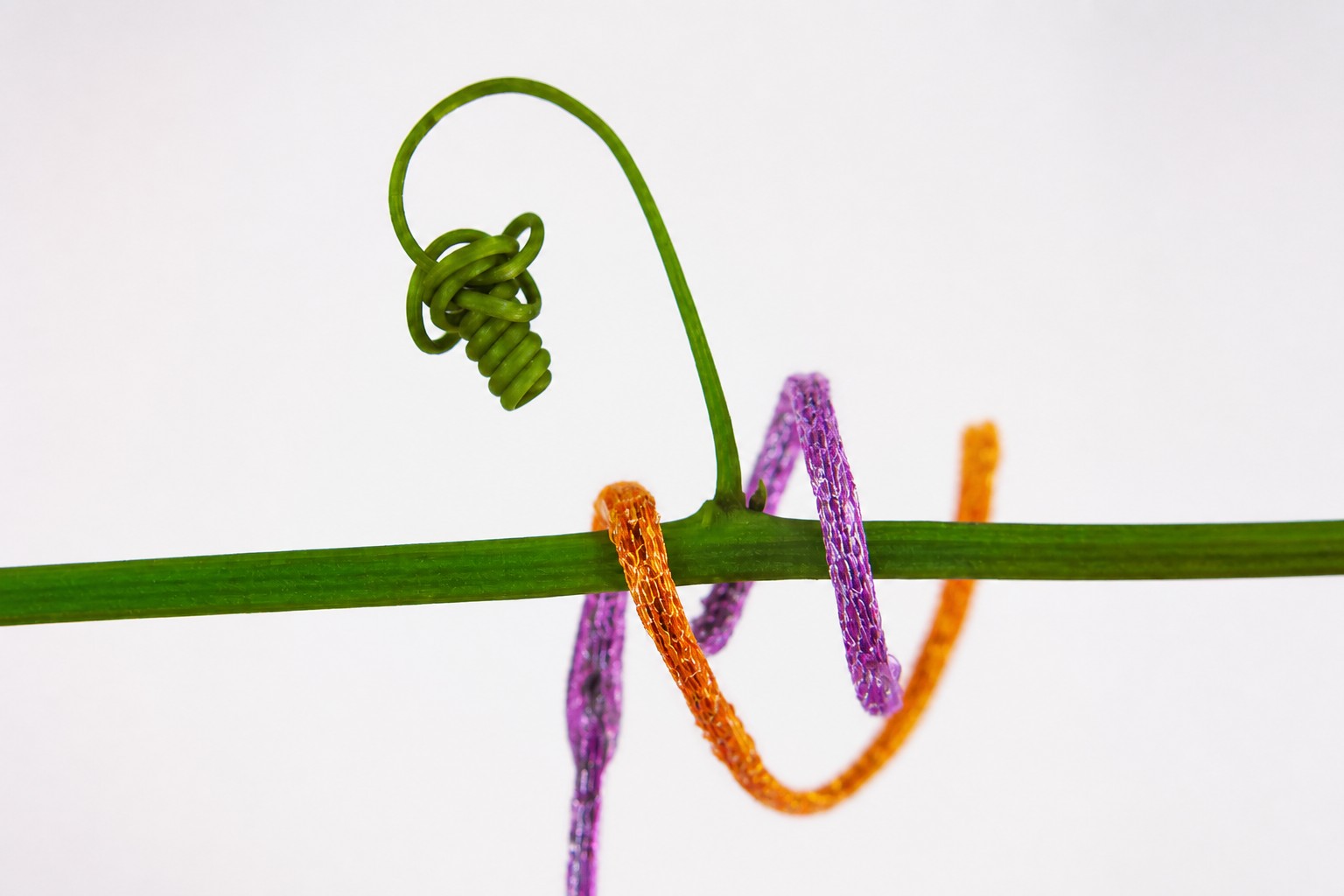
Another robot resembles a tendril and can wind around other structures like a grapevine.
The difficult part is not copying an organism’s shape. It is identifying the operating principle that makes the organism effective, then rebuilding that principle for a machine with a different purpose. Mazzolai says bio-inspired robotics sometimes requires “two separate brains”: one belonging to a biologist and one to an engineer.
Her process therefore starts with a detailed study of the model organism. Only after that do engineers try to reproduce the relevant behavior. A living organism is too complex to duplicate, and its goals are not the goals of a machine.
Plants initially seemed like an unlikely source of robotic ideas because they appeared stationary. Mazzolai argued that they are constantly changing through indeterminate growth: they grow throughout their lives, alter their form and behavior in response to their surroundings, recover from damage, sense conditions and exchange signals.
That view turns “bio-inspired” from a visual style into a systems question. The interesting property of a root is not that it looks unlike a drill. It is that its way of growing reduces the energy needed to explore soil.
The next constraint is the robot itself
For much of her career, Mazzolai borrowed solutions from the natural world. Her manifesto with colleagues asks robotics to examine what it gives back.
She argues that many technologies, including plastics and automobile batteries, were developed without enough attention to what happens at the end of their useful lives. Robotics, in her view, should avoid repeating that pattern by building environmental consequences into the design process from the beginning.
The proposed approach has three principles:
Mazzolai also wants designers to plan for what happens after a robot stops working. A machine could be reused, recycled or even made biodegradable once its useful service ends.
I think this is the more consequential shift in her work. Bio-inspiration can produce an impressive prototype, but it does not by itself answer whether the machine should be built, who can use it or what remains after the demonstration. Sustainable robotics tries to make those questions part of the technical brief rather than an afterthought.
What the manifesto leaves open
Mazzolai believes the necessary components for this approach already exist. She also sees sustainability as a way to attract future robotics researchers, particularly young scientists who want to build technologies that respond to continuing environmental damage.
The harder question is how the principles become measurable design constraints. “Minimal impact” could refer to materials, energy use, manufacturing, operation or disposal. Accessibility could mean price, availability or technical simplicity. Symbiosis could describe a robot that monitors an ecosystem, farms with less waste or simply causes less harm.
The manifesto establishes the direction, but not yet the accounting system. My guess is that sustainable robotics will become a meaningful field only when a robot’s environmental and social costs can be evaluated as rigorously as its movement, sensing and control. Until then, nature may still be supplying the better engineering standard.
Daily AI news
Every day we pick what actually matters in AI and explain it plainly — no hype, no filler. Subscribe if you want to follow where the industry is going.
Only what matters — every day
Follow on X