
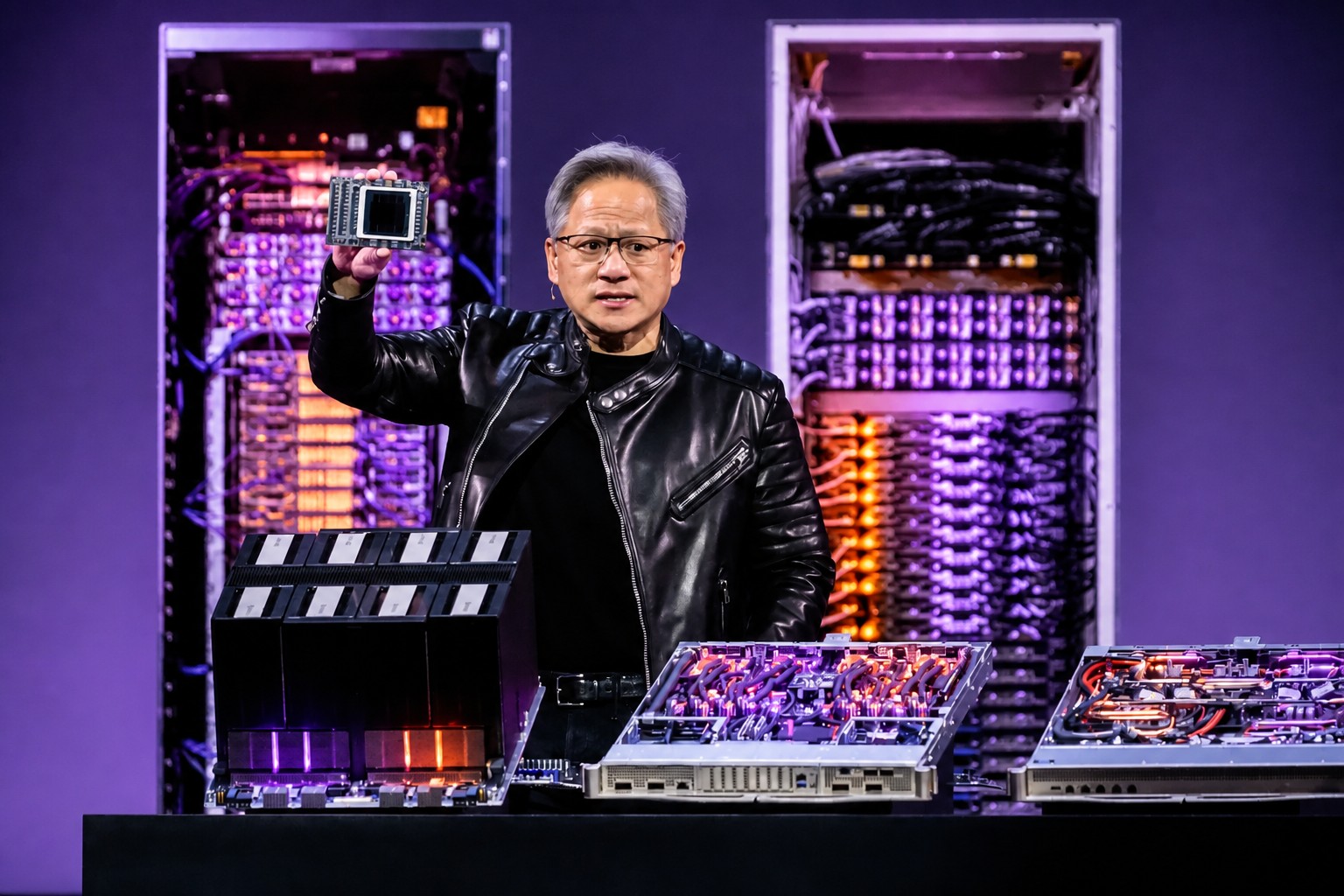
Nvidia's share of China's AI chip market has gone from about 95% before American export controls to zero, CEO Jensen Huang said in a May 2026 interview, warning that the policy "has already largely backfired." The controls, in force since October 2022 and tightened repeatedly since, were meant to deny Chinese labs the compute needed to build frontier systems. What they produced is a Chinese industry organized around needing less of it — and, as of January 2026, a Chinese customs service that freezes Nvidia shipments Washington has just approved.
The sequence is worth laying out, because each step was a response to the previous one. Export controls govern what American companies, and foreign companies using American technology, may sell abroad. In October 2022 the US Commerce Department barred advanced AI chips from China, starting with Nvidia's A100 and H100 — the processors on which nearly every leading model of that period was trained. Nvidia built slightly slower parts to stay inside the rules; in October 2023 Commerce added the A800 and H800 to the list. In December 2024 the controls were extended to high-bandwidth memory, the stacked chips that feed data to AI processors. In April 2025 licensing requirements hit the H20, a chip Nvidia had designed specifically around the earlier rules. Nvidia wrote off $4.5 billion of inventory it could no longer sell.
Two administrations held the same objective: strip China of compute and leave Chinese models years behind American ones. The premise was that advanced chips are a chokepoint resource with no substitute. But scarcity raises the price of a resource and, at the same time, raises the payoff from using less of it. The economist John Hicks called this induced innovation — invention aimed at whichever factor of production has become expensive. Michael Porter later made a related argument about regulation: strict rules can push firms toward solutions they would not otherwise have found, a claim now known as the Porter hypothesis. Washington made compute the most expensive input in Chinese AI, and Chinese engineers started engineering around it.
The clearest evidence is in the model architectures. DeepSeek released V3 in December 2024, trained on 2,048 Nvidia H800s — the degraded part that was still legal to sell into China at the time. Renting the compute for the final training run cost roughly $5.6 million. That figure comes from DeepSeek's own technical paper and excludes the full research budget, but it still sits far below what American labs spend. In January 2025 DeepSeek followed with R1, a reasoning model built on V3, which matched OpenAI's o1 — then the leading American reasoning system — on math and coding benchmarks while costing developers more than 90% less. Nvidia lost nearly $600 billion of market value in a single day, the largest one-day loss in the history of the US stock market.
Efficiency has kept climbing since. Chinese labs have gone deep on mixture-of-experts designs, in which a model is made of hundreds of small expert networks but activates only a few of them per word of output. DeepSeek's 2024 flagship engaged roughly 9% of its parameters for each word. The current V4.1-Flash activates about 3%, and Alibaba's Qwen models are moving the same way. Fewer active parameters means less computation, fewer chips, less electricity and cheaper answers. DeepSeek's newer model also compresses the KV cache — the working memory of the current conversation — into a lower-precision format, cutting memory per word to a quarter of its previous level. High-bandwidth memory was precisely what the December 2024 controls were meant to withhold, and this particular piece of engineering is what knocked South Korean memory makers' shares.
Then the hardware question closed too. When DeepSeek shipped its V4 series in April 2026, the models ran on Huawei, Cambricon and Hygon silicon on release day, and came with code for CANN — Huawei's answer to CUDA, the software layer that tied AI developers to Nvidia hardware for years. A model built from the start to run on Chinese chips is a model an export control cannot reach.
The second half of the strategy is distribution. DeepSeek and Alibaba ship open weights: anyone can download the model files, run and modify them locally, and build a business on top without permission or payment. Alibaba has open-sourced more than 460 Qwen models. In August 2025 Hugging Face, the main repository for open models, reported that Qwen had passed Meta and Google to become the most-downloaded model family in the world, with 3 billion downloads and more than 300,000 derivative models built by third parties.
Giving away an expensive product looks like charity. For a company that cannot win on raw capability, it is a standard distribution play. Open models entrench themselves among developers the way other technical standards do: engineers learn their quirks, build tooling, fine-tune them for particular industries, and every derivative deepens the sunk investment in that ecosystem. In October 2025 Airbnb CEO Brian Chesky said his company "heavily relies" on Alibaba's Qwen in production because it is fast and cheap — a statement that later drew questions in Congress. American startups that would never buy a Chinese chip are building on Chinese models, because those models are good enough for most tasks and cost almost nothing to run. A model that activates 3% of its weights is cheap enough for a mid-sized company to host itself.
Nvidia is the clearest loser. In fiscal 2025 it booked about $17 billion of revenue in China, roughly 13% of its total. Washington has since tried three times to reopen the channel, and the shape of those attempts is telling. Under an August 2025 arrangement Nvidia agreed to remit 15% of its H20 China revenue to the US government. In December 2025 H200 sales were cleared in exchange for a 25% government cut. In January 2026, within hours of the American approval, Chinese customs froze the H200 shipments. Nvidia then removed Chinese data center revenue from its guidance entirely. After three years of building substitutes, China started restricting American chips on its own account.
Here is where I part company with the official reading. The strongest case for the controls came from Anthropic CEO Dario Amodei, who argued after R1 that DeepSeek's efficiency gains strengthen rather than weaken the rationale: efficiency is available to everyone, American labs included, so the frontier still belongs to whoever has more compute, and withholding chips keeps pushing back the date on which Chinese labs catch the best American systems. On the narrow question of who can train the single most capable model, that logic holds. It is also the wrong question for most of the market. Market share is set by price as much as by frontier capability, and the everyday choice for most companies is the model that is easy to obtain and cheap to run. On that axis the controls handed China the exact advantage they were designed to deny it.
Two things in this story get misread, and both are visible in the source material. The $5.6 million did more work in public argument than it can carry — it is the rental cost of one final training run, self-reported, not the cost of building DeepSeek. And the decisive move was not the benchmark parity in January 2025 but the software shipped in April 2026. Nvidia's durable advantage was never only the chips; it was CUDA, the layer on which two decades of AI development was built. Every major Chinese release now arrives with software for domestic silicon, which lowers the switching cost for the next developer who decides CUDA is optional. That compounds in a way a benchmark score does not.
Washington understands the stakes in outline. The July 2025 AI Action Plan and its accompanying executive order directed the administration to promote exports of "full AI technology stacks" — chips, models and applications together — on the theory that the country whose stack the world builds on gains lasting economic and security advantage. The problem is that the open layer of that global stack gets more Chinese by the week, and one of the standing questions about the next year is whether American labs will ship open-weight models competitive enough to pull developers back and climb the Hugging Face download rankings. That the question is open at all is the measure of the policy's result.
The part that should worry American officials most is the part open weights do not solve. Chinese models are trained to observe Beijing's information restrictions, and when they sit underneath global applications, state-shaped answers end up inside products users never associate with China. The House Select Committee on China found that DeepSeek's hosted services send American user data to China, where intelligence law obliges companies to cooperate with the state; federal agencies and several states have banned the app on government devices. Running the weights on your own servers fixes the data problem and not the behavior one: a model cannot be audited the way source code can, and whatever is baked into the base model propagates to every application built on it.
So the live question is no longer whether the controls slowed China down. It is whether Washington keeps unwinding them — as it did with the H20 in August 2025 and the H200 in December — and whether Beijing keeps refusing the chips anyway. A policy that ends with the United States asking China to buy Nvidia hardware, and China declining, has stopped being leverage and become a negotiation the other side no longer needs to have.