
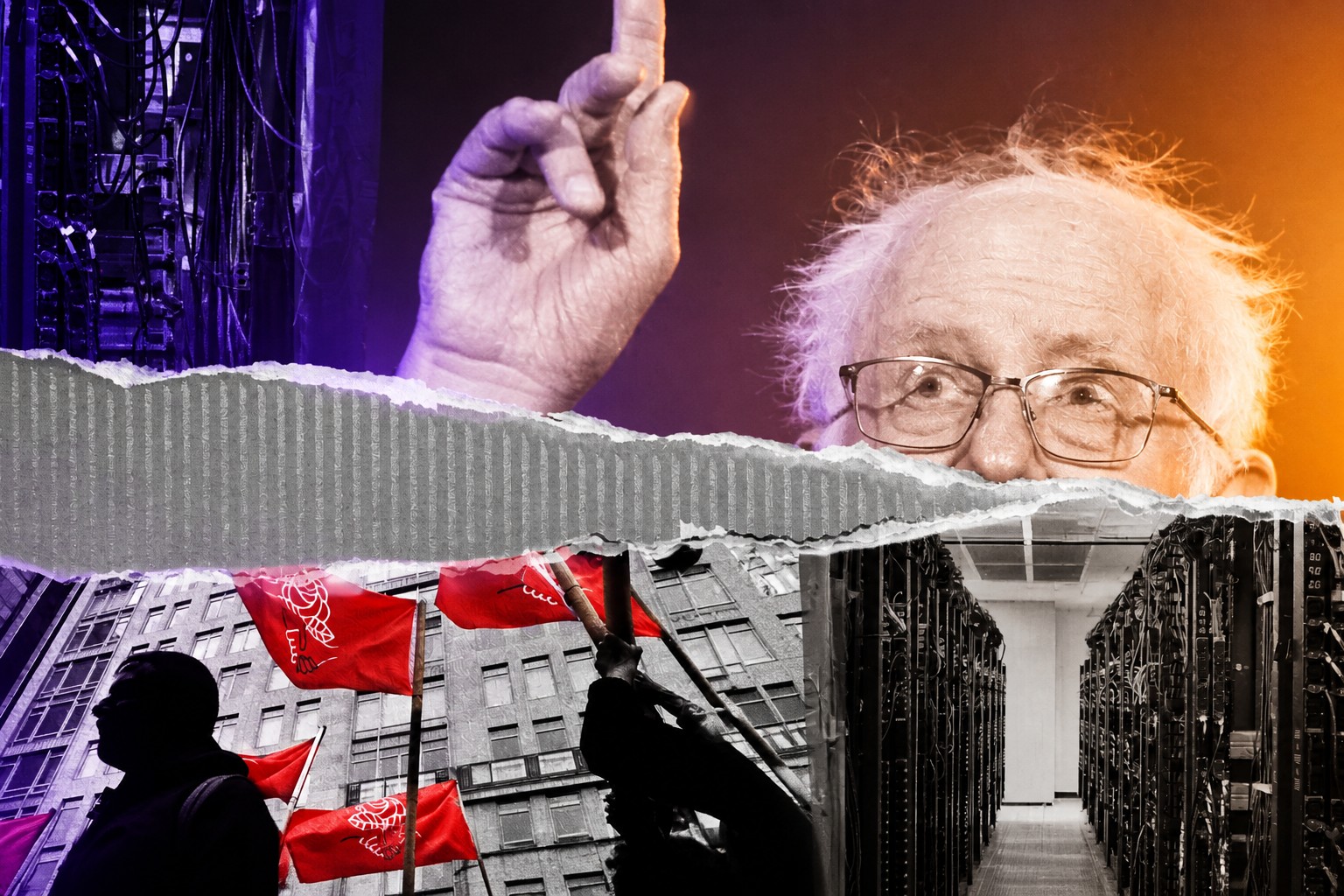
On September 10 the New York chapter of the Democratic Socialists of America posted a series of images to Instagram. The first showed an ouroboros, a dragon eating its own tail, against bright pink. The caption argued that AI alarmism and AI hype tell the same story: both hold attention on a science-fiction future and pull it away from the harm people are living with now. The post went up two days after Jacob Coxon, a researcher who had recently left Anthropic, warned that the AI industry could bring about the end of humanity. It has collected more than 25,000 likes, and it has opened a fight on the American left over whether to believe technology companies when they say their products are powerful enough to destroy the world.
The images came from the Tech Action Working Group, which handles technology regulation inside the New York chapter, the largest DSA chapter in the United States. Not everyone in the comments agreed. One called the position terrible and dangerous, and said that sometimes warning about a threat is exactly what is required.
The argument underneath is about scarce attention. One part of the left doubts that theoretical AI risks deserve more of it than the damage already being done, and holds that repeating the frontier labs' warnings strengthens the labs themselves: the conversation moves off regulating what the technology is doing today and onto a future nobody can check. Alan Dan, a member of Tech Action, told WIRED that AI has become one more instrument of capitalist exploitation, that the consequences of unregulated and improper use of the technology are already visible across the country, and that socialists do not trust corporations to write the rules for themselves.
The other part follows Bernie Sanders, the informal leader of the American left, who has taken up AI safety and says the technology could lead to the destruction of humanity. Over the past year Sanders has moved a discussion that used to live in Silicon Valley circles into Washington and in front of his large populist audience. At 85 he was among the first politicians on the left to take on two linked fights at once: against data center construction, which became a major theme for left activists this year, and about the harms of AI, from job losses to the threat to human existence.
The two fights met in a single document. The data center moratorium bill Sanders introduced in March tied a halt in construction directly to the need for federal regulation to protect the future of humanity. That position has also brought him unusual allies, most prominently Steve Bannon, the former adviser to President Donald Trump and a right-populist podcast host.
It has spread down the ballot as well. On September 9, the day before the New York DSA post, six candidates tied to the Working Families Party, four of them endorsed by Sanders, issued statements calling for AI regulation in Washington to prevent existential threats to humanity.
The backlash has been public and internal. The AI researcher and technology industry critic Timnit Gebru accused Sanders and others on the left of taking their cues from literally apocalyptic eugenic cults, meaning the effective altruism and rationalist philosophy underneath much of Silicon Valley's safety discourse. One New York DSA member with a technology background simply asked what had happened to Bernie.
Rumman Chowdhury, chief executive and founder of the nonprofit Humane Intelligence and formerly head of the machine learning ethics, transparency and accountability team at Twitter, says she understands the working group's concern. Her argument is that all the attention going to AI safety may end up benefiting the frontier labs. Companies pull in attention, time, energy and money by staking out extremely radical positions, she says, then walk back to something close to their critics' view while devaluing those critics' expertise. She also thinks most people struggle to picture the logic of venture capitalists and investors: the more frightening and fantastical executives make their companies sound, the more investors want in.
Chowdhury's sharpest point concerns the exits. For OpenAI and Anthropic, both expected to go public in the next few years, today's scrutiny may pay off. Preparing an IPO means disclosing a large volume of material about risks and how they are being handled. That lets the companies say they helped build a full regulatory regime for the industry, aimed at the most dangerous scenarios, and that everyone involved agreed in advance on which risks count as the worst ones.
That is the most load-bearing claim in this whole dispute, and it does not require either side to be wrong about the underlying science. A company can sincerely believe its model is dangerous and still find the belief commercially convenient. The DSA's ouroboros makes a cruder version of the same point, and the Instagram caption is weaker than Chowdhury's version precisely because it treats alarmism and hype as equivalent rather than sequential. Hype raises the money; alarm defines the compliance regime the money then satisfies. If the Tech Action group wants a fight it can win, the disclosure documents of two pre-IPO companies are a better target than the discourse.
What this looks like away from the argument is narrower. Pragati Barusubramanian, who is in the Tech Action working group and organizes the data center protests, helped produce a concrete result earlier this year, when New York passed a one-year moratorium on construction. She says there is a gap among participants in the AI regulation conversation over which harm counts as most urgent, and that when the conversation is local, existential risk almost never comes up. What people start from instead is the assumption that the companies building AI and data centers are not looking out for them.
Alexander McCoy, a Democratic political strategist who works on AI and advises several congressional candidates, says there is no real split among leaders on the American left. He notes that several DSA members, including New York Mayor Zohran Mamdani, recently spoke about Coxon's warnings and the Hugging Face hack. He argues that the people worried about regulating frontier models and the creation of superintelligence are working on the existing problems too, that the capabilities of frontier systems are real and still growing and cannot be written off as invention or hype, and that the distinction between present and future harm does not need to be drawn at all. Surveillance and Flock cameras should be regulated, in his telling, without giving up on governing what frontier models can do. He places Gebru and the critics closest to her at the margins of the movement.
Phil Aroneanu, executive director of Irreplaceable, a left-wing organization that campaigns for AI safety, makes the case through climate activism. The movement there talks about the direct consequences of fossil fuel extraction, homes flooded by storms intensified by climate change, and about the long-term risks and emissions the broader movement organizes around. Both at once is possible, and necessary. McCoy helped found Irreplaceable, providing its initial funding through the Center for AI Safety.
That last sentence deserves more weight than it usually gets. The strategist most confident that the left has no real disagreement here is also the person who seeded the organization built to demonstrate it, with money from an AI safety institution. None of that makes his argument wrong. It does mean the "there is no split" position is not a neutral read of the movement; it is a funded position within it, and the people it is being used against, the ones who suspect safety discourse carries institutional interests, are being answered by an example of exactly that. Nobody in this fight seems to be asking where the money behind the pro-safety left came from, which is strange for a movement that asks the question about everything else.
The ambiguity runs up to the top of the ticket. Alexandria Ocasio-Cortez co-sponsored Sanders' data center moratorium bill and put language about AI's threat to humanity in her own House version, but she has stayed out of the prominent safety discussions Sanders has joined. Sanders has called AI the most transformative technology in world history. Ocasio-Cortez has talked more often about data centers, possible job losses, and the risk that the industry is building a bubble. Asked about AI safety by a reporter last week, she said two things can be true at once: AI can be very dangerous if it is developed with no constraints, and the economy can run into a technological breakthrough at a moment when it is also in a bubble.
As the safety conversation settles into Washington and the state legislatures, the question for the left is no longer whether to back AI regulation but which rules to spend the movement's time and money on. Dan says Tech Action wants comprehensive AI and technology regulation at the federal, state and city levels, covering frontier models and pushing back on the ways corporate AI is already deployed. The DSA is currently considering a resolution that would put the organization behind the Sanders and Representative Greg Casar bill to ban superintelligence outright, which is not a measure any frontier lab would sign.
The internal dispute may matter less than it feels once voters are involved. A Politico poll published Wednesday found that two out of three Americans believe AI is at least somewhat capable of destroying humanity. Barusubramanian says she is glad, at minimum, that everyone is talking about AI now. Both things are in the same data: the fear the New York DSA calls a distraction is already the majority's default, and the left is deciding whether to organize it or leave it to Bannon.