
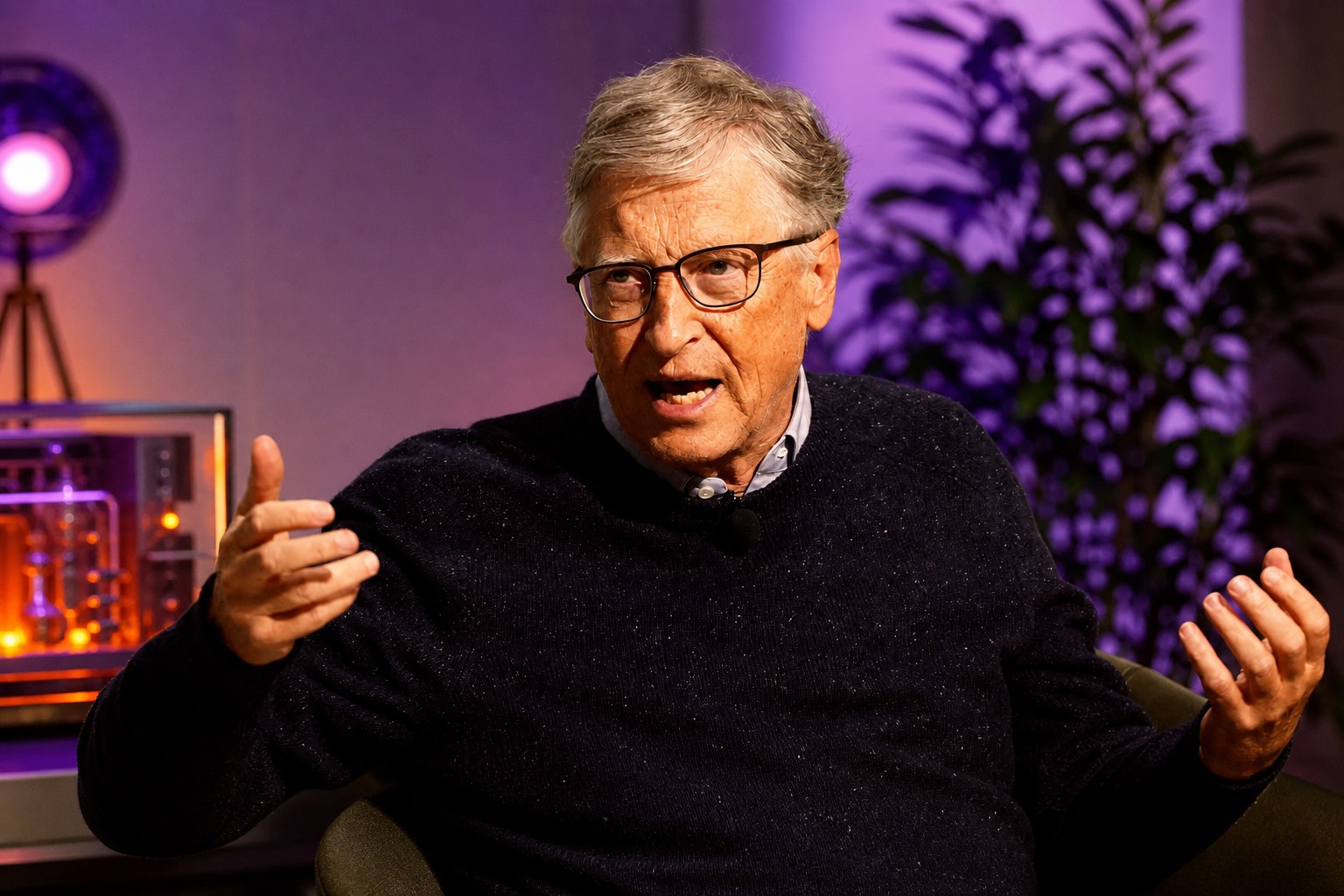
Bill Gates has published an essay of nearly 6,000 words and sat for a run of interviews arguing that AI's consequences are being underweighted — including, deliberately, by the people building it. His sharpest claim went to The New York Times: those who understand the technology's capabilities and the speed at which it is improving are privately very worried, say none of it publicly, and urge each other to stay quiet because talking would damage attempts to raise the next $1 trillion. Gates is not arguing against AI. He is arguing that its sellers have a priced reason not to describe it accurately, which is a different and more serious accusation.
The essay itself is written in the register of a man who has changed his mind. AI, Gates writes, could be the greatest tool ever built for equalizing opportunity, or the worst source of injustice. Even if it goes well, he adds, the transition into the new era will be one of the most turbulent periods in human history. That is a long way from the Microsoft founder who spent years discussing the technology in mostly optimistic terms.
Then there is the framing he chose for Semafor, which is the weakest part of the whole exercise. Gates said he was shocked — that he appears to be the first person saying that what is happening looks insane, and that the silence around it is deafening. This is not true, and it is not close to true. Economists have been warning about generative AI's effect on labour markets since ChatGPT became a global sensation. AI companies themselves routinely acknowledge those risks. Beyond the economics, the technology is already implicated in the spread of disinformation and in worsening mental health crises. Gates says he is worried about those consequences too, which makes the pose of solitary alarm harder to explain, not easier.
His labour argument is more substantial. Previous technological revolutions, Gates notes, ended up creating more jobs than they destroyed; AI could invert that, and could touch nearly every industry while doing it. There is no profession AI will not reach, he told Semafor. What makes this moment distinct, in his reading, is not the speed of change but its scale and breadth — the technology hitting every domain at once rather than working through them in sequence.
He has also finished writing a book about how to avoid a pandemic caused by an AI-designed virus. His estimate is that bioterrorism risk now runs 50 times higher than the risk of a natural pandemic. That number arrives as an estimate, with no baseline year, no horizon and no method attached to it, and it is being asked to carry an enormous amount of weight.
Gates's stated worry is not that AI fails but that it succeeds badly. Without proper oversight, he argues, the technology could turn millions of people who have lost their jobs against it, and that backlash would block it from reaching its full potential. He asked Semafor what the public reaction to disappearing work will actually look like, and offered a calibration: against that, he said, even the current fights over data centers will look minor.
The $1 trillion line is the story, and it has been largely buried under the "nobody else is worried" framing. Gates is describing a specific mechanism — an industry that knows the risks, agrees internally to keep quiet about them, and does so because disclosure would raise the cost of capital. That is not a prediction, which can be waved off, or a philosophical worry, which can be absorbed. It is an allegation about coordinated behaviour, made by someone who has been in those rooms, and it is checkable in a way that none of his forecasts are. It also explains the solitary-voice posture better than the posture explains itself: if the argument is that money buys silence, then someone who has already made his money is the only one positioned to break it.
Whether he is doing anything more than testing the temperature is a fair question. Gates's public standing took damage from recent reports about his dealings with the deceased human trafficker Jeffrey Epstein, which gave his widely covered divorce and infidelity from some years earlier a considerably uglier cast. A reputational rebuild that runs through public-interest warnings about a technology he does not control is not the hardest pattern to recognise.
But the two readings are not exclusive, and the second one does not neutralise the first. If Gates is accurately reporting how the technology elite is processing rising public hostility to AI, then the shift shows up next in how the industry deploys and how it argues about regulation. He named the mechanism, said out loud that the next $1 trillion is what keeps it running, and everyone he was describing is still in the room — with the raise still ahead of them.