
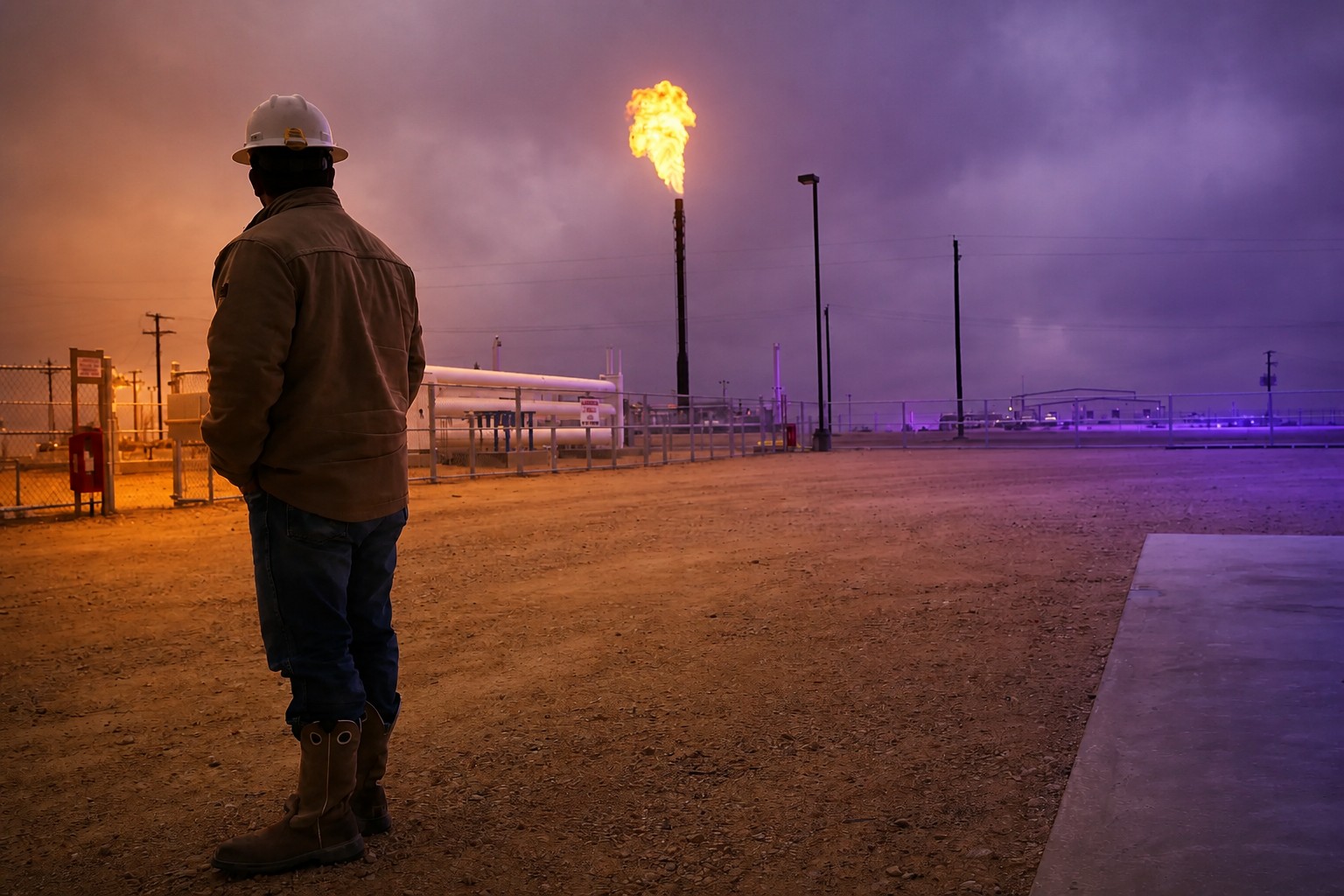
BloombergNEF now expects US data centers to burn roughly 18 billion cubic feet of natural gas a day by 2035, almost double what the same firm projected nine months ago. That makes data centers the second-largest driver of gas demand growth over the next decade, behind only LNG exports. At 18 billion cubic feet a day, American data centers alone would consume more gas than Germany and Japan combined. The revised figure is not a count of announcements: BloombergNEF built it assuming that not every announced project gets finished.
The part of this that has drawn attention over the past months is the smallest part of it. Meta, Microsoft, Google and Amazon have all announced plans for new gas plants that generate power on site and stay off the grid. By 2035, those behind-the-meter projects are expected to consume between 2.9 and 3.4 billion cubic feet a day — roughly what every data center in the country consumes today, including the gas burned on their behalf by grid generators. It is a striking number in isolation and less than a fifth of the total.
The other 15 billion cubic feet a day lands on the grid. BloombergNEF puts that as the additional daily gas consumption grid-connected data centers will add to the power sector by the middle of the next decade, and offers a comparison that does more work than the headline number: through 2035, that growth is five times the combined increase in demand from every other grid-connected sector.
If the demand materializes, gas prices go up. Many data center projects are currently underwritten on the assumption that the stable gas prices of recent years hold. Analysts at Noreva think that bet may be wrong, since data center construction and LNG export growth arriving at once could push prices sharply higher. Tech company financials may be able to absorb that. Utility customers on the same system may not be ready for it.
The emissions arithmetic is straightforward and worse than the price arithmetic. The International Energy Agency puts the full lifecycle emissions of one cubic foot of natural gas — extraction, processing and transport included — at the equivalent of 60 grams of carbon dioxide. The additional data center demand therefore adds about 1 million metric tons of greenhouse gas pollution per day, a figure set against all US greenhouse gas emissions today at roughly 12%.
The revision itself is the story here, more than the level. Nine months is shorter than the permitting timeline for a single combined-cycle turbine, and in that window a serious forecasting shop doubled its view of how much gas this industry will burn in 2035. That is not a refinement, it is an admission that the models cannot keep pace with the announcements. The direction of the error also matters: forecasters have been revising up, not down, which means the base case has been consistently behind what the buildout actually does. And 18 billion cubic feet a day is what remains after the haircut for projects that never get built. The optimistic reading is already priced in.
The forecast models demand. It does not model who pays for what the demand does to price, and that is the gap where this goes political. A hyperscaler signing a twenty-year supply arrangement is buying insulation from exactly the price move it is helping to create. A residential customer on the same grid has no such instrument and no say in the interconnection queue. Noreva names the exposure; nobody has quantified it, and no regulator's rate case has yet been built on a forecast this size.
Every project in the 18 billion cubic feet was financed on the assumption of cheap gas. Together they are the reason gas stops being cheap.