Finding links across fields
Schwartz’s case for BootLoops rests on the gaps between established disciplines. He compares human knowledge to a “convex hull”: fields advance along their own paths, leaving the spaces between them less explored. A lab might spend 20 years studying one group of genes with one method without examining nearby genes or alternative approaches. BootLoops is meant to help search those boundaries.
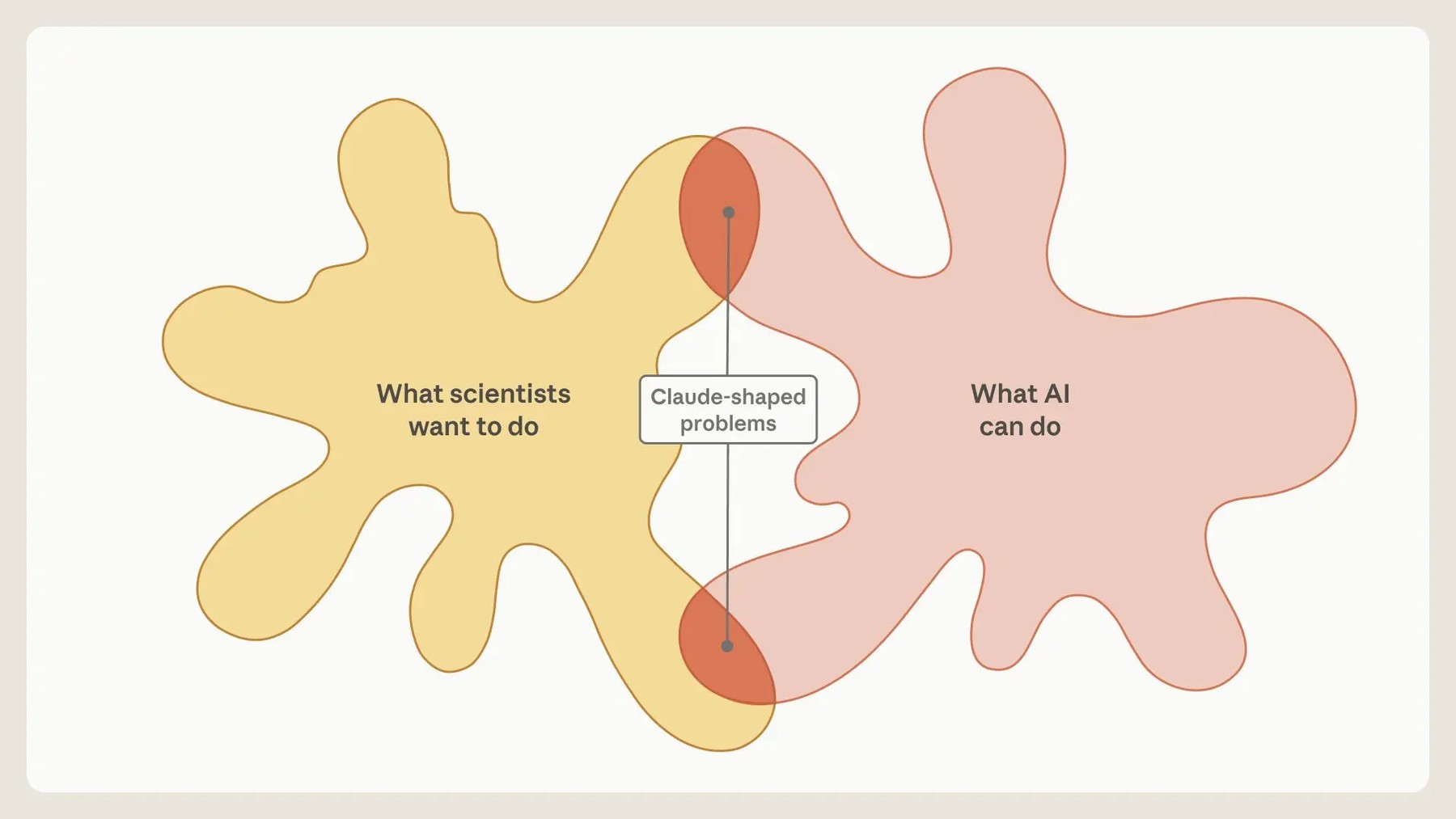
"Claude-shaped problems" sit at the overlap between what scientists want to study and what AI can actually do. | Image: Anthropic
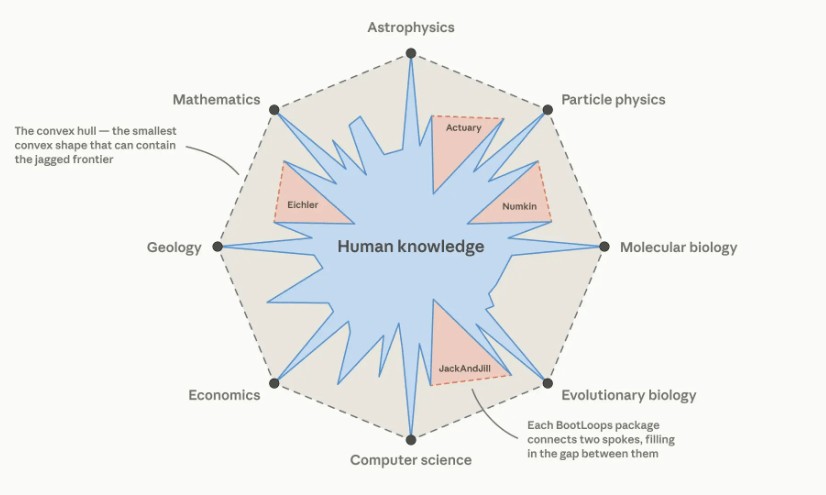
Human knowledge spans various disciplines while the gaps between them remain uncharted. AI harnesses like BootLoops are designed to fill those gaps. | Image: via Anthropic
Source: the-decoder.com
Source: the-decoder.com
The early projects ranged from physics to ecology and language. In particle physics, Claude computed 30 integrals with BootLoops: 15 matched known results, while 15 had not been calculated before. In ecology, it solved an equation from neutral biodiversity theory that had resisted calculation at that scale for 20 years. Applying the result to data from Barro Colorado Island in the Panama Canal, researchers found that tree species composition changed 4.5 times faster than the theory allowed. Ecologist James O’Dwyer helped turn that observation into an improved predictive model.
Other projects included an analysis of 5.7 billion pairs of mutations from the 1000 Genomes Project, which found evidence of gene conversion, and tools for economic research and linguistics:
Speed changes the training question
Schwartz argues that AI is already changing how researchers plan work. If a model can complete a calculation overnight, he asks, what is the case for applying for a three-year grant to do it?
That pressure also reaches graduate training. Schwartz once considered “Python for engineers” an essential course; now he thinks Claude can handle the tasks it teaches. He also expects AI to take on building machine-learning models for studying physical phenomena, reducing the advantage of knowing neural-network methods in depth when Claude can implement current techniques on request.
Faster calculations still need scientists
The project’s limits complicate any claim that AI can do research on its own. Schwartz says Claude can declare victory before a task is complete, misjudge how long work will take, and brute-force calculations instead of finding more elegant solutions. Automated checks are not fully reliable, and conclusions can be wrong even when the calculations are correct. He also notes the projects’ high computing and token costs.
I think the most important result here is not the claim that Claude can replace scientific training. It is that the tool can make some calculations cheap enough to attempt, while the choice of question and judgment of the result remain human work. Schwartz says the research gained scientific value when specialists directed it. The unresolved tension is whether faster computation will broaden scientific inquiry—or simply make researchers reach familiar questions sooner.
Daily AI news
Every day we pick what actually matters in AI and explain it plainly — no hype, no filler. Subscribe if you want to follow where the industry is going.
Only what matters — every day
Follow on X