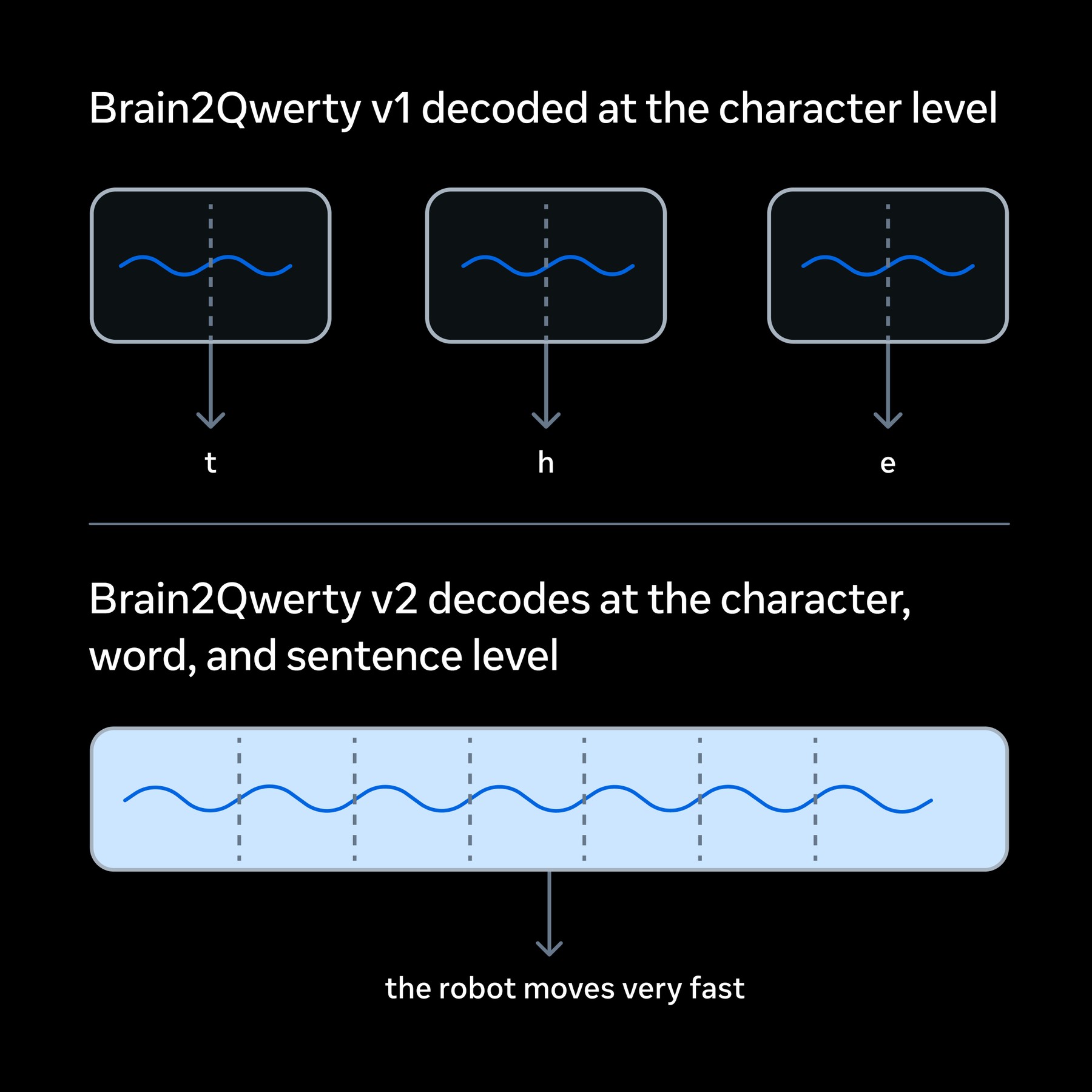
A brain-to-text decoder that requires no surgery has reached 61% word accuracy on sentences read out of magnetoencephalography recordings, against 8% for other non-invasive methods. Brain2Qwerty v2 is an end-to-end pipeline that decodes sentences in real time, and its authors say it is approaching the accuracy of decoders that need an implant. The team is releasing the full training code for both v1, presented last year, and v2. Its partner, the Basque Center on Cognition, Brain, and Language, is publishing the v1 dataset.
Source: ai.meta.com
The clinical target is people with brain damage who have lost the ability to speak or write. That case has already been made with surgery: stereotactic electroencephalography and electrocorticography have shown that a neuroprosthesis feeding signals to an AI decoding system can restore communication. What they have not shown is how to scale, since every user needs an operation. The non-invasive route exists to close that distance, and until now it has been far behind — 8% word accuracy is not a communication device, it is a demonstration.
Source: ai.meta.com
Brain2Qwerty v2 was trained on about 22,000 sentences from nine volunteers. Each spent ten hours inside a magnetoencephalography machine, actively typing.
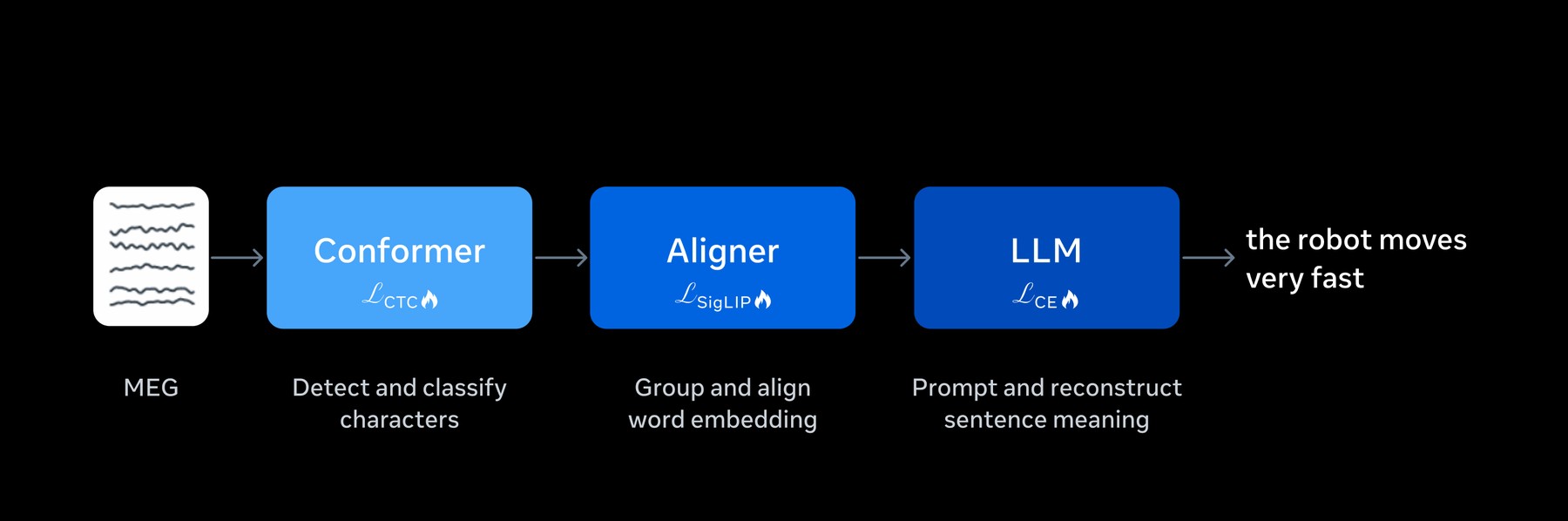
Rather than hand-designed pipelines that hunt for individual neural events, the team used end-to-end deep learning that decodes directly from the raw brain signals. Large language models fine-tuned on neural data supply semantic context, which is what lets the system tie noisy recordings to language that stays coherent across a sentence.
Source: ai.meta.com
AI agents were used to search for optimizations to the decoding pipeline, but the engineers chose the final training configuration by hand. That division of labor is stated plainly and is worth keeping in mind whenever a lab says agents helped: here they searched, humans decided.
The result is connected sentences recovered from noisy neural signals. Word accuracy came in at 61%, and for the best participant it reached 78%, with more than half of all sentences decoded with one word error or none.
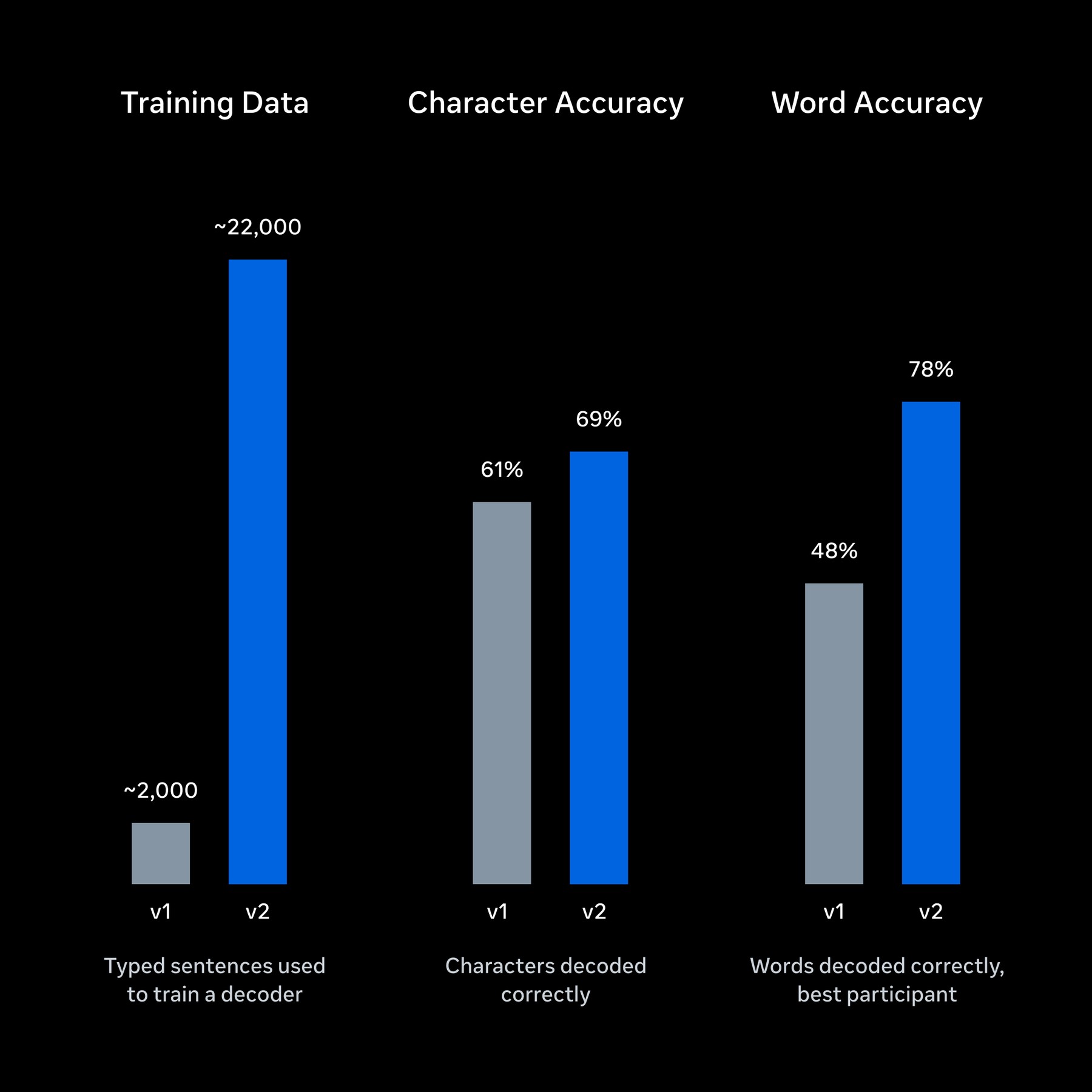
Source: ai.meta.com
The authors also found that decoding accuracy rises logarithmically with the amount of data, which they read as evidence that the remaining gap to surgical methods can be closed by collecting more.
The work sits inside a broader program to build open foundation models of the brain, alongside Tribev2 for encoding perception, NeuralSet for processing brain data at scale, and NeuralBench for evaluating models systematically. Through the Digital Brain Project initiative, the team recently set up a $5 million fund to support open datasets, on the argument that neurological disease will be identified, diagnosed and treated faster through open work than through labs operating alone.
Source: ai.meta.com
The number I would watch is not 61% but the seventeen points between it and 78%. An average over nine people is a research result; a communication prosthesis has to work for the one person sitting in front of it. If the best participant is that far above the mean, then the variable that decides whether this helps someone is not the model but the individual brain, and nothing in the release says why one participant decoded so much better than the rest.
The release itself is also asymmetric in a way that is easy to skip past. Training code goes out for both versions; the dataset that goes with it is v1's, from the partner institution. The 22,000 sentences behind the 61% figure are not part of the announcement. For a project whose stated theory is that open data accelerates the field, and which has just funded open datasets to the tune of $5 million, the newest corpus staying in-house is the gap between the argument and the shipment.
And a logarithmic curve is a promise and an invoice at the same time. Reading it the authors' way, the remaining distance to implant-level accuracy is purchasable — but each further point costs a multiple of the data that bought the last one, and that data comes ten hours at a time, one volunteer at a time, in an MEG machine.