
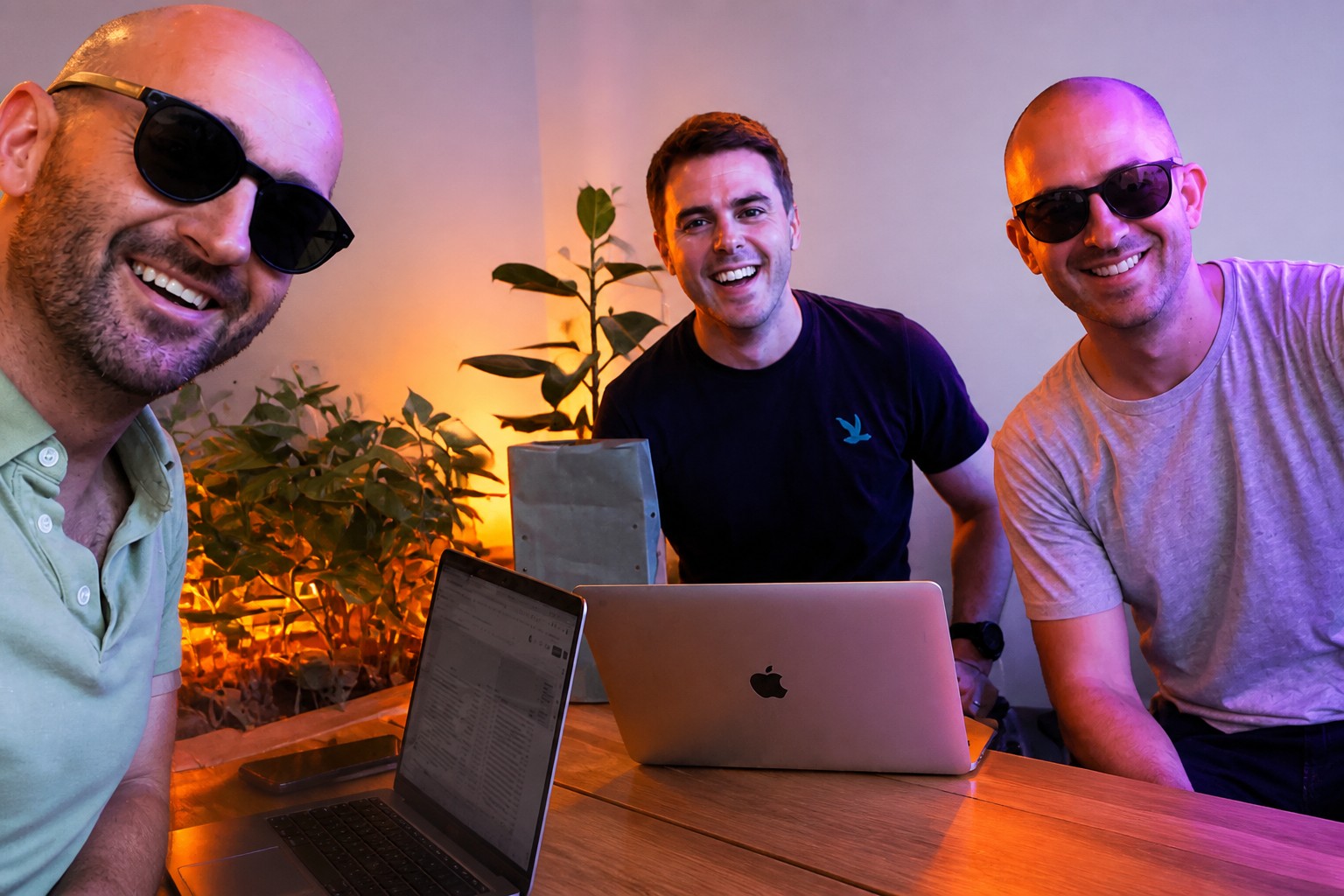
Three Australian brothers, working out of Southeast Asia with about a dozen employees, have assembled a network of at least 24 acquired websites that claims more than 50 million pageviews a month and fills them almost entirely with machine-written text. A Futurism investigation published this month identified more than 50 invented authors across Brown Brothers Media's properties: a NASA Jet Propulsion Laboratory engineer, a Dublin psychologist, a retired English teacher whose stated age moved between 68 and 71 over four months. None of them exist. When reporters started contacting people connected to the company in May, BBM deleted the personas and replaced them with something harder to see.
The audience figures are what make this more than a curiosity. BBM said in 2025 that its network had passed 50 million monthly pageviews. Similarweb put its average monthly audience over the preceding year at 64.7 million visitors, which on one ranking would place BBM among the 30 most-visited English-language media companies on the internet. That combined digital audience would sit noticeably above NPR's, slightly above CBS News and Forbes, and only a little below the Washington Post's. NPR and the Post employ hundreds or thousands of journalists to gather and verify information. BBM, as far as reporters could establish, has about twelve people, three of them the founding brothers.
Nearly all of that reach runs through one company. Ahrefs data shows Google supplies the bulk of BBM's traffic, and BBM has said as much itself: its own press release credited the audience to organic reach in Google Discover and search results.
The fake bylines were built to survive a skeptical glance. On Space Daily, which Similarweb rated one of BBM's most successful properties at roughly 10 million pageviews a month, articles appeared under the name of Dr. Katherine Chen, described as a former systems engineer at NASA's Jet Propulsion Laboratory with 15 years designing autonomous systems for deep-space missions. Beside her ran pieces by Dr. James Whitfield, presented as an aerospace medicine researcher at the European Space Agency. Neither exists anywhere outside Space Daily — no social accounts, no press releases, no co-authorship on NASA or ESA papers, and not a single mention of Katherine Chen on NASA's website. NASA declined to comment and said it does not verify claims about past employment or affiliation. ESA confirmed that James Whitfield does not work there and, according to its archives, never did.
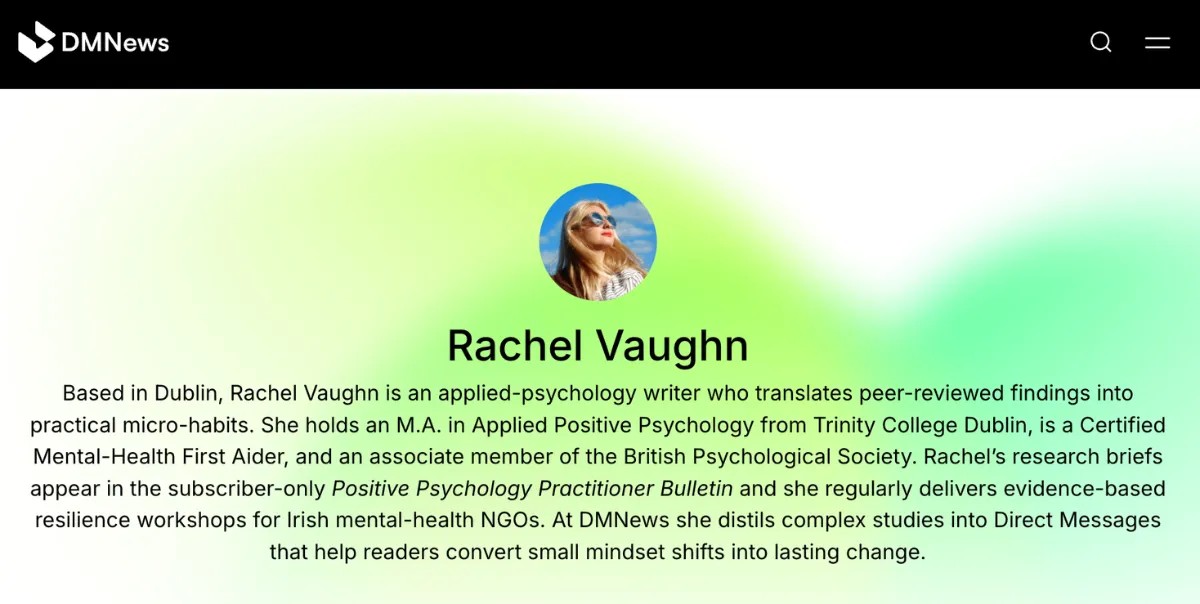
The pattern held outside space coverage. Direct Message News published mental health articles under the name Rachel Vaughn, described as a Dublin psychologist with a master's in applied positive psychology from Trinity College Dublin, a mental health first aid certificate, and associate membership of the British Psychological Society. The bio said she ran evidence-based resilience workshops for Irish mental health organizations. No practicing psychologist by that name could be found in Dublin. The British Psychological Society confirmed no such member is on its register. Trinity College Dublin said applied positive psychology exists there neither as a degree program nor as a standalone course. A reverse image search traced Vaughn's photograph to a stock library.
Source: futurism.com
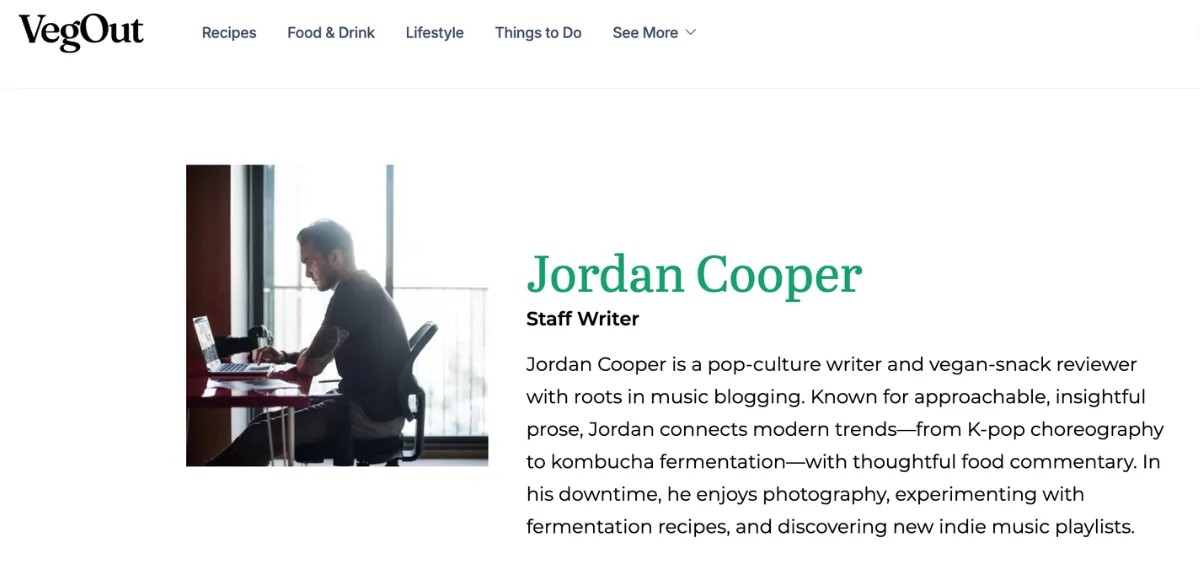
Where BBM's fictional reporters attempted actual journalism, they took it from someone else. In February, VegOut — about 13.3 million pageviews a month by Similarweb's count — ran an investigation into Los Angeles recycling under the byline Jordan Cooper, described as a tattooed pop-culture writer and vegan snack reviewer who started out in music journalism. Cooper claimed he bought a four-pack of Apple AirTags, superglued them to plastic containers and sent them through the American recycling system, and that a month of tracking changed everything he thought about the three-arrow symbol. The accompanying photo of a plastic bottle with an AirTag showed a distorted Apple logo, and several AI detection services rated the image as very likely generated.
The reporting itself came from CBS8, a San Diego television station, which ran the same experiment in 2024. CBS8 attached AirTags to four recycled items: a water bottle, a yogurt container, an orange juice bottle and a cleaning product package. Cooper's version listed a water bottle, an orange juice container, a yogurt container and a cleaning product bottle. There was no link to CBS8; the piece was presented as VegOut's own work. An AI detector rated the text as fully machine-generated with 100 percent confidence and no sign of human involvement. In a separate article, the Cooper persona wrote that he had voted for Donald Trump's "America First" promise and later regretted it, because the promise had been broken in almost every possible respect.
Source: futurism.com
A second category of persona was aimed at readers rather than at Google. Marlene Martin, on VegOut, was introduced as a former high school English teacher with decades of life experience who gardens at dawn, bakes Sunday bread, takes watercolor classes, plays piano and volunteers teaching life skills to women at a local shelter. Under her name BBM published a large volume of sentimental essays about aging, loneliness and lost purpose. In one, she recalled retiring at 66 after 32 years of teaching; in another she left at 64, in a third at 61. In January she was 68. In February she was a 69-year-old woman with two bad knees. By March she was 71, and by April she was 70 again. Her final essay described her husband's death and the end of seven years of caregiving.
Others drifted the same way. On Silicon Canals, which Similarweb puts at roughly 3.3 million pageviews a month, "editor-in-chief and clinical psychologist" Sarah Mitchell wrote that her child's first word was the family dog's name, Max; weeks later, in an article about the psychology of dog owners, she mentioned that she does not have a dog. On VegOut in February, Adam Kelton — billed as a food and drink writer with deep experience in the expensive end of the trade — complained about his mother's passive-aggressive attitude toward his vegan diet at a recent dinner. Two days later the same byline described attending a bereavement support group and said his mother had died almost a year earlier of pancreatic cancer.
Readers of the acquired sites noticed. A former Silicon Canals follower wrote on LinkedIn that the brand was destroyed almost instantly, that the site had been part of his morning routine for years, and that after the November 2025 handover to Brown Brothers Media the entire feed turned overnight into a meaningless stream of AI output. VegOut stopped publishing food reviews and reporting and switched to template pop-psychology lists and personal essays frequently unrelated to plant-based eating. One Reddit commenter said the articles "smell like AI"; another called VegOut a bland content farm that had clearly lost direction. In May 2026, founder Maggie Ortlieb posted a video saying she started the magazine at 24, ran it for about a decade and sold it the previous summer because of burnout and economic circumstances, and that the new owners had turned it into another AI-written site, which was not what she had intended for it.
The people who used to write these sites were cheaper to replace than to keep. Before generative AI, BBM mostly hired writers from the Philippines and other low-income countries. One former contractor said she had always wanted to be a writer and was glad to get the job in 2022, but felt permanently insecure: most writers were Filipino, none had formal contracts, and she understood the company could drop them at any time. After ChatGPT launched in November 2022, BBM initially banned staff from using it and warned that it ran AI and plagiarism detection. The policy did not last. Internal documents obtained by Futurism show that in 2023 the company began testing what it called "robotic" articles, and the same contractor was assigned to a "robot team" told to generate pieces with AI and then edit them to sound human. More writers were converted until almost everyone worked that way.
In 2024, BBM replaced the improvised ChatGPT prompts with its own tool built into the WordPress admin, capable of producing complete articles directly in the CMS. A staffer picked a topic — horoscopes, relationship advice — and a tone, friendly or informative, and the system returned an article within minutes. The tool also had a menu for selecting which author's voice to write in, and the options included the Brown brothers themselves. Justin and Lachlan publish heavily under their own names, mostly musings on life, spirituality, psychology and society; according to another former contractor and to the internal documents, that output is machine-generated too. AI detectors read the brothers' pre-transition articles as human-written and the later ones as fully machine.
The layoffs followed the tooling. Some workers were told directly that AI was the reason; others were told only that the strategy had changed. An internal BBM spreadsheet tracks the contraction: more than 60 active writers in December 2023, about 40 by May 2024, roughly 20 in August, and 12 in December 2024 — all of them using AI. Of the 60 writers on the earlier list, public records suggest only three remain at BBM, plus one person listed as an editor. One former writer cried during her interview and said she still loves writing but that the current economy makes life very hard, and that people should know writers and artists are being replaced by AI. A former Filipino contractor said hiring in Southeast Asia was probably a cost-cutting move from the start; another called the layoffs shocking and close to dystopian, since staff writing was used to train the AI that then replaced them. BBM did not answer questions about the ethics of firing writers from developing countries and replacing them with AI personas who were almost always presented as white Westerners.
While the payroll shrank, the network grew: fewer than 12 sites in 2023, around 17 in 2024, at least 24 in 2025, including VegOut, Silicon Canals and Direct Message News. In 2026 BBM kept buying — The Law Dictionary, Science Blog and Space Media Network, the last of which delivered Space Daily and more than 20 sister sites including Mars Daily, Solar Daily and Nuclear Power Daily. BBM then republished many thousands of very old Space Media Network articles as if they were current news, producing headlines such as a report that the iPhone 5 launch had caused a worldwide stir. It ran in the summer of 2026. Apple released that phone in 2012.
The brothers appear to be connected to several businesses selling the method itself. Mosquito Fleet and Tippa Fleet are registered to addresses in the United Arab Emirates, and their near-identical sites say they specialize in using AI to improve and scale content production for partner sites. Cognitive AI Systems Limited is registered in the British Virgin Islands; a February 2025 capture of its site offered "the best currently available AI technologies" for responsible content scaling and promised partners they could tune the AI's output from daily publication to an article every minute. Those lines later disappeared. The homepage now says Cognitive AI Systems owns a portfolio of digital publications managed by Brown Brothers Media, and reads mainly as a pitch to owners of struggling outlets: BBM buys specialized digital publications with a defined audience, an editorial identity that still holds value and economics that can be sustained, and promises to preserve the brand's name and character after the sale rather than destroying what made it valuable.
In early May, shortly after reporters began making contact, the network carried out a sudden purge. More than 50 fictional author profiles and an unknown number of articles vanished, including Chen, Whitfield, Vaughn, Martin, Mitchell and Kelton. Entire publications went dark: Bible Scriptures, which had run articles by invented Christian theologians, offered an AI-generated Jesus and sold a $97 ebook attributed to a fictional Franciscan scholar shown in traditional monastic dress — an odd choice, given that Franciscans take a vow of poverty — has been password-protected since May. Several ebooks on Hack Spirit that had been sold under invented names are still available, now credited to Lachlan. Even Justin's video about AI replacing writers disappeared in the same rush. BBM did not explain the deletions. It did rewrite its editorial standards, which now state that AI assists with research, drafting, sourcing and editorial checks but is not used to invent quotes or sources or to pass machine text off as personal reporting by real people — a description of precisely what the evidence says the company had been doing. Justin then published a piece titled "How Brown Brothers Media works: our editorial model," which said BBM sometimes uses pseudonyms that may stand for a real employee or freelancer, or serve as an editorial device to keep a consistent voice in personal essays, and that such cases are disclosed on the author page. Reporters found no instance in which BBM told readers a byline was a pseudonym. Shortly before publication, Justin conceded that until May 2026 BBM's sites had used bylines that did not represent real people and that some bios contained inaccurate professional details. He called it a mistake.
That is normally where a story like this ends: caught, cleaned up, standards posted. I read the May purge the other way. It removed the evidence rather than the practice, and what came next is worse for readers, not better. Reporters ran 30 fresh BBM articles through the detector Pangram and every one came back 100 percent AI-generated with no sign of human editing; ten Justin and Lachlan pieces from 2020 and 2021 all came back fully human. Much of the new output carries impersonal bylines like "VegOut Editorial Team" and "Space Daily Editorial Team" — under which first-person essays continue to run, one from an unnamed woman recalling a party where a new acquaintance asked whether she had ever wanted children, another from an unnamed author reflecting on 38 years spent as a reliable employee, parent and spouse.
The rest now runs under the names of living people, and Pangram reads those as fully machine-written too. One writer appears across several BBM sites as Daniel Moran, though an earlier version of his bio linked to a LinkedIn profile giving his name as Daniel Mabanta. In a single week, reporters counted his byline on at least 85 BBM articles totaling more than 90,000 words — longer than George Orwell's 1984 and nearly twice The Great Gatsby — and the real figure is probably higher, since some of his VegOut pieces were deleted before the count finished. No person writes that in a week, and BBM's remaining staff cannot meaningfully check it. The biographical drift continued anyway: in May he wrote on Silicon Canals that he was 11 years old in 1995, which would make him about 42, while repeatedly describing himself as 38 elsewhere that year, and in one article he referred to himself as a daughter. Graham Brown, the brothers' father, now listed as editor-in-chief of several network titles, wrote on May 8 in Expert Editor — about 5.8 million pageviews a month — that he was 77, and three days later gave his age on the same site as 75, several times; those pieces were later deleted. A May article under Lachlan's name, who has written repeatedly about his wife and young daughter, described his "current husband" opening up about career fears. Eluxe Magazine accidentally published two items credited to Lachlan consisting of a few lines of garbled code, still pinned to the top of its homepage when the investigation ran. And a Space Daily piece under Lachlan's byline opened with the model's own scaffolding: a line about now having all the verified sources and being able to write the article with exactly four to five embedded links to real verified addresses.
A fictional persona is at least legible as a fabrication once you check it. Attaching a real person's name to machine output is a transfer of liability to someone who can be named, sued or fired, and it is much harder to disprove from the outside. Notably absent from BBM's new editorial standards is any account of how many articles one named human can be responsible for in a week. The volume, not the byline, is the thing Google says it polices.
The post-purge output shows what the volume is for. Since May the network has published more than 100 articles about the Voyager probes NASA launched in the late 1970s. More than 40 had no discernible point beyond noting that the spacecraft still work and are very far away. Four pieces published weeks apart covered the recording of Ann Druyan's brainwaves; one of them became the top Google result for that query. On a single day, Science Blog posted two nearly identical stretches of incoherent text about the long-known fact that Voyager 1's radioisotope power source should fail in the 2030s. The pop-psychology catalog runs the same way: the psychology of people who apologize too much, people happiest in their sixties and seventies, people who reach 60 without close friends, genuinely kind people who have no close friends, and the claim that the loneliest people are not the unloved but the helpful ones everyone praises and nobody remembers. Tardigrades surviving space, people replaying conversations in their heads and the Antikythera mechanism get the same treatment. The strategy is to rewrite one topic until something catches traffic, then write more of it. BBM did not answer questions about the practice, but after reporters asked, it quietly changed many of the headlines.
The question nobody has pressed hard enough is Google's. Google's published rules prohibit scaled content abuse, which it defines as generating many pages primarily to manipulate rankings rather than to help users, and its own examples name using generative AI to produce pages with no added value, spreading production across multiple sites to hide its scale, and publishing pages that make little sense to a reader but carry search keywords. BBM matches that definition line by line. After a detailed inquiry from reporters, Google temporarily removed several BBM sites from results, including VegOut and Silicon Canals. They were back within a few weeks. Google said in May that its search and news policies bar mass production of low-value content to manipulate rankings, that it does not usually comment on individual sites, and that it enforces against violators so that 99 percent of search visits stay spam-free. When the investigation was published, BBM articles were still surfacing prominently across Google's products, and the company did not answer further questions about the network's scale or its presence in News and Discover.
What BBM actually buys is Google's own trust. Giselle Navarro, managing editor of the review site HouseFresh and a search specialist who studies how AI and Google's changes affect independent publishers, noted that BBM tends to acquire older sites on domains registered in the 1990s or early 2000s, which already hold strong positions in search. The company then swaps human work for AI pages and loads them with ads; identical articles reappear across the network, with hundreds of pages deleted from one property and surfacing on another. That is an arbitrage Google's ranking system created and has so far declined to close, and a three-week delisting is not a price that changes the math. Navarro's own summary of the situation for real publishers in 2026 is that it is nearly impossible to operate: you compete against your own reporting as restated by Google's AI overviews, watch chatbots take your information without compensation, fight social algorithms for your own subscribers and maintain a relationship with an audience that clicks through less every year.
Once publication became unavoidable, BBM issued a scatter of corrections. The most consequential concerned an April 2025 article on Direct Message News published under Justin Brown's name, at a site that now calls him editor-in-chief. It has been replaced with a retraction notice conceding that the piece contained interviews and quotes presented as original reporting that could not be verified with sources; the notice says the article was corrected on September 15, 2026 and then pulled entirely after further review, because it did not meet the network's rules for unverified first-person accounts. At a normal outlet, an editor-in-chief retracting his own reporting because the conversations cannot be confirmed is a career-ending event — the Stephen Glass and Jayson Blair scale of event. BBM did not publicize the notice, and almost nobody noticed.
Meanwhile the operation is expanding into its own critique. BBM has begun promoting a new site, Sentient Blogs, presented as a home for human writers in an age of low-quality AI content; its about page says it supports bloggers who create work themselves rather than with AI, and its FAQ promises that between its contributors and its controls, the chance of AI material appearing is very low. The first article on it was Lachlan's essay on the human experience of fatherhood — thousands of family dinners forming a family's culture, school runs becoming childhood, years of quiet effort turning into a marriage, a friendship, a finished piece of work. A disclosure at the bottom noted the text was prepared with AI assistance. Pangram scored it 100 percent machine-generated. The same company that pitches exhausted publishers on preserving what made their brands valuable is now selling readers a refuge from the product it manufactures, and both pitches are aimed at the same ranking system.