
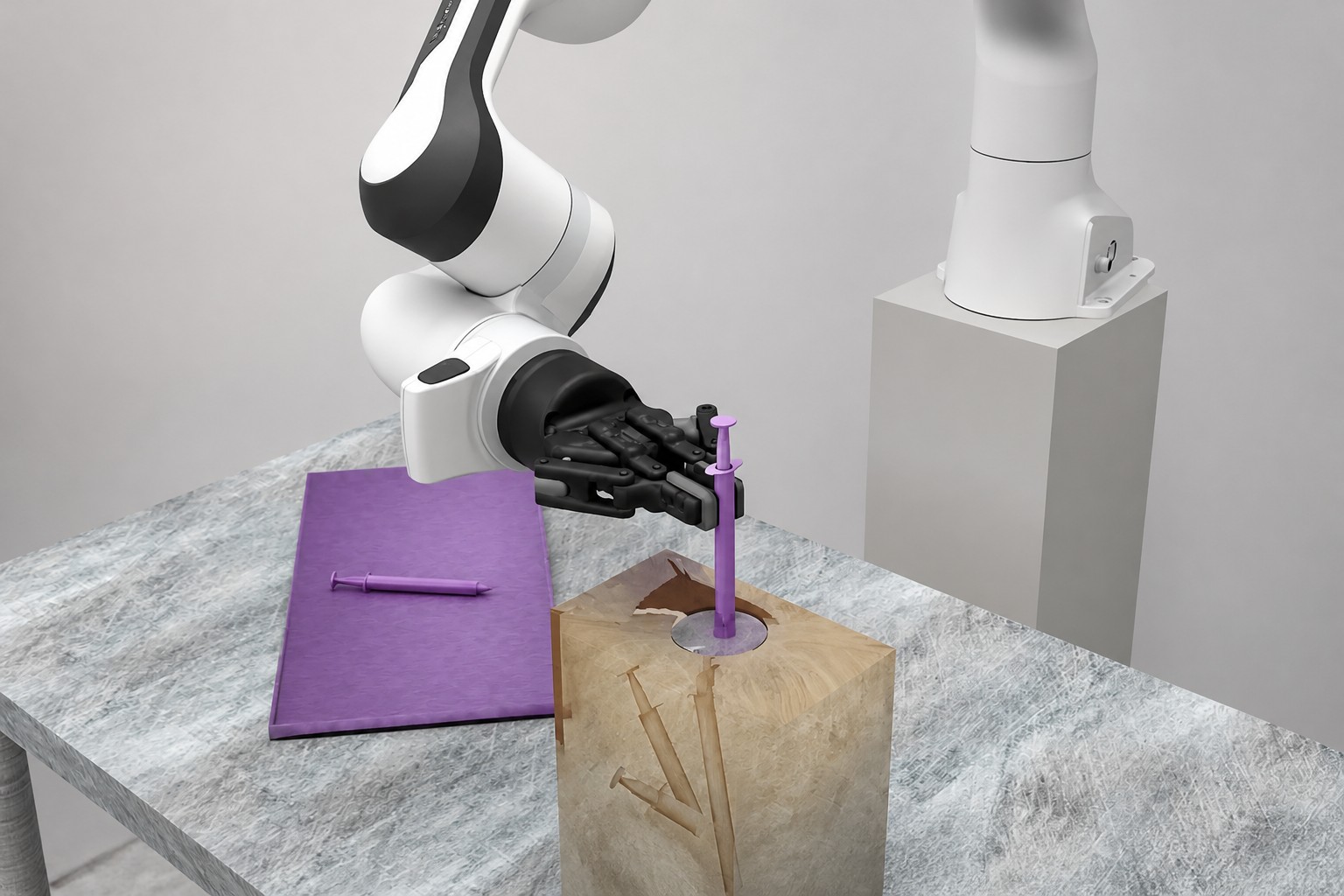
UC Berkeley and NVIDIA have presented an approach to programming robots that shifts some of the work from collecting training data to writing and checking code. At the 2026 Robot Learning Conference, researchers described agentic robotics: AI agents break a task into steps, write code and test it in simulation. In trials, the approach achieved a success rate of up to 99% — matching systems built manually by engineers — while baseline imitation-learning methods achieved just 20%. For now, the approach is designed primarily for precise industrial operations.
AI agents teach robots to work without new demonstrations
Why data may not be enough
For decades, robots have been programmed using models of the physical and mathematical properties of the machine and its environment. Engineers built these models, then specified the robot’s behavior in detail through code. Manually tuned systems could work quickly and reliably, but required time and specialized knowledge. Learning from examples of human actions made development easier and systems more adaptable, but their reliability has limits.
Ken Goldberg, a UC Berkeley robotics professor whose lab is presenting the work on agentic robotics, believes imitation learning has reached a plateau. He says the approach may suit home robots, where speed and reliability are less critical, but industry needs greater reliability. Goldberg co-founded Ambi Robotics, which works in industrial robotics; companies he has collaborated with, including Siemens and Bosch, have faced similar challenges.
More data can initially improve a robot’s performance, but new errors eventually emerge. Goldberg says it remains unclear whether further increases in data volume will deliver the reliability needed. Investors expected robots, like ChatGPT, to become consistently capable over time as they accumulated data. But Goldberg says people in the industry are beginning to doubt that a system will reach that point on its own.
How agentic robotics works
Language models are trained on data at internet scale, but no similarly large dataset exists for robotics. Companies are trying to collect one, but the process is slow and expensive. Agentic robotics — a term popularized by Goldberg and Spencer Huang, director of robotics products at NVIDIA — proposes solving robotic tasks through programming. This makes it possible to use the capabilities of language models and coding tools.
Over the past year, Goldberg says, AI agents have improved enough to be tasked with writing code for robots. Because the system is based on language models, people can interact with it in natural language. For example, UC Berkeley researchers asked a robotic arm to sort groceries into a bag.
The system first breaks the task into simpler ones and assigns them to separate programming agents. One might identify the groceries and the bag, another control the grasping of items, and a third move them with the robotic arm. In software built on language models, an agent can plan, write, test and revise code on its own, with little human involvement.
Huang says many tools for robotics have been developed over the past decades: object classifiers, pose estimation, task and motion planning, and trajectory generation. Previously, a person had to combine them in code. Agents can now draw on that work and create programs for specific tasks.
Testing in simulation
Once the agents have produced an initial solution, they run it in simulation, change the starting conditions, find errors and refine the code. By repeating this process, they can produce a working program. But its reliability in the real world depends on how well the simulation reproduces the physical environment.
Building accurate simulations is difficult: many parameters need to be tuned, often separately for each task. Goldberg tried giving an AI agent access to those settings and asking it to adjust the simulation to match real-world video. The agent matched the environment, lighting and background to the video — work the researchers considered too tedious to do by hand. When they compared the simulation with the video, the differences were hard to see.
But the gap between simulation and reality remains unresolved. Thorsten Krueger, chief scientist at Alphabet’s Intrinsic, who was not involved in the research, says no physics engine can accurately model contact with the real world. Agents can, however, fix unsuccessful attempts: researchers can show them video of a failed task so they can update the simulation and then revise the code.
Huang acknowledges that AI agents can produce poor-quality code. To reduce this risk, the researchers use an adversarial setup: one agent proposes a solution while another tries to find flaws in it.
In UC Berkeley’s trials, agentic robotics achieved a success rate of up to 99%, comparable to systems developed by engineers by hand. Baseline imitation-learning methods achieved just 20%. Goldberg also highlights other properties of the approach: it does not require collecting new data, and the resulting code can be read and corrected if necessary.
Where the approach can be used now
Huang believes agentic robotics will be most useful in the near term for industrial manufacturing and manipulation tasks where precision and reliability matter. For example, NVIDIA’s semiconductor-industry partners need to position components to within 0.3 mm. Huang says NVIDIA’s humanoid platform, GR00T, cannot yet do this work with the required repeatability and reliability; an agent-based approach could help with tasks closer to practical use.
Another potential advantage is quickly reconfiguring robots when production changes. At Wistron’s facility in Taiwan, which makes circuit boards for NVIDIA graphics processors, reconfiguring a single robot for a new product takes at least 8 hours. Huang says agentic robotics could reduce that to a minute or two.
Moving beyond such limited tasks may prove difficult. Huang suggests that code created by agents could be used as training data for future models. He sees this approach as one step toward more general capabilities, but expects robotic general intelligence to start out as an agent coordinating traditional technologies and specialized policies.
Krueger urges caution about trusting agents with safety. A human engineer can check their work, but it remains an open question how to ensure agents always act correctly once people start trusting them.
Goldberg is now working with companies on practical applications of the approach. To evaluate AI agents, the researchers are developing a set of benchmarks using NVIDIA Isaac Lab-Arena and the Newton physics engine. Goldberg does not claim the problem is solved, but says he is encouraged by the results; Huang believes the approach changes how people work with robots.
Dataist’s take: Agentic robotics does not yet eliminate the need to check physical models and AI decisions. Results depend on the quality of the simulation, and reliability on safety-critical tasks remains an open question. Its clearest advantage today is the ability to program and reconfigure robots faster for limited industrial tasks without collecting new demonstrations.
Daily AI news
Every day we pick what actually matters in AI and explain it plainly — no hype, no filler. Subscribe if you want to follow where the industry is going.
Only what matters — every day
Follow on X