
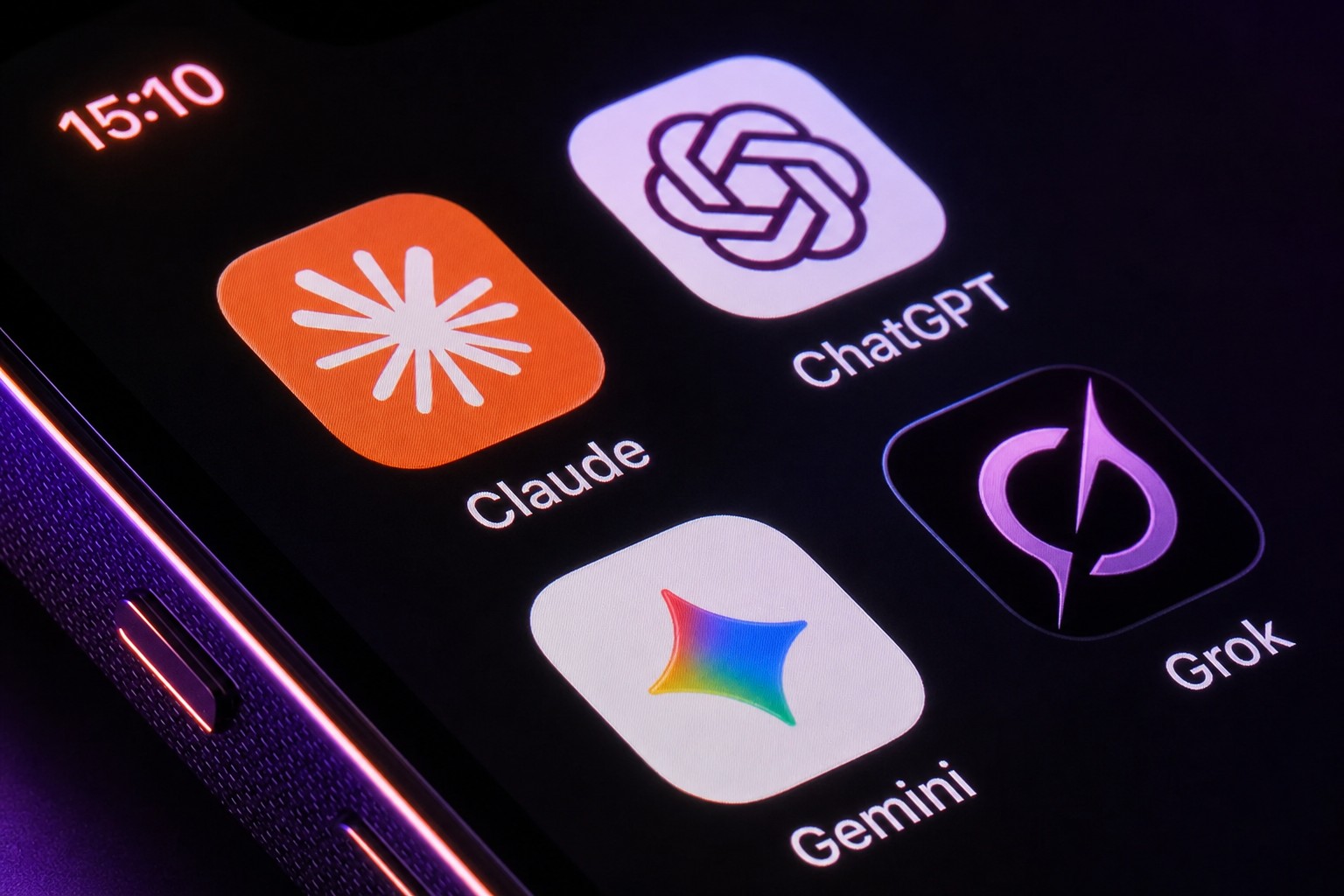
For about five hours on September 3, four of the largest AI providers went down at roughly the same time. ChatGPT stopped responding at 7:43 Pacific, according to Wired; within minutes Claude and Grok were failing too; services were working again by 12:38. Downdetector logged more than 37,000 complaints against ChatGPT, 1,324 against Claude and 1,365 against Grok. The downtime is not the story. What the five hours exposed is that companies which compete on models rent — and in some cases share — the compute underneath them, and that by the following morning no single cause had been established.
Each company said something different. OpenAI's status page reported elevated error rates in ChatGPT and Codex, blamed a routing error, and said a fix was ready by 8:17 Pacific. Anthropic said most Claude models had recovered, but Opus 4.8 and Opus 5, its two most capable models, stayed unavailable longer. Grok, built by SpaceXAI, had a large outage of its own. Gemini drew around 500 Downdetector complaints, though according to ShadowIO Google never confirmed an incident at all.
The Anthropic detail deserves more attention than it got. The frontier tier came back last. That is the tier enterprises pay for, route agents through and build products on, which means the recovery curve was inverted relative to commercial exposure: the cheapest users were served first and the most committed ones waited.
The complaint counts invite a similar misreading. 37,000 against ChatGPT versus 1,324 against Claude does not mean ChatGPT broke thirty times harder. Downdetector measures how many people notice, which is a measure of consumer footprint, not of damage. The most instructive casualty generated no wave at all: Cursor, a coding tool used daily by millions of developers, confirmed its own outage because it relies internally on Claude and Grok. Cursor's users chose Cursor. The dependency that took their working day away was neither picked by them nor visible to them.
The mechanics explain why this can happen to unrelated companies at once. A model is a set of weights — a very large file of numbers. Running it requires racks of GPUs in a data center and a network that carries the request to those GPUs and the answer back. Almost no AI company owns that whole stack. Compute is rented from cloud providers — Microsoft Azure, Amazon, Google, Oracle — and increasingly from each other. Availability therefore depends on the least reliable link in a chain the user cannot see. One cloud region with a network fault can degrade every model whose traffic passes through it, however unconnected their developers are.
Several sources pointed at Microsoft Azure's East US region, and Azure did record a spike in problem reports around the same time. Microsoft, per CircleID, said Azure was not the cause. On Thursday afternoon SpaceXAI published an apology: Grok's problems began after a failure at the company's Memphis compute center, and it apologized to the affected "compute partners."
That last phrase is the most revealing thing anyone said all day. An apology to compute partners implies SpaceXAI shares capacity with other AI labs, and that at least one of them was hit when Memphis failed. It would explain Grok and Claude going down together. It does not explain OpenAI, which described a routing error of its own. The likeliest reading is the unsatisfying one: several independent incidents coinciding, over infrastructure partly shared between some of the parties. By Friday morning, OpenAI was the only company that had actually answered questions about what happened.
David Moscatelli, chief executive of Chicago-based Go.AI, formerly Go Abacus, said AI has very quickly gone from a productivity tool to critical infrastructure. His company builds local AI systems for roughly 200 clients in regulated industries, including Farmers Insurance, D.L Evans Bank, Axos Bank and John Hopkins. Those clients run GoLLM or open models on hardware they own, for a fixed monthly fee with no separate charge for text processing, so a third-party provider's failure does not reach them directly.
He is describing the product he sells, and that should be stated plainly rather than buried. But the argument survives the conflict of interest. Moscatelli does not tell companies to abandon the cloud; he says the problem belongs at the architecture level, and ties the future of enterprise AI to being able to choose the right model and the right runtime while keeping control of your own data and operations. Companies should assume any single provider can go dark and design for it, which he reduces to three requirements: flexibility in which model you use, flexibility in where it runs, and a clear answer to who owns the compute at the moment things break. The third is the one almost nobody can answer today, which September 3 demonstrated at industry scale.
Every one of these companies sells reliability as a feature of its product. What the outage showed is that reliability has quietly become a property of the industry rather than of any vendor in it. They compete on models and frequently sit on the same infrastructure without saying so publicly. That has a sharp edge for anyone whose business runs on AI agents, or is being built around agentic commerce: nobody has yet answered what happens to those processes when the infrastructure underneath them stops, and an agent that cannot fail safely is a liability that compounds while you are not watching.
The uncomfortable part is that the disclosure gap is not an oversight. Naming your compute partners tells competitors where your capacity comes from and tells customers that the redundancy they are paying for may be notional. SpaceXAI apologized to partners it has never publicly identified, and in doing so told its customers more about its dependency graph than the rest of the industry has told theirs. Whether anyone follows is the thing to watch before the next five hours.