From answers to tools
In a preview, a question about slug anatomy produced an illustration with buttons for exploring different body parts, from the upper tentacles to the muscular foot.
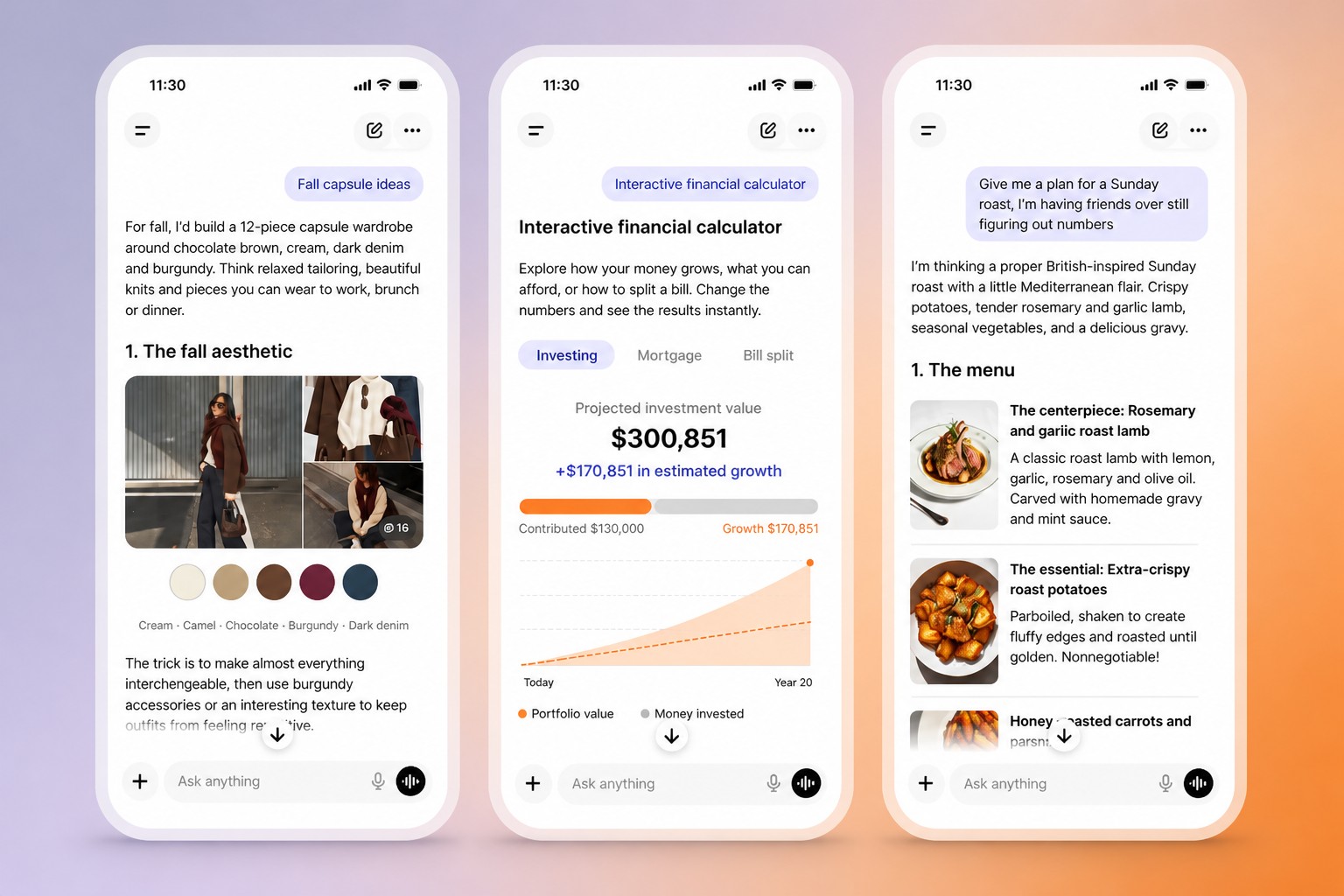
A rent-affordability calculator for San Francisco let users adjust income and other expenses with sliders, then see how much of their after-tax pay different apartments would consume.
The most useful example was an interactive comparison of cabin layouts for four Alaska and Delta aircraft. The author, who dislikes sitting near emergency exits, could select any seat for details; ChatGPT highlighted exit-row seats in green.
These examples turn an answer into something a user can inspect and change. But OpenAI product manager Aarush Selvan said the design team spent a long time deciding when diagrams, charts and buttons help and when they clutter the interface. Users who do not want visual elements can ask ChatGPT to show them less often.
The interface becomes personal
Google introduced a similar approach to search earlier this year, expanding its range of personalized results under the name generative UI. A user exploring deep space, for example, might get an adjustable diagram of black holes with several sliders.
The shift fits a broader move toward multimodal chatbots, where text, images and voice share one interface. ChatGPT’s update is designed for more than a billion users, but its more consequential change may be that the answer can take a different shape for each person.
I think the interesting tension is not whether a chatbot can draw a diagram. It is that software may increasingly decide what an interface looks like for each user. If AI tools can quickly build programs around individual requests, designers may have less control over the screens people actually use.
That could make the interface feel less like a fixed product and more like a response. For someone curious about slug anatomy, that means exploring a diagram instead of working through a wall of text; for designers, it raises a harder question about who is shaping the experience.
Daily AI news
Every day we pick what actually matters in AI and explain it plainly — no hype, no filler. Subscribe if you want to follow where the industry is going.
Only what matters — every day
Follow on X