
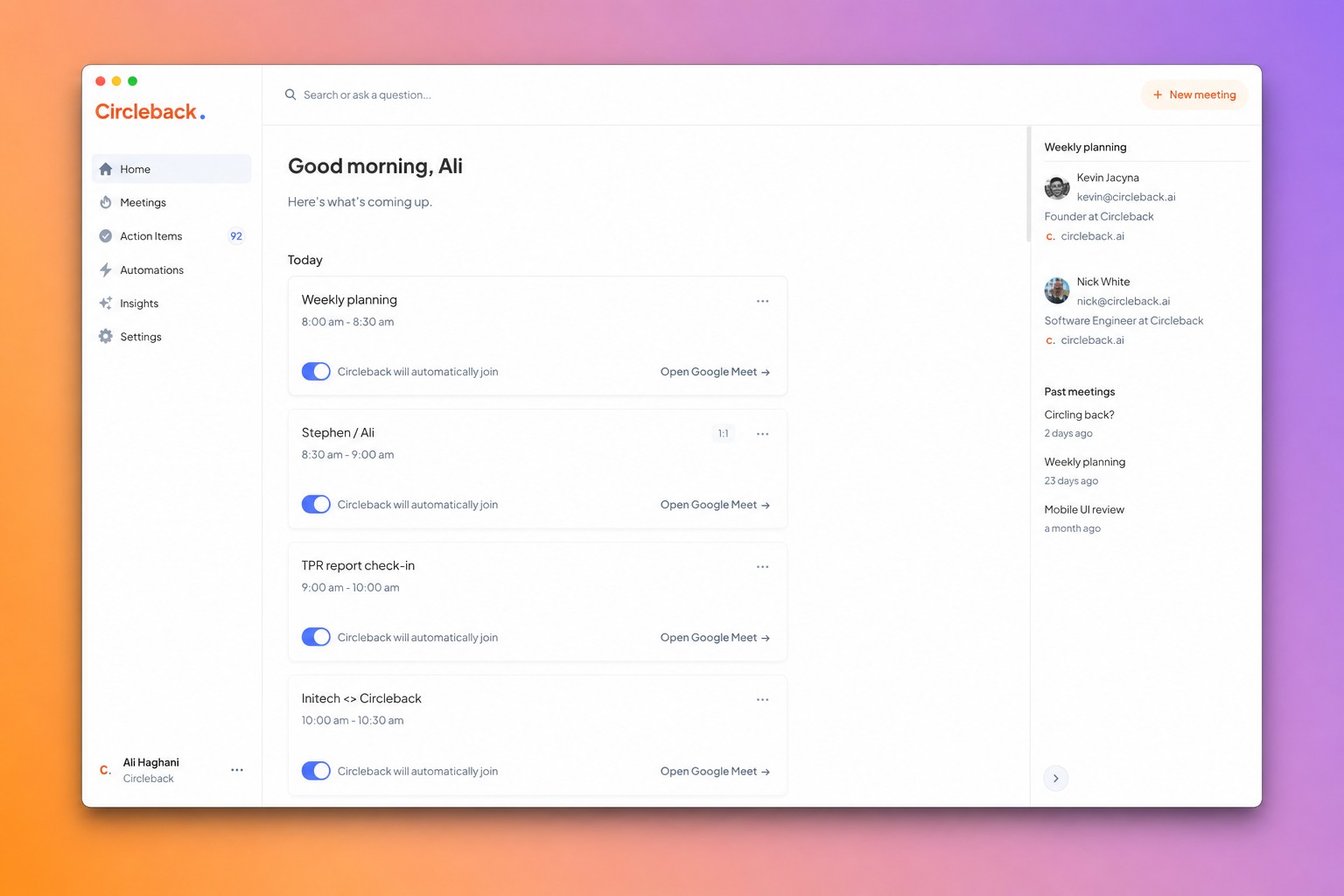
Circleback, an eight-person AI meeting-notes company, has opened a free plan and moved its cheapest paid one from $20.83 a month to $14 a month on annual billing. The free tier transcribes an unlimited number of meetings but shows only the last 30 days of history. The company says it has been profitable since raising $2.5 million in 2024, and that annual revenue per employee now exceeds $1 million — roughly $8 million annualized across the team. It is giving product away from a position of not obviously needing to.
The free tier covers meeting capture, the phone and Apple Watch apps, AI queries against transcripts, and integrations with Linear and Slack. Paying gets the rest: every integration, unlimited meeting history, the full API and MCP.
The timing is the part that explains itself. Over the past few weeks the dictation app Wispr launched its own notes and scheduling service, and Calendly added a comparable tool to its product line. Among the specialists, Granola, Read AI and Fireflies have each raised millions of dollars, and Granola shipped a free tier of the same shape a few months ago. Circleback is not opening a new front here; it is matching one competitor's packaging while two adjacent products start bundling the feature for people who are already paying them for something else.
Ali Haghani, who founded the company in 2023 with Kevin Jacyna, attributes the change to the old limited trial: Circleback was losing a lot of users the moment it expired. The expectation is that open access puts the product in more hands and that some share of those hands eventually reach for the paid features. The company says it spends nothing on Google or Meta advertising and treats the free tier as its marketing budget instead.
On funding, Haghani says there is no new round planned despite investor interest, and that the company sees nothing blocking further growth. He says Circleback regularly competes for customers against companies far larger in both headcount and capital raised, and wins those deals. The company would revisit the question if it concluded that money solved a problem it actually had.
The free plan is the announcement; the price cut is the news. Entry pricing fell about a third, from $20.83 to $14 a month on annual billing, and that is the number to watch in a market where the core capability — turn a meeting into searchable text and a summary — has stopped being scarce. When a dictation app and a scheduling company can both add notes in a quarter, notes are a feature. Price is what you cut when a feature stops being defensible on quality alone, and Circleback cutting it while profitable is the strategically sound version of that move: do it before the market forces you to.
The 30-day history cap, meanwhile, is a better-designed conversion lever than the trial it replaces. A meeting-notes product is only worth much as an archive — the value is in the six-month-old decision you can find again. Free users accumulate exactly that and watch it roll off the back end, which means the pressure to pay grows with usage instead of arriving on a calendar date. It is also more honest than a countdown clock: nothing gets taken away that the user was told they had.
What the announcement does not address is what happens to the material free users generate. Circleback describes the free tier as marketing spend, and marketing spend that yields a corpus of other people's meetings is a different sort of asset from a Google ad — but the company has said nothing about how that data is handled or used, and nobody appears to have asked. The claim that Circleback beats much larger competitors head to head sits in the same category: plausible for an eight-person team with real revenue, and entirely unaccompanied by numbers.
Circleback's position is that it does not need investors because nothing is blocking it. The thing most likely to block it is not capital. It is Calendly, Wispr and everyone else with a calendar or a microphone deciding that notes are something you include rather than something you sell, at which point $14 a month is not the floor — it is the last price before zero.