

Extraction, not conversation
Developers specify the fields they need, and Clairic returns values in the requested format along with confidence scores. When a value is missing, it returns null.
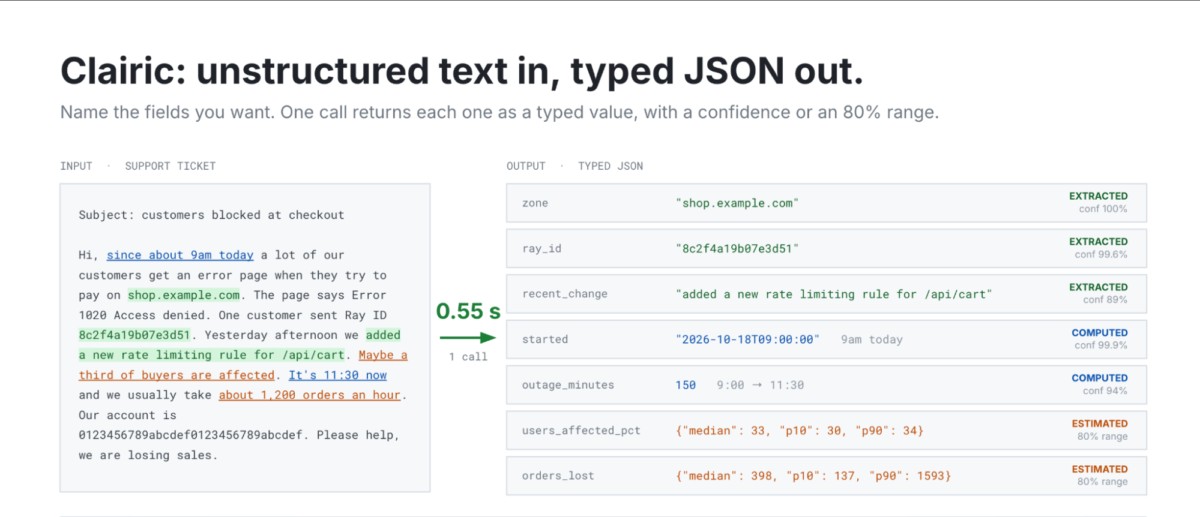
Clairic extracts values from unstructured text and is designed to work as one piece of a larger agent chain. | Image: Cloudflare
Source: the-decoder.com
Cloudflare’s example starts with a complaint email. Clairic extracts the order number, amount and description of the damage, then estimates the repair cost. Clef applies the company’s rules to choose between a refund and a repair. GLM-5.3 then drafts the customer response.
The comparison is striking, but it is also a comparison between two different setups: a chain of specialized models and one model doing every step. Cloudflare says the chain costs nearly half as much, but does not give a price breakdown or explain how the result changes across different documents and workloads.
A narrow model with a clear limit
Cloudflare expects Clairic to work in chains with large language models and other “system 1” models, such as Jev. That makes the product less a general-purpose alternative to an LLM than a component for jobs with clearly defined fields and outputs.
The company also says Clairic is not yet reliable at long chains of calculations, and recommends that developers handle those calculations in their own code. I think that limitation matters more than the headline speedup: the workflow still depends on careful task boundaries and software around the models. The announcement shows a potentially faster division of labor, but leaves open how much engineering it takes to make that division dependable.
Daily AI news
Every day we pick what actually matters in AI and explain it plainly — no hype, no filler. Subscribe if you want to follow where the industry is going.
Only what matters — every day
Follow on X