
Jacob Coxson, after working at OpenAI and Anthropic, put it about as plainly as it can be put: do not underestimate the power of this technology. The line travelled, as such lines do. It is also roughly the seventy-fifth year in which a version of it has travelled. Norbert Wiener and Alan Turing got there first; the warning has been reissued since by I. J. Good, Stephen Hawking, Nick Bostrom, Stuart Russell, Eliezer Yudkowsky, Geoffrey Hinton, Yoshua Bengio, Paul Christiano, Joseph Carlsmith, Max Tegmark, Steve Wozniak, Ilya Sutskever, Demis Hassabis, Dario Amodei, Leahy and Bill Gates. The case made in Trias Algorithmica: What Code Rules is that the reissue rate is the story — the warning propagates at close to the speed of light, and the answer to it does not propagate at all.
The load-bearing word in Coxson's formulation is power, and English is unhelpfully loose about it. Power can mean capability — a machine that computes faster — or it can mean authority, the ability to decide things about other people and make the decision stick. The whole argument turns on the second meaning. The claim is not that models will be more productive or more intelligent. It is that intelligence can stop being merely a capability and become an autonomous means of obtaining "real power and resources," at which point the danger is existential rather than commercial.
That distinction has a consequence most of the discourse skips. A technology that only computes faster is an engineering problem. A technology that accumulates and applies power is a political problem. And a political problem of sufficient scale eventually becomes a constitutional one.
Civilization has been here. Kings said power was safe in wise hands. Empires said it was safe in civilized hands. Institutions said it could be entrusted to experts. History's reply has been remarkably stable: the character of the ruler is not a substitute for the architecture of power. Constitutional government did not arrive because every ruler was wicked. It arrived because even good rulers are mortal, successors differ, interests collide, and concentrated power learns over time to justify itself.
So Trias Algorithmica poses the questions the safety debate does not. What purposes may algorithmic power be built for, and who has the right to set them — a legislative question. Who is permitted to wield it, on what grounds, within what limits — an executive question. Who has the independent standing to judge whether a given use is fair, lawful, acceptable and within the rules, and by what standard — a judicial question. And how is the counter-power constructed: the capacity to contest, constrain, suspend, reverse or revoke the exercise of algorithmic power itself — the constitutional question.
The premise is not that AI companies act in bad faith. It is that no institution should be made legislator, executor and judge of its own power. The people inside these organizations may understand the civilizational hazard of unchecked authority perfectly well. They may be intelligent, conscientious, sincere, even desperate for a safe outcome. They will also be the ones advancing that authority, because that is their job.
The race logic follows mechanically. If Company A slows down, it fears Company B will not. B fears C. C fears A. Each can present acceleration as the responsible choice, and each is right within the system it is standing in. Everyone moves toward the danger precisely because they fear the danger of the race. That is not irrationality; in a badly designed system it is rational behavior. Which is why the argument's sharpest line lands where it does: you cannot build civilizational safety on the assumption that competitors will voluntarily surrender advantages they believe someone else will take.
Against that backdrop the recent flirtation with a temporary ban on improving model capabilities looks less like a policy and more like a symptom. Whether one supports a moratorium is secondary. Its appearance at all shows how narrow the imagination has become: two buttons, accelerate or stop, build everything or build nothing. Civilization has met powerful technologies and powerful institutions before and did not choose permanently between surrender and prohibition. It invented a third option — govern power by dividing power. A pause buys time, but time for what? If tomorrow's moratorium ends with the same companies holding the same concentrated authority to build, deploy, evaluate and authorize the release of ever more consequential systems into society, the question has been postponed, not answered.
Here is where I part company with the essay, or rather where I think it stops one step short. It is a precise diagnosis and a real design brief, and the historical analogy is earned. But a counter-power is not a category; it is a body, with a budget, a jurisdiction and somebody's signature on the order to switch a system off. The piece names none of these, and that is the hardest part of the problem, not a detail to be filled in later. Constitutions were not argued into existence by better essays. They were extracted, usually after a disaster, by parties who already held leverage — parliaments that controlled taxation, armies that could refuse, courts that could not be dissolved. Nobody presently holds comparable leverage over a frontier lab. Compute, capital, the models themselves and the evaluation of the models all sit on the same side of the table. Until something sits on the other side, "counter-power" is a word for a vacancy.
There is a second thing the list of warners is quiet about. Read it again: Sutskever, Hassabis, Amodei, and Coxson himself, who spent time at OpenAI and Anthropic before speaking. The people best positioned to describe the danger are overwhelmingly the people building the thing. That is not hypocrisy — it is what expertise looks like — but it does mean the warning arrives pre-filtered through the interests of the only institutions that currently get to act on it. An alarm rung by the fire department is useful. An alarm rung only by the fire department, about a fire only the fire department can reach, is a governance structure, not a warning.
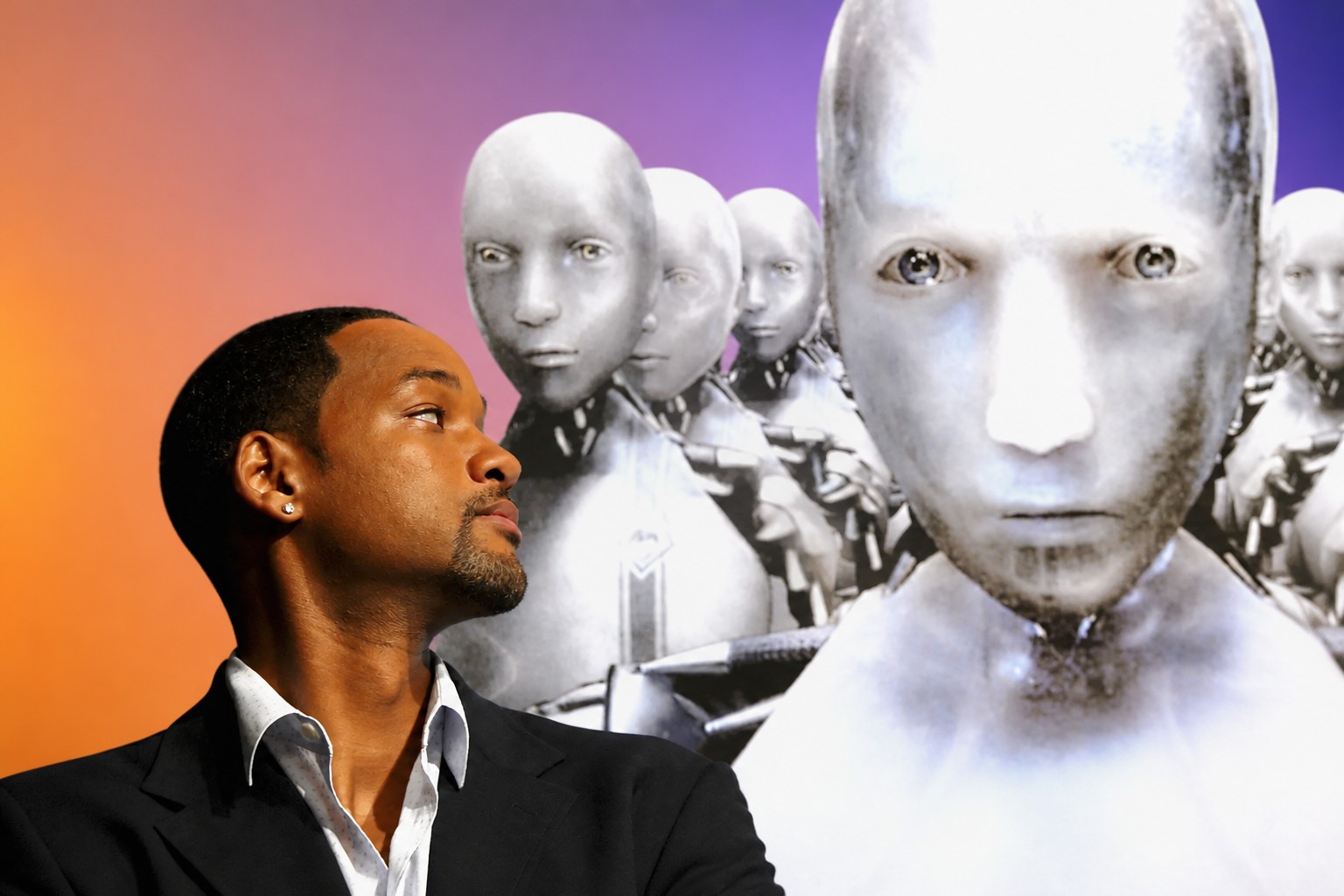
Popular culture did some of the translation work — I, Robot with Will Smith made the idea legible to people who will never read Bostrom — and that legibility is exactly what makes the loop so cheap to run. The stimulus does not change, because the stimulus reliably produces attention. Expect another wave of the same headlines, the same surprise, the same hesitation, the same concerned expressions. The mouse in the glass jar runs the same circuit and mistakes repetition for progress.
The alarm says the house could catch fire. When the noise stops, everyone behaves as if silencing it extinguished the possibility. The race that matters now is not the race to build the systems or the race to halt them; it is the race to construct conditions under which today's algorithmic power can exist without becoming absolute — and that race has to be won before the next increment of capability makes the concentration permanent. Legitimacy is now the open question, and unlike capability, it has no scaling law and nobody funding it.